Credit Card APR Explained: How Interest Charges Work
A comprehensive beginner guide to credit card APR, explaining daily periodic rates, purchase vs balance transfer APRs, grace periods, and interest avoidance.
Credit Card APR Explained: How Interest Charges Work
Credit cards are among the most versatile financial tools, but carrying an unpaid balance can result in substantial finance charges. At the center of credit card interest pricing is the Annual Percentage Rate (APR).
Understanding how credit card APR functions—including how interest compounds on a daily basis, the role of grace periods, and the differences between purchase, cash advance, and balance transfer rates—is essential for avoiding unnecessary debt while building a solid credit foundation alongside guides like how credit scores work and how to build credit from scratch.
1. What Is Credit Card APR?
Annual Percentage Rate (APR) is the standardized annual rate of interest charged on credit card balances under U.S. federal disclosure regulations (specifically the Truth in Lending Act enforced by the Consumer Financial Protection Bureau).
While the stated APR represents an annual percentage, credit card issuers calculate interest on a daily basis using a Daily Periodic Rate (DPR) whenever an unpaid balance is carried across statement billing cycles.
2. Types of Credit Card APRs
Credit card agreements rarely feature a single interest rate. Instead, cardholders are assigned different APRs depending on the transaction category:
- Purchase APR: The standard interest rate applied to regular credit card purchases when balances are carried past the monthly payment due date.
- Balance Transfer APR: The rate applied to balances transferred from another credit card or lender. Often features a temporary promotional rate (such as 0% for 12 to 18 months), which may carry a balance transfer fee (such as 3% to 5% of the transfer amount or a minimum dollar fee, as disclosed in the card agreement).
- Cash Advance APR: The rate applied when using a credit card to withdraw cash at an ATM or purchase cash equivalents. Cash advance APRs are generally significantly higher than purchase APRs and carry no grace period (interest begins compounding immediately).
- Penalty APR: An elevated rate that issuers may apply if a cardholder misses payments by 60 days or more, subject to terms disclosed in the card agreement.
- Introductory APR: A temporary promotional rate (often 0% APR) offered to new cardholders for a specified introductory timeframe.
3. How Credit Card Interest Is Calculated (Daily Periodic Rate)
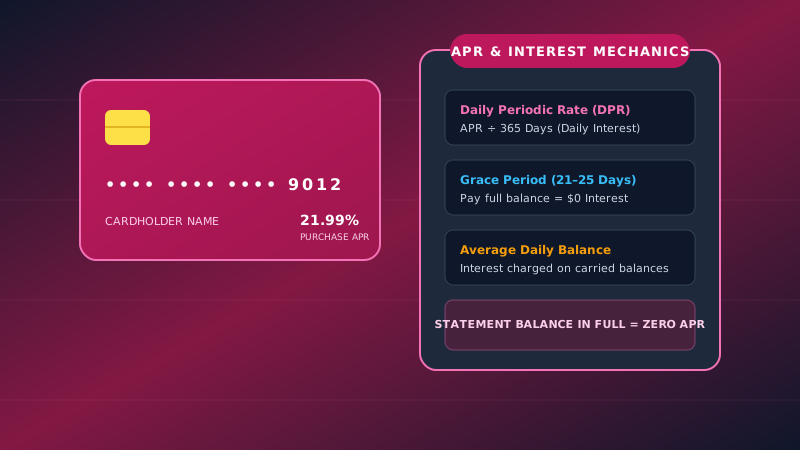
To calculate monthly interest charges, card issuers convert the annual APR into a Daily Periodic Rate (DPR) by dividing the APR by 365 days (or 360 days, depending on the issuer's terms):
$$\text{Daily Periodic Rate (DPR)} = \frac{\text{APR}}{365}$$
For example, if a credit card has a 21.99% Purchase APR:
$$\text{DPR} = \frac{0.2199}{365} \approx 0.00060247 \quad (0.060247% \text{ per day})$$
The Average Daily Balance Method
Most card issuers calculate interest using the Average Daily Balance method:
- The issuer calculates the account balance at the end of each day during the billing cycle.
- The daily balances are summed and divided by the number of days in the billing cycle (typically 30 days).
- The Average Daily Balance is multiplied by the DPR and the number of days in the billing cycle.
Hypothetical Interest Calculation Example
Consider a cardholder with an Average Daily Balance of $2,000 during a 30-day billing cycle at a 21.99% APR who does not qualify for a grace period:
$$\text{Daily Interest Charge} = $2,000 \times 0.00060247 = $1.2049 \text{ per day}$$
$$\text{Monthly Interest Charge (30 Days)} = $1.2049 \times 30 \approx $36.15$$
If the cardholder pays only the minimum payment each month, this daily compounding adds finance charges to the remaining principal, increasing the total cost and extending the repayment timeframe.
4. The Grace Period: How to Pay 0% Interest
A grace period is the window of time between the end of a credit card billing cycle and the payment due date (which must be at least 21 days from when the statement is delivered under federal CARD Act rules).
Under federal U.S. credit card rules:
- If a cardholder pays the full statement balance by the due date every month, the issuer charges zero interest on purchases made during that billing cycle.
- The grace period applies only to purchases. Cash advances and balance transfers typically do not qualify for a grace period.
Losing the Grace Period
If a cardholder pays less than the full statement balance by the due date, interest begins accruing on the unpaid balance. Under many card agreements, failing to pay the statement balance in full also forfeits the interest-free grace period on new purchases until full statement balances are paid across consecutive billing cycles.
5. Fixed vs. Variable APRs
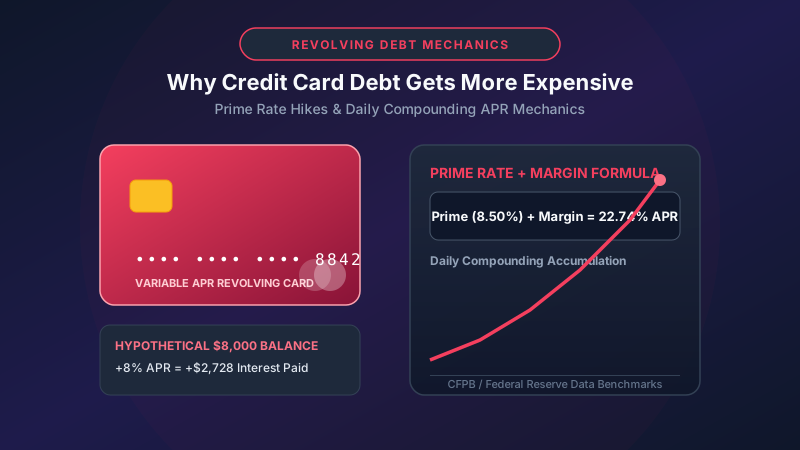
Most consumer credit cards feature variable APRs. A variable rate fluctuates in direct proportion to an underlying benchmark economic index, most commonly the U.S. Prime Rate published by the Federal Reserve.
A variable card rate is typically structured as:
$$\text{Variable APR} = \text{U.S. Prime Rate} + \text{Issuer Margin}$$
For example, if the Prime Rate is 8.00% and the card's margin is 13.99%, the variable purchase APR is 21.99%. When the Federal Reserve adjusts target benchmark rates, credit card APRs adjust accordingly.
6. Statement Balance vs. Minimum Payment
A key distinction in avoiding compound interest is understanding statement requirements:
- Statement Balance: The total cumulative balance owed at the close of the monthly billing cycle. Paying this exact number in full by the due date maintains the interest-free grace period.
- Minimum Payment: The minimum dollar amount required by the issuer (calculated using a formula disclosed in the card agreement, such as a percentage of the balance plus interest and fees, or a minimum dollar threshold) to keep the account current and avoid late payment fees.
Paying only the minimum payment keeps the account in good standing but allows the remaining balance to compound daily at the purchase APR. Individuals struggling with elevated credit card balances may consider exploring structured strategies like debt consolidation or alternative payment options like Buy Now Pay Later (BNPL).
7. What Happens When a 0% Introductory APR Expires?
0% Intro APR credit cards can provide interest relief for major purchases or balance transfers. However, cardholders must understand post-promotional terms:
- Standard Purchase APR Reset: Once the promotional window ends (e.g., after 15 months), any remaining unpaid balance automatically incurs the standard purchase APR.
- Deferred Interest vs. 0% Intro APR: Standard credit cards simply charge the regular APR on remaining balances after expiration. However, store retail cards often utilize deferred interest agreements. Under deferred interest, if the balance is not paid off 100% before the promo period expires, interest is retroactively calculated and charged on the entire original purchase amount from day one.
8. Practical Steps to Minimize Credit Card Interest Costs
To avoid high APR charges, cardholders should adopt these practices:
- Pay the Full Statement Balance Monthly: Set up automatic monthly payments for the full statement balance to preserve the interest-free grace period.
- Avoid Cash Advances: Refrain from ATM credit card cash withdrawals, which incur immediate high APRs and upfront transaction fees.
- Track Promotional Expiration Dates: Note exact end dates for 0% intro APR offers to clear balances before standard rates apply.
- Request an APR Reduction: Cardholders with strong, consistent payment histories can contact their issuer to request a lower standard APR.
Sources
- Consumer Financial Protection Bureau (CFPB): Credit Card Basics and Truth in Lending Rules https://www.consumerfinance.gov/consumer-tools/credit-cards/
- Board of Governors of the Federal Reserve System: Credit Card Accountability Responsibility and Disclosure (CARD) Act https://www.federalreserve.gov/
- Federal Trade Commission (FTC): Understanding Credit Card Rates and Disclosures https://consumer.ftc.gov/
Educational Disclaimer
This guide is for informational and educational purposes only and does not constitute personalized financial, credit, or legal advice. Credit card APRs, terms, fee structures, and grace period policies vary by issuer and card agreement. Consult a qualified credit counselor or advisor regarding individual debt management decisions.
MoneyTalkin' provides financial education, educational concepts, and general informational guides. Articles do not constitute personalized financial, investment, legal, or tax advice. Financial products, rates, terms, and regulatory rules change frequently; consult a qualified financial professional regarding your specific situation. Read our full Disclaimer Policy.
Written by MoneyTalkin'
MoneyTalkin' researches and publishes objective financial education content, money management fundamentals, and practical financial guides.