Debt Snowball vs. Debt Avalanche: Which Strategy Fits You?
Detailed financial analysis and educational guide on Debt Snowball vs. Debt Avalanche: Which Strategy Fits You?.
Debt Snowball vs. Debt Avalanche: Which Debt Payoff Strategy Fits You?
Eliminating debt is one of the most impactful financial goals an individual can undertake. When accelerating debt payoff beyond minimum monthly payments, financial experts primarily recommend two structured methodologies: the Debt Snowball and the Debt Avalanche.
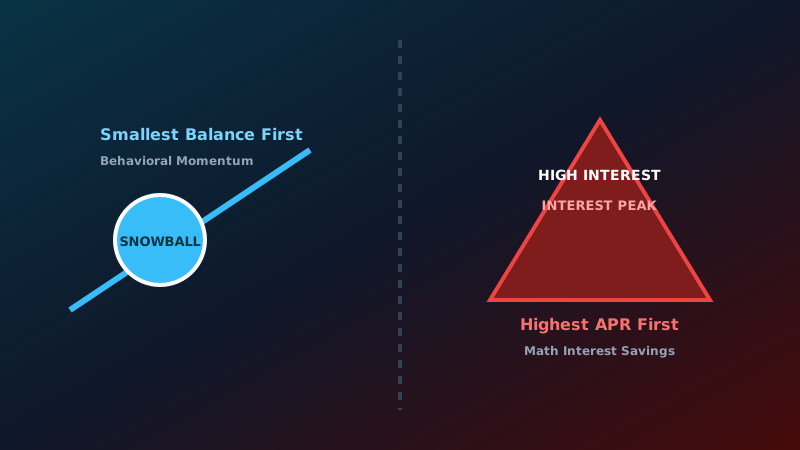
Both strategies require making minimum payments on all debt accounts while directing all remaining extra cash flow toward a single target debt. However, they differ fundamentally in how they select that target debt: one prioritizes psychological momentum, while the other prioritizes mathematical interest minimization.
Executive Summary: Strategy Comparison
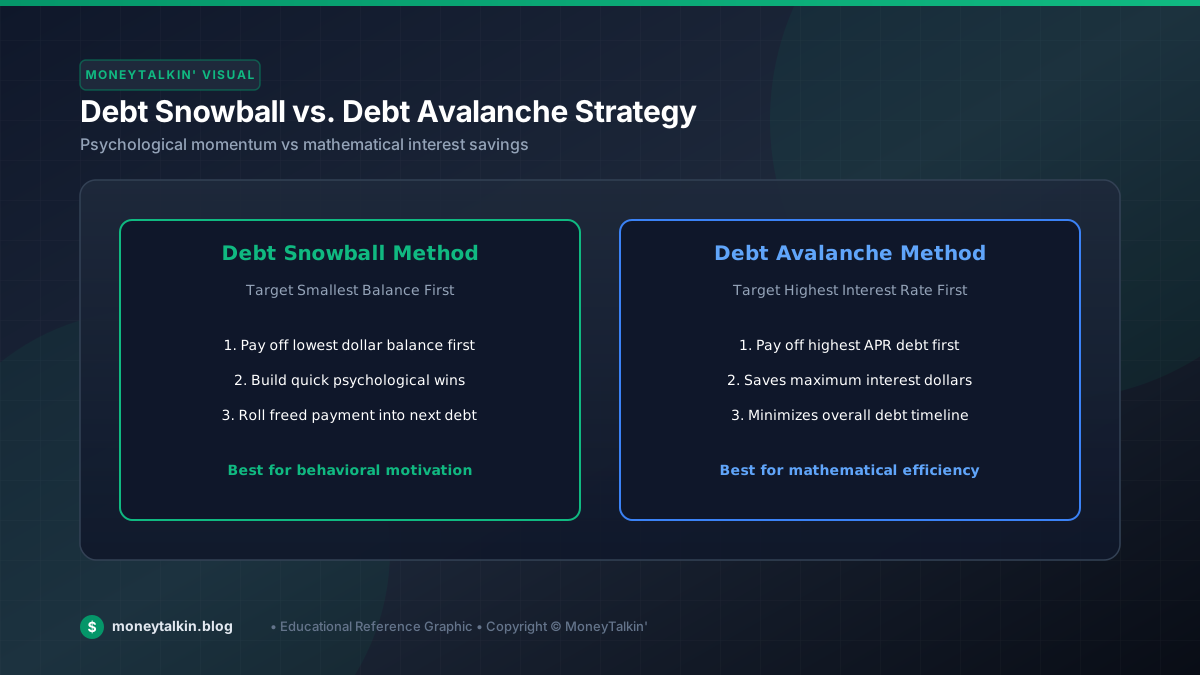
- Debt Snowball: Target the debt with the smallest dollar balance first, regardless of interest rate. Maximizes psychological wins and behavioral motivation.
- Debt Avalanche: Target the debt with the highest interest rate (APR) first, regardless of balance size. Maximizes mathematical interest savings and minimizes total time in debt.
- Verdict: The Avalanche method is mathematically optimal, but the Snowball method is often behaviorally superior for individuals needing quick psychological victories.
The Debt Snowball Method Explained
Popularized by financial author Dave Ramsey, the Debt Snowball method focuses on human behavior rather than pure mathematics.
                    DEBT SNOWBALL METHODOLOGY
┌─────────────────────────┐     ┌─────────────────────────┐     ┌─────────────────────────┐
│ Debt 1: Medical Bill    │ ──► │ Debt 2: Credit Card     │ ──► │ Debt 3: Auto Loan       │
│ Balance: $400 (Target)  │     │ Balance: $2,500         │     │ Balance: $8,000         │
└─────────────────────────┘     └─────────────────────────┘     └─────────────────────────┘
  Order: Smallest Balance to Largest Balance (Builds Momentum)
How It Works
- List all non-mortgage debts in order from smallest balance to largest balance. Ignore interest rates completely.
- Pay minimum required balances on all debts except the smallest.
- Throw all extra available cash flow toward the smallest balance until it is completely eliminated.
- Once the smallest debt is paid off, roll its entire monthly payment amount into the next-smallest debt (creating a growing "snowball" of cash momentum).
The Debt Avalanche Method Explained
The Debt Avalanche method prioritizes financial efficiency by attacking high-cost debt first.
                    DEBT AVALANCHE METHODOLOGY
┌─────────────────────────┐     ┌─────────────────────────┐     ┌─────────────────────────┐
│ Debt 1: Store Card      │ ──► │ Debt 2: Credit Card     │ ──► │ Debt 3: Student Loan    │
│ APR: 26.99% (Target)    │     │ APR: 18.50%             │     │ APR: 5.25%              │
└─────────────────────────┘     └─────────────────────────┘     └─────────────────────────┘
  Order: Highest Interest Rate (APR) to Lowest Interest Rate (Saves Math Interest)
How It Works
- List all non-mortgage debts in order from highest interest rate (APR) to lowest interest rate. Ignore balance sizes.
- Pay minimum required balances on all debts except the highest-APR debt.
- Throw all extra available cash flow toward the highest-APR debt until it is completely paid off.
- Roll that payment into the debt with the next-highest APR.
Comprehensive Mathematical Case Study
Consider a borrower with $500 per month in extra debt-payoff funds (above minimum required payments) facing three debts:
- Debt A (Credit Card): $3,000 balance | 24.00% APR | Minimum Payment: $90
- Debt B (Medical Bill): $500 balance | 0.00% APR | Minimum Payment: $25
- Debt C (Personal Loan): $7,000 balance | 12.00% APR | Minimum Payment: $180
Strategy Execution Comparison
| Metric | Debt Snowball Strategy | Debt Avalanche Strategy |
|---|---|---|
| First Target Debt | Debt B ($500 Medical Bill) | Debt A ($3,000 Credit Card at 24% APR) |
| First Elimination Milestone | Month 1 (Quick psychological win!) | Month 6 (Requires longer patience) |
| Total Interest Paid | $1,620 | $1,180 |
| Total Time to Debt-Free | 19 Months | 17.5 Months |
Outcome: The Debt Avalanche method saved this borrower $440 in interest and eliminated all debt 1.5 months faster. However, the Debt Snowball method eliminated the first account in just 30 days, providing immediate behavioral positive reinforcement.
Choosing the Right Strategy for You
- Choose Debt Snowball if: You struggle with staying motivated, feel overwhelmed by multiple debt accounts, or need quick psychological wins to stay on track.
- Choose Debt Avalanche if: You are analytical, disciplined, motivated by mathematical efficiency, and determined to pay the least possible interest.
Sources
- National Foundation for Credit Counseling (NFCC): Debt Repayment Strategies
https://www.nfcc.org/ - Consumer Financial Protection Bureau (CFPB): Repaying Student and Personal Debt
https://www.consumerfinance.gov/
Disclaimer
Educational content only. Consult a qualified credit counselor or financial professional for individualized debt advice.
Detailed Case Study: Snowball vs. Avalanche Math
To visualize the practical differences between both debt payoff methods, examine a hypothetical borrower with three revolving credit card balances:
- Card A: $1,500 balance at 18.00% APR (Minimum Payment: $45)
- Card B: $4,000 balance at 24.50% APR (Minimum Payment: $120)
- Card C: $8,000 balance at 15.00% APR (Minimum Payment: $200)
- Total Monthly Payoff Budget: $600/month
| Payoff Strategy | Primary Target Order | Total Months to Zero | Total Interest Paid ($) | Total Out-of-Pocket ($) |
|---|---|---|---|---|
| Debt Snowball | Card A ($1.5k) ──► Card B ($4k) ──► Card C ($8k) | 27 Months | $2,840 | $16,340 |
| Debt Avalanche | Card B (24.5%) ──► Card A (18.0%) ──► Card C (15.0%) | 25 Months | $2,210 | $15,710 |
In this hypothetical example, the Debt Avalanche method saves $630 in interest and eliminates all debt 2 months faster. However, if the psychological win of eliminating Card A quickly keeps the borrower motivated, the Debt Snowball remains an effective behavioral strategy.
Choosing the Right Method for Your Budget
To select between the Debt Snowball and Debt Avalanche methods, evaluate your personal behavioral preferences:
- Select Debt Snowball If: You feel overwhelmed by multiple small debt accounts and need quick psychological wins to build momentum and consistency.
- Select Debt Avalanche If: You are analytical, motivated by interest optimization, and focused on minimizing total cumulative out-of-pocket interest costs over the repayment period.
Key Execution Guidelines for Both Methods
- Maintain Minimum Payments: Always make mandatory minimum payments on all debt accounts to protect credit scores from 30-day late delinquencies.
- Automate Monthly Payments: Set up automatic monthly payments to avoid missed due dates.
Educational Summary & Key Definitions
Understanding financial fundamentals requires mastering core vocabulary and operational definitions:
- Principal: The original amount of money deposited or borrowed, excluding interest earnings or finance charges.
- Annual Percentage Yield (APY): The real rate of return earned on a deposit account, taking into account the effect of compounding interest over a 12-month period.
- Liquidity: The ease and speed with which an asset can be converted into liquid cash without incurring significant capital loss.
- Diversification: An investment risk management strategy that mixes a wide variety of investments within a portfolio to limit exposure to any single asset class.
Consulting official regulatory guidelines—such as disclosures from the CFPB, FDIC, NCUA, and Federal Reserve—ensures you make informed financial decisions backed by verified consumer protections.
MoneyTalkin' provides financial education, educational concepts, and general informational guides. Articles do not constitute personalized financial, investment, legal, or tax advice. Financial products, rates, terms, and regulatory rules change frequently; consult a qualified financial professional regarding your specific situation. Read our full Disclaimer Policy.
Written by MoneyTalkin'
MoneyTalkin' researches and publishes objective financial education content, money management fundamentals, and practical financial guides.
Related Technical Articles
Explore related topics in this cluster to deepen your understanding.