Renting vs. Buying a Home: Understanding the Financial Math
Analyze the financial trade-offs of renting versus buying property, evaluating opportunity cost, unrecoverable costs, inflation, and market mobility.
Renting vs. Buying a Home: Understanding the Financial Math
The choice between renting a home and buying real estate is often framed as a simple milestone: "Renting is throwing money away, while buying builds equity." However, from a rigorous personal finance perspective, this narrative oversimplifies the complex financial trade-offs involved.
Both renting and buying incur substantial unrecoverable costs—money spent that does not build equity. Evaluating whether renting or buying is mathematically superior requires analyzing mortgage interest, property taxes, maintenance costs, opportunity costs of down payment capital, and market mobility.
Executive Summary: Financial Math Fundamentals
- Unrecoverable Costs of Buying: Mortgage interest, property taxes, home insurance, HOA fees, routine maintenance (1%–2% of home value annually), and closing costs.
- Unrecoverable Costs of Renting: Monthly rent payment.
- The 5% Rule Heuristic: Annual unrecoverable buying cost $\approx 5%$ of home value (1.5% property tax + 1% maintenance + 2.5% mortgage interest/cost of capital). If annual rent is less than 5% of home value, renting is often mathematically superior.
- Down Payment Opportunity Cost: Capital used for a down payment cannot earn compounding returns in stock market index funds.
Comparing Unrecoverable Costs
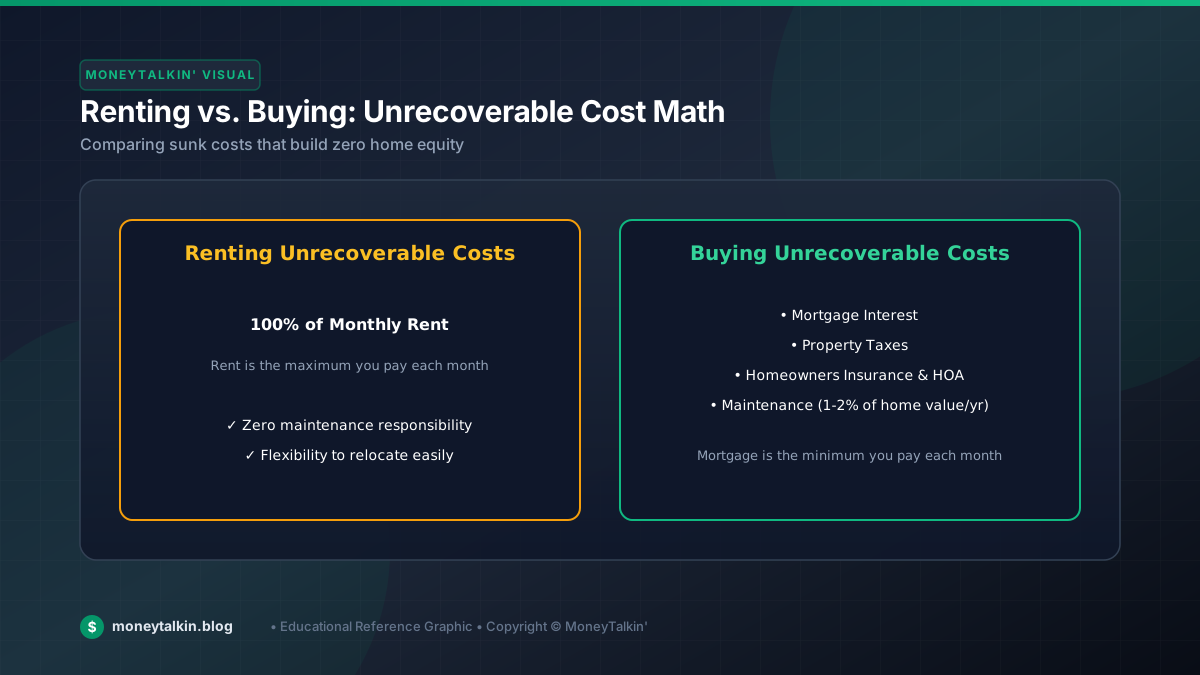
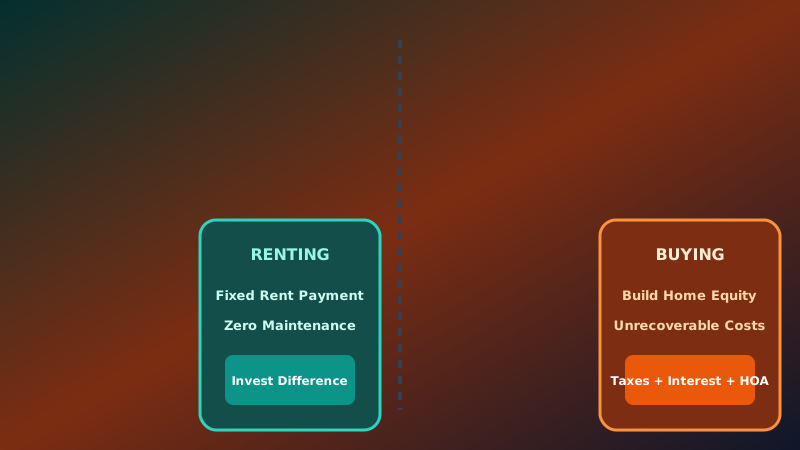
                    UNRECOVERABLE COST COMPARISON
┌───────────────────────────┐        ┌───────────────────────────┐
│     Renting Costs         │        │      Buying Costs         │
│ • Monthly Rent Payment    │        │ • Mortgage Interest       │
│                           │        │ • Property Taxes          │
│                           │        │ • Home Insurance & HOA    │
│                           │        │ • 1%-2% Annual Maintenance│
└───────────────────────────┘        └───────────────────────────┘
A common misconception is that 100% of a mortgage payment builds home equity. In reality, during the first 10 to 15 years of a 30-year fixed mortgage, the vast majority of your monthly payment goes toward mortgage interest, with only a small fraction reducing loan principal.
Mathematical Example: The 5% Rule in Practice
Suppose a buyer is evaluating a $400,000 home versus renting a comparable home for $1,800 per month.
Step 1: Apply the 5% Rule to Buying
The 5% rule estimates annual unrecoverable buying costs as:
- Property Taxes: ~1.25%
- Maintenance & Repairs: ~1.25%
- Cost of Capital / Mortgage Interest: ~2.50%
- Total Unrecoverable Cost Rate: 5.00%
$$\text{Annual Unrecoverable Cost of $400k Home} = $400,000 \times 0.05 = \mathbf{$20,000/\text{year}}$$ $$\text{Monthly Unrecoverable Cost} = \frac{$20,000}{12} = \mathbf{$1,666.67/\text{month}}$$
Step 2: Compare to Monthly Rent
- Monthly Rent for Comparable Home: $1,800/month
- Monthly Unrecoverable Cost of Buying: $1,667/month
Step 3: Factor Down Payment Opportunity Cost
Buying the $400,000 home requires a 20% down payment ($80,000) plus $10,000 in closing costs ($90,000 cash upfront). If the renter invests that $90,000 in an index fund earning 7% annually, it generates $6,300 per year ($525/month) in compounding growth.
Verdict: In this scenario, renting for $1,800/month and investing the $90,000 down payment yields a higher net worth over a 7-year horizon than buying the $400,000 home.
Key Non-Financial Decision Factors
- Time Horizon: If you plan to live in a city for less than 5 years, buying is rarely cost-effective due to 6% seller real estate commissions and closing fees.
- Control vs. Flexibility: Homeownership grants full freedom to modify property; renting offers career mobility and zero repair hassle.
Practical Takeaway Checklist
- Calculate the 5% rule threshold for homes in your target area.
- Estimate your exact time horizon in the location (target 5–7+ years for buying).
- Calculate the opportunity cost of your down payment capital.
- Include maintenance (1%–2%) and HOA fees in your monthly housing budget.
Sources
- Federal Reserve Bank of St. Louis (FRED): Housing Market Data & Price Indices
https://fred.stlouisfed.org/ - U.S. Census Bureau: Homeownership & Housing Costs Reports
https://www.census.gov/housing/
Disclaimer
Educational content only. Consult a real estate professional and financial planner for tailored guidance.
Unrecoverable Cost Comparison & Opportunity Cost
Evaluating whether to rent or buy requires analyzing unrecoverable costs on both sides of the balance sheet:
- Unrecoverable Rent Cost: 100% of monthly rent payments.
- Unrecoverable Ownership Costs: Mortgage interest, property taxes, homeowners insurance, HOA dues, and physical home maintenance (averaging 1% to 2% of home value annually).
When mortgage interest rates exceed 6% to 7%, early-year mortgage interest payments represent an unrecoverable cost that often exceeds equivalent local rent. Retaining down payment cash in liquid investments provides compound interest returns that must be factored into the mathematical comparison. Compare housing dynamics in rent vs buy 2026.
Rule of Thumb: The 5% Housing Unrecoverable Rule
Real estate analysts evaluate homeownership unrecoverable costs using the 5% Rule:
Annual Unrecoverable Cost = (Property Value × 5%) / 12 Months
- 1% Property Taxes + 1% Maintenance + 3% Capital Cost / Mortgage Interest = ~5% Annual Unrecoverable Cost.
- If local monthly rent for an equivalent property is lower than the calculated 5% unrecoverable cost, renting and investing the difference is statistically favorable.
Key Decision Takeaways for Housing
- Compare Total Unrecoverable Costs: Factor in mortgage interest, property taxes, insurance, maintenance, and lost investment returns.
- Evaluate Planned Tenure: Rent if planning to relocate within 5 to 7 years to avoid transaction cost drag.
Educational Summary & Key Definitions
Understanding financial fundamentals requires mastering core vocabulary and operational definitions:
- Principal: The original amount of money deposited or borrowed, excluding interest earnings or finance charges.
- Annual Percentage Yield (APY): The real rate of return earned on a deposit account, taking into account the effect of compounding interest over a 12-month period.
- Liquidity: The ease and speed with which an asset can be converted into liquid cash without incurring significant capital loss.
- Diversification: An investment risk management strategy that mixes a wide variety of investments within a portfolio to limit exposure to any single asset class.
Consulting official regulatory guidelines—such as disclosures from the CFPB, FDIC, NCUA, and Federal Reserve—ensures you make informed financial decisions backed by verified consumer protections.
Long-Term Equity Build vs. Invested Liquidity
A long-term evaluation of homeownership versus renting requires comparing total balance sheet growth over 10 to 30 years:
- Homeowner Equity Paydown: Monthly mortgage payments gradually pay down loan principal, building forced home equity. Over 15 to 30 years, fixed-rate mortgage payments remain static while nominal rents rise, making homeownership progressively more advantageous in later loan years.
- Renter Investment Compounding: Renters who discipline themselves to invest the monthly cost difference between renting and buying in low-cost index funds build liquid investment portfolios that compound tax-efficiently without real estate property tax or maintenance costs.
For tenant coverage fundamentals, review our guide on Renters Insurance Explained.
MoneyTalkin' provides financial education, educational concepts, and general informational guides. Articles do not constitute personalized financial, investment, legal, or tax advice. Financial products, rates, terms, and regulatory rules change frequently; consult a qualified financial professional regarding your specific situation. Read our full Disclaimer Policy.
Written by MoneyTalkin'
MoneyTalkin' researches and publishes objective financial education content, money management fundamentals, and practical financial guides.
Related Technical Articles
Explore related topics in this cluster to deepen your understanding.