Renters Insurance Explained: Coverage, Costs, Deductibles, and Limits
A beginner-focused guide to renters insurance, explaining personal property coverage, liability protection, loss of use, replacement cost vs actual cash value, and deductibles.
Renters Insurance Explained: Coverage, Costs, Deductibles, and Limits
When renting an apartment, single-family house, or condominium, many tenants assume that their landlord's insurance policy protects their personal belongings in the event of a fire, theft, or water leak. In reality, a landlord's insurance policy covers only the physical building structure—leaving the tenant personally responsible for replacing their furniture, electronics, clothing, and personal liability exposures.
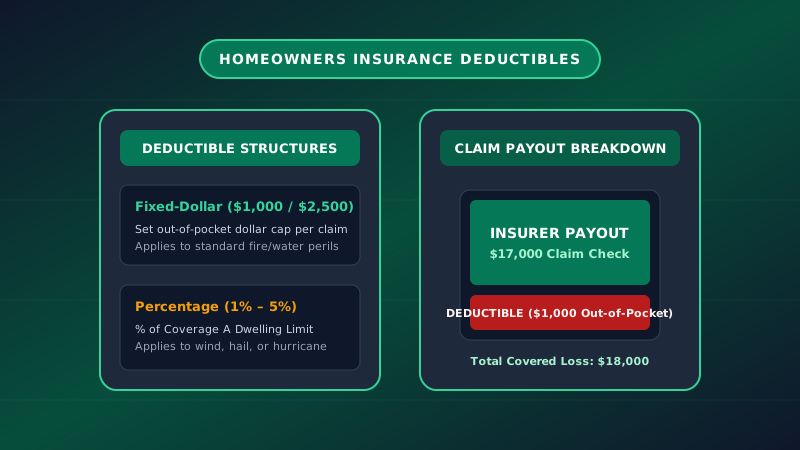
Understanding renters insurance (standardized as an HO-4 tenant policy)—including personal property coverage, liability limits, loss of use provisions, replacement cost options, and policy deductibles—is essential for protecting your financial stability alongside a dedicated emergency fund and understanding homeowners insurance deductibles.
1. What Is Renters Insurance?
Renters insurance is a property and casualty insurance policy designed specifically for tenants renting residential real estate. An HO-4 policy provides financial reimbursement for damaged or stolen personal property, covers legal defense and medical expenses if a guest is injured inside the rental unit, and pays for temporary housing if a covered disaster makes the rental unlivable.
2. Core Coverage Components of a Renters Insurance Policy
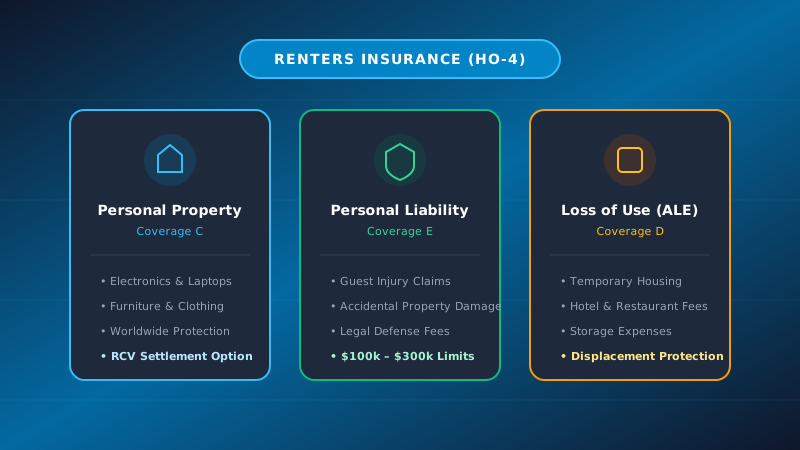
A standard renters insurance policy comprises three primary coverage sections:
A. Personal Property Coverage (Coverage C)
Personal property coverage pays to repair or replace your personal belongings if they are damaged, destroyed, or stolen due to a covered peril (such as fire, smoke, lightning, windstorm, vandalism, or burst plumbing pipes).
Covered personal belongings typically include:
- Electronics, computers, televisions, and gaming consoles
- Furniture, rugs, and home decor
- Clothing, shoes, and personal accessories
- Kitchen appliances, utensils, and housewares
- Bicycles and sports equipment
Off-Premises Protection: Most renters policies extend personal property coverage worldwide. If your laptop is stolen from your car or a hotel room while traveling, personal property coverage generally applies (subject to policy sub-limits and deductibles).
B. Personal Liability Protection (Coverage E)
Personal liability coverage protects you financially if you are held legally responsible for causing bodily injury to someone else or damaging another person's property.
Examples of liability scenarios include:
- A visitor slips and breaks an arm on a wet floor inside your apartment.
- You accidentally leave a sink running, causing water damage that leaks into the apartment below you.
- Your dog bites a guest inside your home (subject to breed restrictions and policy terms).
Liability coverage pays for legal defense fees, court judgments, and negotiated settlements up to the policy limit (which often starts at $100,000, with options to purchase higher limits depending on policy choices).
C. Additional Living Expenses / Loss of Use (Coverage D)
If a covered peril (such as a structural fire) makes your rental unit uninhabitable, Loss of Use coverage reimburses necessary temporary living expenses above your normal baseline costs while repairs are completed.
Reimbursable expenses typically include:
- Hotel bills or temporary apartment rental fees
- Reasonable restaurant meal expenses if your temporary housing lacks a kitchen
- Temporary storage fees for salvaged furniture
3. Actual Cash Value (ACV) vs. Replacement Cost Value (RCV)
When purchasing renters insurance, policyholders must choose between two valuation settlement methods:
| Feature | Actual Cash Value (ACV) | Replacement Cost Value (RCV) |
|---|---|---|
| Valuation Method | Current market value minus depreciation | Cost to purchase brand-new equivalent item |
| Payout Calculation | Original Cost - Depreciation - Deductible | Replacement Cost - Deductible |
| Premium Cost | Lower annual premium | Slightly higher annual premium |
| Financial Protection | Lower out-of-pocket claim payout | Comprehensive replacement protection |
Example Claim Comparison:
Suppose your 4-year-old laptop (originally purchased for $1,500) is stolen during a apartment break-in. A brand-new equivalent laptop costs $1,500 today, but due to age and wear, its depreciated market value is $400. With a $250 deductible:
- Under ACV: The insurer pays $$400 - $250 = \mathbf{$150}$.
- Under RCV: The insurer pays $$1,500 - $250 = \mathbf{$1,250}$.
Choosing Replacement Cost Value (RCV) coverage provides broader financial protection when replacing lost belongings.
4. Policy Deductibles and Coverage Limits
Like other property policies, renters insurance includes a policy deductible—the dollar amount subtracted from your claim reimbursement.
- Common deductible options are $250, $500, or $1,000.
- Choosing a higher deductible lowers your monthly or annual insurance premium.
- Choosing a lower deductible increases your annual premium but reduces out-of-pocket stress during a claim.
Policyholders select overall aggregate coverage limits (e.g., $30,000 in personal property and $100,000 in liability). To determine your ideal personal property limit, conduct a room-by-room home inventory calculation.
5. Common Renters Insurance Exclusions
Renters insurance policies do not cover every type of loss. Standard policies contain explicit exclusions:
- Flood Damage: Damage caused by natural surface flooding, storm surges, or external water overflow is excluded. Separate flood insurance is required.
- Earthquake Damage: Earth movement and earthquake damage require a separate policy endorsement.
- Roommate Property: Standard policies cover only the named insured and related family members residing in the household. Roommates must purchase their own individual renters policies.
- Business Equipment Sub-Limits: If you run a business or work from home, commercial equipment (such as dedicated server hardware or inventory) is subject to policy sub-limits (e.g., $2,500) unless backed by an endorsement.
6. Scheduled Endorsements for High-Value Items
Standard renters policies enforce internal category sub-limits on high-risk, high-value items:
- Jewelry and watches (often subject to category sub-limits, such as $1,000 to $2,500 for theft losses, depending on policy terms)
- Fine art, collectibles, and antiques
- Firearms and high-end musical instruments
Policyholders owning items exceeding standard category limits can purchase a scheduled personal property rider (or endorsement). Scheduling an item provides full replacement coverage up to appraised value and often eliminates the standard policy deductible for that specific item.
7. Landlord Insurance vs. Renters Insurance
A frequent point of friction between tenants and property managers is understanding policy boundaries:
- Landlord Insurance (DP-3 Policy): Covers the physical building structure, foundation, roof, landlord-owned appliances, and landlord liability. It offers zero coverage for tenant belongings.
- Renters Insurance (HO-4 Policy): Covers tenant personal property, tenant liability, and tenant temporary relocation expenses.
Many property managers and landlords now require tenants to maintain a minimum level of personal liability coverage (such as $100,000) as a lease condition.
8. Practical Steps for Renters Insurance Setup
To set up and manage an effective renters insurance policy, follow these steps:
- Create a Digital Home Inventory: Walk through your rental with a smartphone camera, photographing serial numbers, receipts, electronics, and wardrobe items.
- Select Replacement Cost Value (RCV): Opt for RCV coverage over ACV to ensure full replacement funding.
- Schedule Special Possessions: Add riders for expensive jewelry, camera equipment, or high-end laptops.
- Store Inventory Backups in the Cloud: Keep digital receipts and inventory photos backed up securely online.
Sources
- National Association of Insurance Commissioners (NAIC): A Consumer Guide to Renters Insurance https://content.naic.org/
- Insurance Information Institute (III): Renters Insurance Basics and Coverage Types https://www.iii.org/
- Consumer Financial Protection Bureau (CFPB): Renter Financial Security Resources https://www.consumerfinance.gov/
Educational Disclaimer
This guide is for informational and educational purposes only and does not constitute formal legal or insurance advice. Renters insurance terms, sub-limits, endorsements, and premium rates vary by insurance company, state regulations, and policy contract. Consult a licensed insurance agent for personalized coverage advice.
MoneyTalkin' provides financial education, educational concepts, and general informational guides. Articles do not constitute personalized financial, investment, legal, or tax advice. Financial products, rates, terms, and regulatory rules change frequently; consult a qualified financial professional regarding your specific situation. Read our full Disclaimer Policy.
Written by MoneyTalkin'
MoneyTalkin' researches and publishes objective financial education content, money management fundamentals, and practical financial guides.
Related Technical Articles
Explore related topics in this cluster to deepen your understanding.