Homeowners Insurance Deductibles Explained: How They Affect Claims and Costs
A practical guide to homeowners insurance deductibles, explaining dollar vs percentage deductibles, separate peril rules, claim payouts, and premium trade-offs.
Homeowners Insurance Deductibles Explained: How They Affect Claims and Costs
Homeowners insurance is a foundational risk-management tool designed to protect your home and personal property against major property damage and liability claims. At the center of every property insurance policy is the insurance deductible.
Understanding how your homeowners insurance deductible functions—along with the differences between fixed-dollar and percentage deductibles, separate peril endorsements, and premium trade-offs—is essential for avoiding unexpected out-of-pocket expenses when managing the hidden costs of homeownership or allocating reserves in your emergency fund.
1. What Is a Homeowners Insurance Deductible?
A homeowners insurance deductible is the specific out-of-pocket dollar amount (or percentage of coverage) that the policyholder is responsible for paying before the insurance company begins paying for a covered property loss.
Unlike health insurance deductibles, which compound annually across multiple doctor visits, a homeowners insurance deductible applies per claim event. Each time a policyholder files a separate property claim, the applicable deductible is subtracted directly from the total claim payout issued by the insurer.
2. Fixed-Dollar vs. Percentage Deductibles
Insurance companies structure policy deductibles using two primary methods:
A. Fixed-Dollar Deductibles
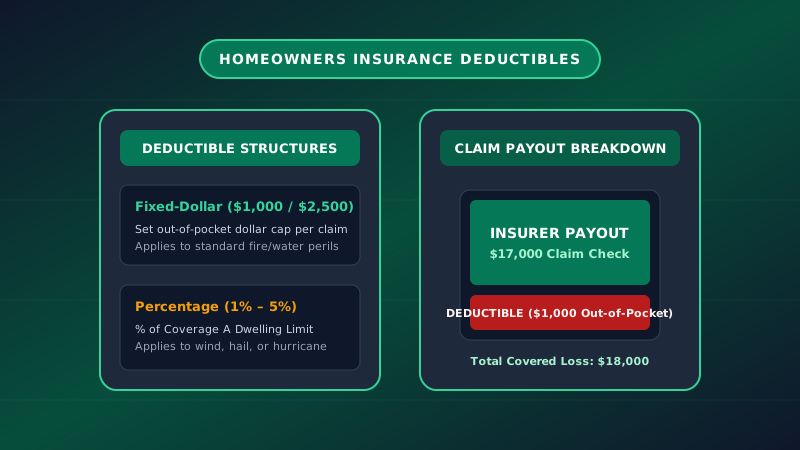
A fixed-dollar deductible is a set dollar amount specified in the policy declarations page (commonly $1,000, $2,500, or $5,000).
When a covered loss occurs, the policyholder pays the set dollar amount out-of-pocket, and the insurer pays the remaining covered damage up to policy limits.
B. Percentage Deductibles
A percentage deductible is calculated as a percentage of the home's total insured value—specifically Coverage A (Dwelling Limit)—rather than a fixed dollar amount. Percentage deductibles often range from 1% to 5% of the dwelling limit, depending on insurer options and state rules.
Example Calculation:
If a home has a Dwelling Coverage A limit of $400,000 and a 2% percentage deductible: $$\text{Deductible Amount} = $400,000 \times 0.02 = \mathbf{$8,000}$$
In this scenario, the homeowner must absorb the first $8,000 of covered property repair costs out-of-pocket before insurance reimbursement begins.
3. Separate Peril Deductibles (Windstorm, Hail, and Hurricane)
Depending on your geographic location, building characteristics, and state insurance regulations, a policy may include separate deductibles for specific weather hazards:
- Standard All-Peril Deductible: Applies to general covered perils such as fire, lightning, burst pipes, or theft (e.g., $1,000 fixed deductible).
- Hurricane / Named Storm Deductible: Applies specifically to damage caused by federally declared hurricanes or named storms in coastal states, which are commonly structured as percentage deductibles (e.g., 2% to 5% of Dwelling Coverage), subject to state regulations and policy terms.
- Windstorm & Hail Deductible: Applied in regions prone to severe hail or tornado activity (such as the Midwest Plains), requiring a separate percentage or higher fixed deductible for roof and siding damage.
4. How Deductibles Affect Claim Payouts (Claim Example)
To see how a deductible functions during a claim, consider a hypothetical homeowner with $350,000 in Dwelling Coverage who suffers $18,000 in severe roof damage from a covered windstorm.
Scenario A: $1,000 Fixed-Dollar Deductible
- Total Covered Loss: $18,000
- Policy Deductible: -$1,000
- Insurer Claim Payout: $17,000
- Homeowner Out-of-Pocket Cost: $1,000
Scenario B: 2% Percentage Wind/Hail Deductible
- Total Covered Loss: $18,000
- Dwelling Limit: $350,000
- Policy Deductible (2% of $350,000): -$7,000
- Insurer Claim Payout: $11,000
- Homeowner Out-of-Pocket Cost: $7,000
If total repair costs had been $5,000 in Scenario B, the loss would fall entirely below the $7,000 deductible threshold, meaning the insurer would issue $0 in claim reimbursement.
5. How Deductible Size Impacts Annual Insurance Premiums
There is generally an inverse relationship between your policy deductible and your annual insurance premium:
- Higher Deductible $\rightarrow$ Lower Premium: Selecting a higher deductible (e.g., increasing from $1,000 to $2,500) reduces the insurer's potential payout risk, resulting in a lower annual insurance premium.
- Lower Deductible $\rightarrow$ Higher Premium: Selecting a lower deductible (e.g., $500) increases insurer payout frequency and risk, resulting in a higher annual premium.
While increasing your deductible reduces fixed monthly expenses, homeowners must ensure they maintain sufficient liquid reserves in a dedicated sinking fund to cover the higher out-of-pocket obligation should a loss occur.
6. Small Claims vs. Claims History Impact
Beyond out-of-pocket costs, homeowners should evaluate whether filing a small claim makes financial sense.
Insurance loss history databases (such as the Comprehensive Loss Underwriting Exchange, or C.L.U.E.) generally track property claims for up to 7 years. Filing multiple minor claims that barely exceed your deductible can trigger premium surcharges or non-renewal notices from your insurer.
For minor losses where the repair cost exceeds the deductible by only a few hundred dollars, paying out-of-pocket may be more cost-effective than risking a multi-year premium increase.
7. Coverage Exclusions: What Insurance Deductibles Do Not Cover
A common misconception is assuming a homeowners insurance policy covers all forms of physical property damage once the deductible is met. Standard homeowners policies (such as HO-3 policies) contain explicit exclusions:
- Flood Damage: Surface water flooding, storm surge, and rising river waters are excluded from standard homeowners insurance. Flood protection requires a separate policy through the National Flood Insurance Program (NFIP) or private flood insurers.
- Earthquake & Earth Movement: Damage from earthquakes or landslides is excluded unless added via a specific earthquake endorsement.
- Normal Wear and Tear / Maintenance: Gradual roof deterioration, aging HVAC systems, or deferred maintenance issues are the homeowner's financial responsibility.
8. Practical Checklist for Setting Your Homeowners Deductible
When selecting or updating your homeowners insurance deductible, review this practical checklist:
- Review Your Declarations Page: Identify your baseline all-peril deductible and confirm whether separate hurricane or windstorm deductibles apply.
- Calculate Percentage Dollar Caps: Convert any percentage deductibles into actual dollar figures based on your current Dwelling Coverage A limit.
- Match Deductible to Liquid Reserves: Ensure your emergency savings or property sinking fund can cover your total deductible without requiring high-interest credit.
- Evaluate Annual Premium Savings: Compare quotes for $1,000, $2,500, and 1% deductibles to measure annual cost differences against out-of-pocket risk.
- Read Actual Policy Endorsements: Confirm water backup, sewer overflow, or roof endorsement terms with your insurance provider.
Sources
- National Association of Insurance Commissioners (NAIC): A Consumer Guide to Homeowners Insurance https://content.naic.org/
- Insurance Information Institute (III): Understanding Your Home Insurance Deductible https://www.iii.org/
- Federal Emergency Management Agency (FEMA): National Flood Insurance Program Policy Rules https://www.fema.gov/
Educational Disclaimer
This article is for educational and informational purposes only and does not constitute formal insurance, legal, or financial advice. Policy terms, deductible structures, peril exclusions, and premium calculations vary by insurance company, state regulations, and property characteristics. Review your policy contract and consult a licensed insurance agent for individual coverage advice.
For personal policy breakdowns, consult our comparison of Term vs. Whole Life Insurance.
MoneyTalkin' provides financial education, educational concepts, and general informational guides. Articles do not constitute personalized financial, investment, legal, or tax advice. Financial products, rates, terms, and regulatory rules change frequently; consult a qualified financial professional regarding your specific situation. Read our full Disclaimer Policy.
Written by MoneyTalkin'
MoneyTalkin' researches and publishes objective financial education content, money management fundamentals, and practical financial guides.
Related Technical Articles
Explore related topics in this cluster to deepen your understanding.