Term vs. Whole Life Insurance: Differences, Costs & Coverage Analysis
Compare term and whole life insurance on premiums, duration, cash value growth, and suitability for different financial goals.
Term vs. Whole Life Insurance: Differences, Costs, and Coverage Analysis
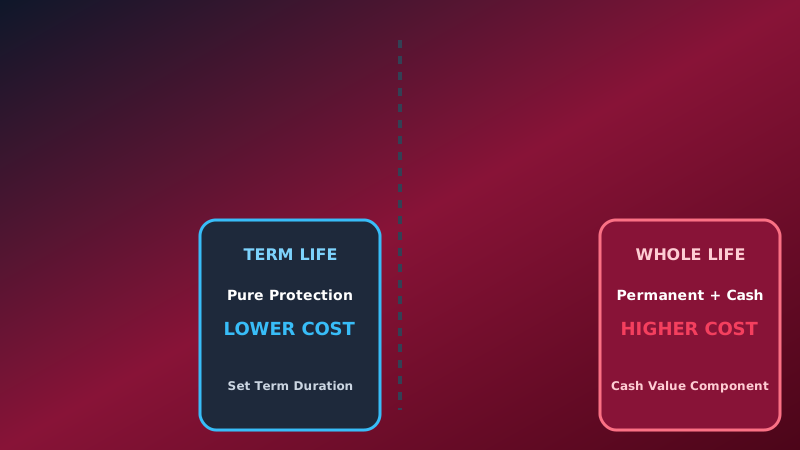
Life insurance is a foundational risk management tool designed to provide financial protection to surviving dependents in the event of an insured individual's death. When evaluating policy options, consumers encounter a fundamental choice between two primary categories: Term Life Insurance and Whole Life Insurance (a form of permanent life insurance).
While both policies pay a death benefit to beneficiaries, they differ dramatically in duration, premium cost structure, and complexity. Whole life insurance generally costs substantially more than comparable term life insurance for equivalent death benefit coverage because it provides permanent lifelong coverage and incorporates a cash-value savings component.
Executive Summary: Term vs. Whole Life Comparison
- Term Life Insurance: Provides death benefit coverage for a specified time horizon (e.g., 10, 20, or 30 years). Simple, low-cost, pure risk protection.
- Whole Life Insurance: Provides lifelong permanent coverage as long as premiums are paid, paired with a tax-deferred cash-value accumulation account.
- Cost Differential: Whole life premiums are substantially higher than term life premiums for equivalent death benefit amounts due to cash value building and contractual lifelong death benefit coverage.
- Financial Strategy Verdict: Most financial advisors recommend "buy term and invest the difference"—purchasing low-cost term life insurance and investing remaining cash into low-cost index funds.
Detailed Comparison of Features
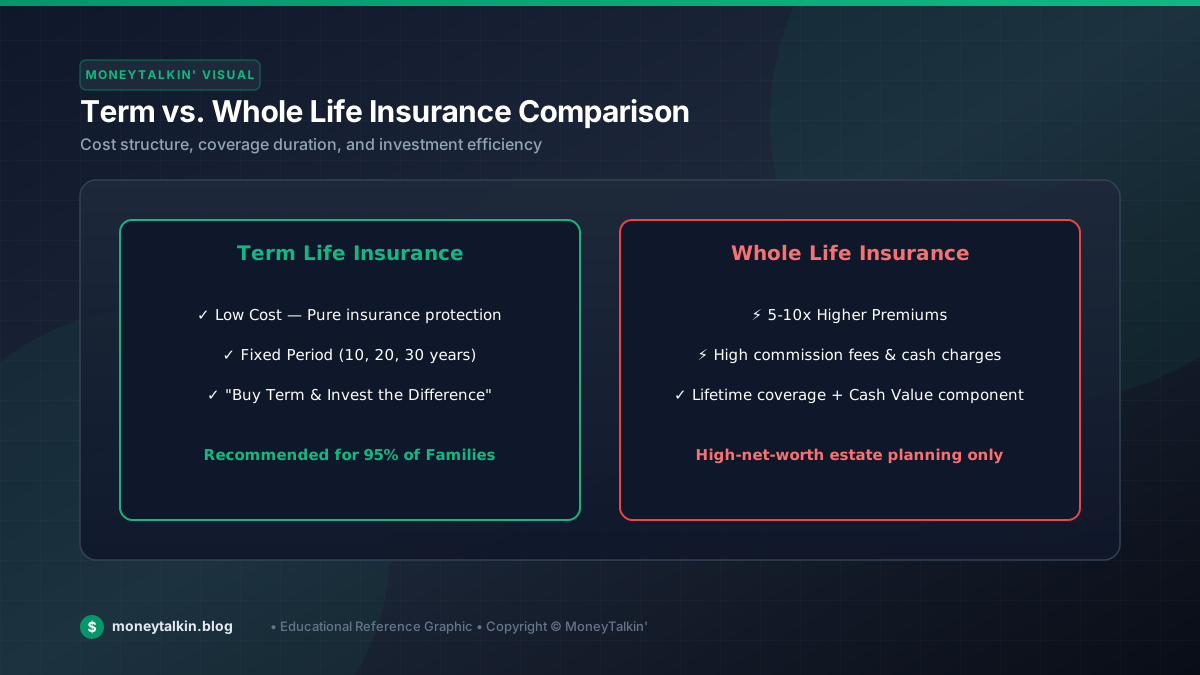
                    LIFE INSURANCE STRUCTURAL DIFFERENCES
┌──────────────────────────────┐        ┌──────────────────────────────┐
│     Term Life Insurance      │        │     Whole Life Insurance     │
│ • Pure risk protection       │        │ • Permanent lifelong protection│
│ • Low annual premium         │        │ • High annual premium        │
│ • Expires after 10-30 years  │        │ • Cash value accumulation    │
│ • No cash value component    │        │ • Surrender charges & fees   │
└──────────────────────────────┘        └──────────────────────────────┘
| Feature | Term Life Insurance | Whole Life Insurance |
|---|---|---|
| Coverage Duration | Fixed term (10, 20, or 30 years) | Permanent (Lifelong up to age 100–121) |
| Premium Cost | Low, fixed rate for term duration | Substantially higher fixed annual premium |
| Cash Value Component | None (Pure insurance) | Accumulates tax-deferred cash value |
| Policy Complexity | Simple, transparent contract | Complex fees, surrender charges, dividend rules |
| Primary Purpose | Income replacement during working years | Estate planning, permanent tax-advantaged strategy |
Understanding Cash Value and Surrender Charges in Whole Life
A central selling point of whole life insurance is its cash value account. A portion of your premium is directed into a conservative accumulation account that grows tax-deferred.
However, whole life policies carry heavy upfront administrative fees and agent commissions. During the first 3 to 10 years of a policy, early surrender penalties (surrender charges) make it difficult or costly to access your cash value if you cancel the policy.
Mathematical Case Study: "Buy Term and Invest the Difference"
Consider a healthy 30-year-old evaluating coverage options for a $500,000 death benefit:
- Option A (Whole Life Policy): Annual Premium = $4,800/year ($400/month) for permanent coverage.
- Option B (20-Year Term Policy + Investing):
- 20-Year Term Life Premium ($500k coverage): $360/year ($30/month).
- Remaining cash invested in index funds (7% return): $4,440/year ($370/month).
20-Year Mathematical Comparison
- Option A (Whole Life Cash Value at Year 20): Estimated cash value accumulation $\approx \mathbf{$110,000}$ (after policy fees and mortality charges).
- Option B (Term + Index Fund Investment at Year 20):
$$$4,440 \times \text{Future Value Factor (20 Yrs @ 7%)} = \mathbf{$182,000+}$$
Outcome: By purchasing low-cost term insurance and investing the premium difference directly in low-cost index funds, the investor built over $72,000 more in liquid wealth while maintaining identical $500,000 protection during their peak working years.
Practical Takeaway Checklist
- Choose Term Life if your primary goal is protecting family income during working/parenting years.
- Match term length to your longest financial obligation (e.g., 20-year term for a new mortgage or child raising).
- Target coverage equal to 10x to 12x your annual gross income.
- Consider Whole Life only if you have maxed out all tax-advantaged accounts (401k, IRA, HSA) and require specialized estate planning.
Sources
- National Association of Insurance Commissioners (NAIC): Life Insurance Buying Guide
https://content.naic.org/ - FINRA: Understanding Life Insurance Products
https://www.finra.org/investors/investing
Disclaimer
Educational content only. Consult a licensed insurance advisor for personal policy reviews.
Cash Value Growth Mechanics & Policy Loan Risks
Whole life insurance policies combine a death benefit with an internal cash value accumulation account. However, policyholders must understand the contractual mechanics:
- Low Cash Value Returns: Cash value growth in permanent policies typically yields net annual returns between 2% and 4% after accounting for high internal insurance charges, administrative fees, and agent commissions.
- Policy Loan Interest: Borrowing against your policy's cash value incurs interest charged by the insurance company. Outstanding policy loans reduce the final death benefit paid to beneficiaries if unpaid at death.
For the vast majority of families, purchasing low-cost Term Life Insurance and investing the premium savings in low-cost index funds yields superior net wealth accumulation.
Key Questions Before Buying Life Insurance
Before purchasing any life insurance policy, ask the issuing agent:
- What is the breakdown of initial premium dollars going to agent commission vs cash value accumulation?
- What are the surrender charges if I cancel the policy within the first 10 years?
- How does the projected return compare to a low-cost S&P 500 index fund over a 20-year term?
Core Insurance Guidelines for Families
- Buy Term for Income Replacement: Select 20 or 30-year term policies covering 10x annual income during dependent raising years.
- Invest the Difference: Direct premium savings into low-cost index funds to build independent long-term wealth.
Educational Summary & Key Definitions
Understanding financial fundamentals requires mastering core vocabulary and operational definitions:
- Principal: The original amount of money deposited or borrowed, excluding interest earnings or finance charges.
- Annual Percentage Yield (APY): The real rate of return earned on a deposit account, taking into account the effect of compounding interest over a 12-month period.
- Liquidity: The ease and speed with which an asset can be converted into liquid cash without incurring significant capital loss.
- Diversification: An investment risk management strategy that mixes a wide variety of investments within a portfolio to limit exposure to any single asset class.
Consulting official regulatory guidelines—such as disclosures from the CFPB, FDIC, NCUA, and Federal Reserve—ensures you make informed financial decisions backed by verified consumer protections.
MoneyTalkin' provides financial education, educational concepts, and general informational guides. Articles do not constitute personalized financial, investment, legal, or tax advice. Financial products, rates, terms, and regulatory rules change frequently; consult a qualified financial professional regarding your specific situation. Read our full Disclaimer Policy.
Written by MoneyTalkin'
MoneyTalkin' researches and publishes objective financial education content, money management fundamentals, and practical financial guides.
Related Technical Articles
Explore related topics in this cluster to deepen your understanding.