Mortgage Refinancing Explained: Costs, Break-Even, and When It May Help
A practical guide to mortgage refinancing, detailing rate-and-term vs cash-out options, upfront closing costs, breakeven calculations, and loan term trade-offs.
Mortgage Refinancing Explained: Costs, Break-Even, and When It May Help
A mortgage is typically a household's largest long-term financial obligation. However, the interest rate and loan terms established at purchase are not permanent. As interest rates fluctuate, home equity grows, or your credit score improves, mortgage refinancing offers a way to restructure your debt.
Refinancing replaces an existing mortgage with a new loan contract. While refinancing can reduce monthly payments or shorten repayment timelines, it requires upfront closing costs, resetting loan schedules, and equity evaluations.
Understanding refinancing mechanics—including rate-and-term vs. cash-out options, closing cost components, breakeven calculations, and lifetime interest trade-offs—helps homeowners make sound financial decisions alongside guides on mortgage discount points, evaluating the hidden costs of homeownership, and mortgage guidelines like debt-to-income (DTI) ratio.
1. What Is Mortgage Refinancing?
Mortgage refinancing is the process of taking out a new mortgage to pay off and replace an existing home loan.
When you refinance:
- You apply for a new mortgage with a lender (your current servicer or a new lender).
- The lender evaluates your income, credit score, DTI ratio, and property value through standard underwriting.
- Upon closing, proceeds from the new loan pay off the remaining balance of your original mortgage in full.
- You begin making monthly payments under the new loan agreement.
2. Primary Types of Mortgage Refinancing
The two primary types of mortgage refinancing serve different strategic goals:
[Rate-and-Term Refinance] ➔ Replaces rate/term ONLY ➔ Goal: Lower rate or shorter payoff
[Cash-Out Refinance]      ➔ Increases loan balance ➔ Goal: Extract home equity cash
A. Rate-and-Term Refinance
A rate-and-term refinance alters your interest rate, loan duration (term), or both, without significantly changing the principal loan balance (other than financing closing costs).
Common objectives include:
- Securing a Lower Interest Rate: Lowering your interest rate (e.g., from 7.00% to 5.50%) to decrease monthly payments and lifetime interest.
- Shortening Loan Duration: Switching from a 30-year to a 15-year mortgage to pay off your home faster.
- Converting ARM to Fixed-Rate: Moving from an Adjustable-Rate Mortgage (ARM) into a fixed-rate loan to eliminate rate volatility.
- Eliminating Mortgage Insurance: Replacing an FHA loan with a conventional mortgage once you reach 20% equity to remove mortgage insurance premiums.
B. Cash-Out Refinance
A cash-out refinance replaces your existing mortgage with a larger loan balance, allowing you to extract accumulated home equity in cash at closing.
For example, if your home is worth $400,000 and your current balance is $200,000, you have $200,000 in equity. Under a cash-out refinance, you might borrow $250,000. The new loan pays off your existing $200,000 balance, and the remaining $50,000 (minus closing fees) is paid to you in cash.
Risks: Extracting equity increases your total debt balance and monthly obligation, placing your home at risk if household income drops.
3. Understanding Refinance Closing Costs
Refinancing is a new mortgage transaction that incurs administrative, legal, and underwriting fees. Closing costs typically range from 2% to 6% of the new loan balance.
Common closing cost items include:
- Lender Origination Fees: Processing, application, and underwriting charges (0.5%–1.5% of loan amount).
- Home Appraisal Fee: Licensed property appraisal to verify market value ($400–$800).
- Title & Settlement Fees: Title search, lender title insurance, and closing attorney fees ($1,000–$2,500).
- Escrow Reserves: Establishing your new mortgage escrow account for taxes and insurance.
"No-Closing-Cost" Refinance Myths
Lenders advertising "no-closing-cost" refinances do not waive fees. Instead, closing costs are covered by:
- Financing Costs into Principal: Adding fees to your loan balance, increasing total debt and ongoing interest.
- Charging a Higher Interest Rate: Increasing your interest rate (e.g., from 5.75% to 6.125%) in exchange for lender credits covering upfront fees.
4. The Refinance Breakeven Calculation
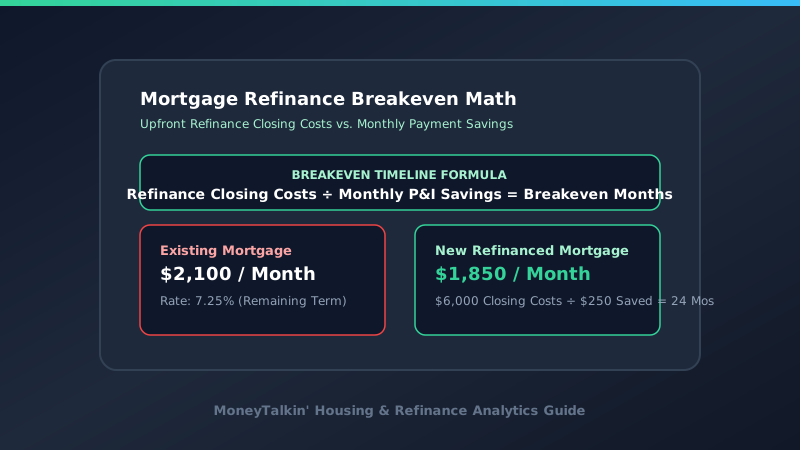
To evaluate whether a rate-and-term refinance makes economic sense, calculate your breakeven period—the months required for monthly payment savings to offset closing costs.
The Breakeven Formula
$$\text{Breakeven Period (Months)} = \frac{\text{Total Refinance Closing Costs}}{\text{Monthly Payment Savings (P&I)}}$$
$$\text{Breakeven Period (Years)} = \frac{\text{Breakeven Period (Months)}}{12}$$
Hypothetical Calculation Example
Consider a homeowner refinancing a $350,000 mortgage balance:
- Current Mortgage (7.25% Interest Rate): Monthly P&I Payment = $2,388.00
- New Refinanced Mortgage (5.75% Interest Rate): Monthly P&I Payment = $2,042.00
- Monthly Savings: $$2,388.00 - $2,042.00 = \mathbf{$346.00 \text{ per month}}$
- Total Closing Costs: $6,228.00
Breakeven Calculation:
$$\text{Breakeven Months} = \frac{$6,228.00}{$346.00} = \mathbf{18 \text{ months}} \quad (1.5 \text{ years})$$
Interpretation
- Staying in the home longer than 18 months results in net financial savings.
- Selling or moving in less than 18 months creates a net financial loss, as monthly savings will not recover the $6,228 closing fee.
5. Monthly Payment vs. Lifetime Interest Trade-Offs
A key risk when refinancing is extending your repayment timeline. If you have paid 10 years on a 30-year loan (leaving 20 years remaining) and refinance into a new 30-year term, you reset the payoff clock.
The Extension Trap
Even with a lower interest rate, stretching 20 remaining years of payments back into 360 monthly installments can increase total lifetime interest paid.
Avoiding the Trap:
When refinancing mid-term, select a 15-year or 20-year term, or voluntarily make extra principal payments on a 30-year loan to maintain your original payoff schedule.
6. Underwriting Requirements for Refinancing requires satisfying standard mortgage underwriting standards:
- Sufficient Equity: Rate-and-term refinances require 3%–5% equity; cash-out refinances generally require at least 20% equity (80% LTV).
- Credit Score Thresholds: Lenders typically require a minimum 620 credit score, with 740+ unlocking optimal rates.
- Debt-to-Income (DTI) Limits: Servicers verify total recurring monthly debt stays within DTI benchmarks (typically under 43%–45%).
- Income Verification: Submitting recent W-2s, pay stubs, and tax returns to verify earnings.
7. Practical Questions to Ask Before Refinancing
Evaluate these key checklist items before refinancing:
- What is your breakeven horizon? Divide total closing costs by monthly P&I savings.
- How long will you remain in the home? Ensure planned occupancy exceeds the breakeven point.
- Are you extending your loan term? Compare total remaining interest on your current loan against total interest on the new loan.
- How are closing costs structured? Confirm whether fees are paid out-of-pocket or added to principal.
- Will refinancing remove mortgage insurance? Confirm if the new loan eliminates monthly PMI fees.
Sources
- Consumer Financial Protection Bureau (CFPB): Mortgage Refinancing Guide and Tools https://www.consumerfinance.gov/owning-a-home/refinance/
- U.S. Department of Housing and Urban Development (HUD): Refinancing Your Mortgage Options https://www.hud.gov/
- Fannie Mae: Single Family Refinance Eligibility Guidelines https://singlefamily.fanniemae.com/
Educational Disclaimer
This guide is for educational purposes only and does not constitute financial, tax, or legal advice. Refinance rates, closing costs, underwriting criteria, and breakeven timelines vary by lender, loan product, and borrower creditworthiness. Consult a qualified mortgage professional regarding your loan.
MoneyTalkin' provides financial education, educational concepts, and general informational guides. Articles do not constitute personalized financial, investment, legal, or tax advice. Financial products, rates, terms, and regulatory rules change frequently; consult a qualified financial professional regarding your specific situation. Read our full Disclaimer Policy.
Written by MoneyTalkin'
MoneyTalkin' researches and publishes objective financial education content, money management fundamentals, and practical financial guides.
Related Technical Articles
Explore related topics in this cluster to deepen your understanding.