Inflation and Purchasing Power: How Rising Prices Affect Your Money
An educational guide explaining inflation, purchasing power erosion, Consumer Price Index (CPI) metrics, nominal vs real returns, and inflation hedging strategies.
Inflation and Purchasing Power: How Rising Prices Affect Your Money functions as a medium of exchange, unit of account, and store of value. However, the purchasing power of a dollar is not static. Due to inflation, the quantity of real goods and services a single dollar buys diminishes over time.
While mild, predictable inflation accompanies expanding economies, persistent inflation presents a subtle risk to long-term wealth. If cash savings or investment yields fail to outpace rising prices, your real purchasing power declines—even if your nominal account balance grows.
Understanding inflation mechanics, Consumer Price Index (CPI) metrics, nominal vs. real returns, and inflation impacts on wages, debt, and retirement helps households protect wealth alongside resources on the power of compound interest, calculating retirement savings goals, evaluating high-yield savings returns, and structuring a 50/30/20 budget framework.
1. What Is Inflation?
Inflation is the generalized, sustained rise in the average price level of goods and services across an economy over time.
When inflation occurs:
- A unit of currency buys fewer goods and services.
- Currency suffers a decline in purchasing power.
Inflation is distinct from a temporary price hike in a single commodity (such as seasonal gasoline spikes or localized supply disruptions). Economic inflation occurs when price increases spread broadly across energy, housing, food, transportation, medical care, and consumer services throughout the entire economy.
2. Measuring Inflation: The Consumer Price Index (CPI)
In the United States, the primary official benchmark for measuring consumer price inflation is the Consumer Price Index (CPI), compiled and published monthly by the U.S. Bureau of Labor Statistics (BLS).
How the CPI Is Calculated
- The Market Basket: The BLS tracks prices for a representative "market basket" of approximately 80,000 goods and services.
- Expenditure Groups: The basket spans eight primary categories: Food and Beverages, Housing, Apparel, Transportation, Medical Care, Recreation, Education and Communication, and Other Goods.
- Headline vs. Core CPI:
- Headline CPI: Measures price changes across the entire basket, including food and energy.
- Core CPI: Excludes volatile food and energy items to track underlying long-term inflation trends.
According to BLS economic reporting, historical U.S. consumer price inflation has averaged approximately 2.5% to 3.0% per year over multi-decade periods.
3. Purchasing Power: Nominal vs. Real Values
Evaluating inflation requires distinguishing between nominal values and real values:
- Nominal Value: Stated dollar amounts of wages, cash, or investment returns, unadjusted for inflation.
- Real Value: Actual purchasing power of money, adjusted for inflation.
Real Rate of Return Formula
To calculate real economic growth on investments or savings:
$$\text{Real Rate of Return} \approx \text{Nominal Interest Rate} - \text{Inflation Rate}$$
Fisher Equation:
$$\text{Real Rate of Return} = \frac{1 + \text{Nominal Rate}}{1 + \text{Inflation Rate}} - 1$$
4. Compounding Math of Purchasing Power Erosion
Because inflation compounds annually, even modest inflation significantly erodes purchasing power over time.
The Rule of 72 for Inflation
Estimate how many years it takes inflation to halve purchasing power:
$$\text{Years to Halve Purchasing Power} \approx \frac{72}{\text{Annual Inflation Rate}}$$
- At 3% annual inflation, purchasing power halves in 24 years ($72 \div 3$).
- At 6% annual inflation, purchasing power halves in 12 years ($72 \div 6$).
Hypothetical Compounding Example
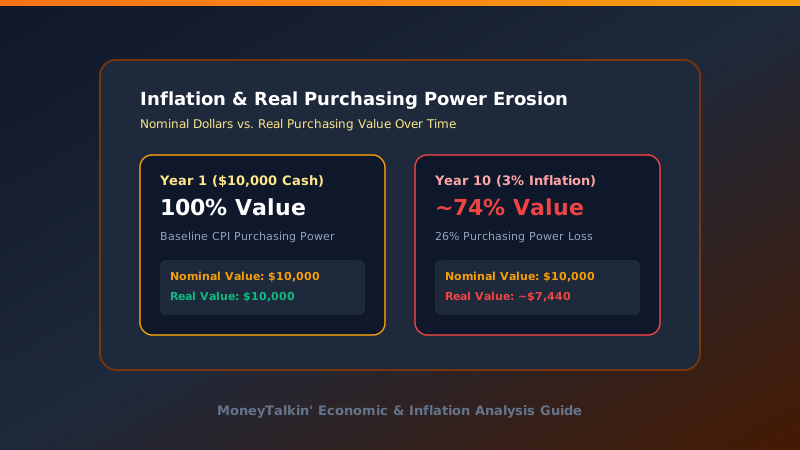
Consider $10,000 cash savings held over 10 years with a constant 3.0% annual inflation rate:
| Year | Stated Cash Balance | Purchasing Power Multiplier | Real Purchasing Value (Year 1 Dollars) | Cumulative Loss |
|---|---|---|---|---|
| Year 1 | $10,000 | 1.0000 | $10,000.00 | 0.0% |
| Year 3 | $10,000 | 0.9151 | $9,151.40 | -8.5% |
| Year 5 | $10,000 | 0.8626 | $8,626.10 | -13.7% |
| Year 10 | $10,000 | 0.7441 | $7,440.90 | -25.6% |
While nominal cash remains $10,000, 10 years of 3% inflation reduces real purchasing power to $7,440.90—a 25.6% real loss.
5. How Inflation Affects Household Finances
Inflation impacts different personal finance areas in distinct ways:
A. Cash Savings
Uninvested cash in low-yielding bank accounts (e.g., earning 0.01% APY) suffers negative real returns. If inflation is 3.5% and your account pays 0.01%, your real return is -3.49% per year.
B. Fixed Incomes and Retirees living on fixed, non-indexed pensions or annuities face eroding purchasing power as living costs rise. (U.S. Social Security provides partial protection via annual Cost-of-Living Adjustments, or COLAs, tied to CPI metrics).
C. Wages and Earned Income
If wage increases lag inflation (e.g., a 2.0% pay raise during 4.0% inflation), workers experience a drop in real wages (-2.0%), reducing standard of living despite a higher nominal paycheck.
D. Fixed-Rate Debt (Borrower Advantage)
While inflation hurts savers, it benefits holders of fixed-rate debt (like a 30-year fixed mortgage).
Because monthly mortgage payments remain fixed in nominal dollars (e.g., $1,500/month), borrowers repay debt using future dollars with diminished purchasing power, while nominal wages and property values generally rise.
6. Strategies to Protect Purchasing Power
Financial planners recommend allocating capital to assets that match or outpace inflation:
- High-Yield Savings & Short-Term Treasuries: Move excess cash into high-yield savings accounts or short-term U.S. Treasury bills to reduce real erosion.
- Equities & Stock Index Funds: Broad stock indexes (like S&P 500 funds) have delivered historical long-term returns (8%–10%) well above average inflation.
- Inflation-Indexed Securities (TIPS & I Bonds): U.S. Treasury Inflation-Protected Securities (TIPS) and Series I Savings Bonds adjust their principal value or interest rate directly in response to official Consumer Price Index metrics, providing a direct government-backed defense against rising consumer prices.
- Real Assets & Real Estate: Real estate historically hedges inflation, as property values and rental income rise alongside general price levels.
7. Summary Checklist for Inflation Planning
To protect your budget against purchasing power loss:
- Calculate Real Returns: Subtract CPI inflation from account APYs or portfolio yields.
- Limit Excess Cash: Maintain core emergency reserves in liquid accounts; invest long-term funds in growth assets.
- Seek Real Wage Growth: Negotiate pay increases that equal or exceed consumer price inflation.
- Lock In Fixed Liabilities: Utilize fixed-rate debt rather than variable rates during low-interest environments.
- Account for Inflation in Retirement: Factor a 2.5%–3.0% inflation rate into long-term retirement calculations.
Sources
- U.S. Bureau of Labor Statistics (BLS): Consumer Price Index (CPI) Overview & Historical Data https://www.bls.gov/cpi/
- Board of Governors of the Federal Reserve System: Monetary Policy and Inflation Framework https://www.federalreserve.gov/monetarypolicy.htm
- Federal Reserve Bank of St. Louis (FRED): Economic Data: Consumer Price Index for All Urban Consumers https://fred.stlouisfed.org/
Educational Disclaimer
This article is for educational purposes only and does not constitute economic forecasting, tax, or investment advice. Inflation metrics, CPI adjustments, and asset returns fluctuate across economic cycles. Consult a qualified financial advisor regarding personal financial planning.
To understand how rate policy impacts digital assets, read Bitcoin and Interest Rates.
To examine precious metals as an inflation hedge, see Gold and Inflation Explained.
MoneyTalkin' provides financial education, educational concepts, and general informational guides. Articles do not constitute personalized financial, investment, legal, or tax advice. Financial products, rates, terms, and regulatory rules change frequently; consult a qualified financial professional regarding your specific situation. Read our full Disclaimer Policy.
Written by MoneyTalkin'
MoneyTalkin' researches and publishes objective financial education content, money management fundamentals, and practical financial guides.
Related Technical Articles
Explore related topics in this cluster to deepen your understanding.