Why Credit Card Debt Gets More Expensive When Interest Rates Rise
When interest rates rise, revolving credit card debt becomes significantly more expensive. Here is how variable APRs, prime rates, and compounding work.
Why Credit Card Debt Gets More Expensive When Interest Rates Rise
Revolving credit card debt is among the most sensitive consumer liabilities to central bank monetary policy shifts. When benchmark interest rates rise, credit card holders carrying monthly balances notice almost immediate increases in their annual percentage rates (APRs). Unlike fixed-rate mortgages or personal installment loans, credit card balances adjust automatically to market rate changes, compounding interest costs for households across the United States.
Data published by the Consumer Financial Protection Bureau (CFPB) and the Federal Reserve Board as of September 2026 indicate that average commercial credit card APRs hover near historical highs. Understanding the mechanism connecting central bank policy to consumer credit card interest charges is essential for managing personal cash flow and debt reduction.
1. The Prime Rate Connection: Why Credit Card APRs Change
The overwhelming majority of consumer credit cards feature variable APRs. A variable rate means the interest rate charged on unpaid statement balances is directly pegged to an underlying financial index.
Federal Reserve Target Rate Range Shift
                  │
                  ▼
Prime Rate Adjustments (Commercial Banks)
                  │
                  ▼
Variable Credit Card APR = Prime Rate + Margin
The Formula Behind Your Card's Interest Rate
Credit card agreements define variable APR using a simple additive formula:
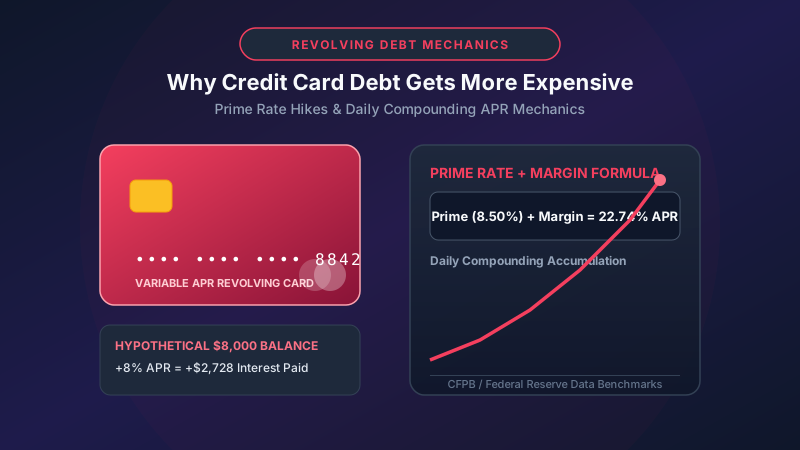
Variable Card APR = Current Prime Rate + Lender Margin
- The Prime Rate: The benchmark interest rate that commercial banks charge their most creditworthy corporate clients. In the United States, the Prime Rate is directly tied to the Federal Reserve's target federal funds rate (typically set 3.00 percentage points higher than the upper limit of the Fed funds target range).
- The Lender Margin: A fixed percentage added by the card issuer based on credit risk underwriting, card product features, and reward structures. For example, if the Prime Rate is 8.50% and your card agreement specifies a margin of 14.24%, your total variable APR is 22.74%.
When the Federal Reserve increases its target rate by 0.25 percentage points, the Prime Rate rises by 0.25 percentage points, and your variable credit card APR automatically increases by 0.25 percentage points—usually within one to two billing cycles.
Understanding the fundamental mechanics of interest disclosures, as covered in credit card APR explained, highlights why credit card borrowing costs far exceed standard loan rates.
2. Daily Compounding and Monthly Interest Calculations
Unlike simple interest loans, credit card interest compounds on a daily basis. Issuers calculate monthly finance charges using the Daily Periodic Rate (DPR).
Daily Periodic Rate (DPR) = Annual Percentage Rate (APR) / 365 Days
How Daily Compounding Works
- Each day, the card issuer applies the DPR to your average daily balance.
- The calculated interest charge is added to your account principal.
- On the following day, interest is calculated on the new, higher balance (principal plus previous interest).
If you maintain an unpaid revolving balance, daily compounding accelerates interest accumulation, making debt repayment progressively harder as APRs rise.
3. Hypothetical Calculation: Impact of Rate Hikes on Revolving Debt
To evaluate how interest rate increases affect consumer debt costs, consider a hypothetical cardholder carrying a revolving balance over a 12-month period without making new purchases.
- Revolving Credit Card Balance: $8,000
- Repayment Scenario: Cardholder pays a fixed monthly amount of $240.
(Note: Figures are calculated for illustrative purposes based on standard daily compounding formulas.)
| Rate Scenario | Variable APR (%) | Estimated Time to Pay Off | Total Interest Paid ($) | Total Out-of-Pocket Cost ($) |
|---|---|---|---|---|
| Baseline Rate | 16.50% | 43 months | $2,254 | $10,254 |
| Elevated Rate (+4.00%) | 20.50% | 48 months | $3,371 | $11,371 |
| High Rate (+8.00%) | 24.50% | 55 months | $4,982 | $12,982 |
In this hypothetical example, an 8 percentage point increase in APR adds $2,728 in additional interest charges and extends the repayment timeline by 12 full months for the exact same initial $8,000 balance.
4. Why Rising Credit Card Costs Erode Household Budgets
Elevated APRs create cascading financial pressures for credit-dependent households:
Higher Minimum Monthly Payments
Minimum monthly payment formulas used by credit card issuers typically require paying all accrued monthly interest plus a small percentage of principal (often 1% to 2%). As APRs rise, accrued monthly interest increases, driving up the mandatory minimum payment required simply to remain current on the account.
Deterioration of Credit Utilization Ratios
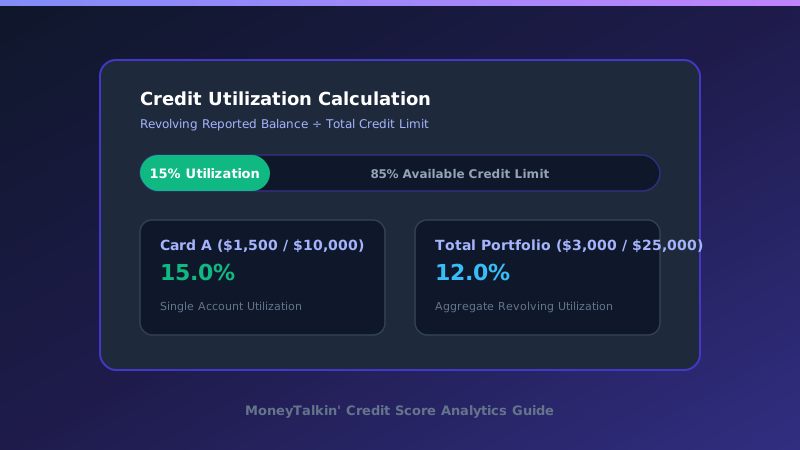
Carrying high revolving balances relative to maximum credit limits increases your credit utilization ratio. Credit utilization accounts for 30% of standard FICO credit scoring models. High utilization can lower credit scores, making it harder to qualify for low-cost refinancing options.
Escalating Delinquency Risk
When household wage growth fails to match rising living costs and elevated credit card debt service, cardholders face increased risk of missed payments. Severe late payments trigger late fees, penalty APRs (often approaching 29.99%), and negative marks on credit files. Managing your debt-to-income ratio is critical to preventing debt spiraling.
5. Promotional 0% APR Expiration Traps and Deferred Interest
Cardholders seeking relief from high variable rates frequently utilize promotional 0% APR offers. However, borrowers must distinguish true 0% APR promotional offers from deferred interest promotions:
- True 0% APR Promotions: Offered primarily by major credit card issuers on balance transfers or purchases. If a balance remains when the promotional period ends, the standard variable APR applies only to the remaining balance.
- Deferred Interest Promotions: Often offered on store credit cards or financing programs. If the entire promotional balance is not paid off 100% by the expiration date, the issuer retroactively charges the full variable APR on the original purchase amount back to day one.
Carefully reading promotional terms on balance transfer credit cards explained prevents unexpected finance charge spikes.
6. Strategies to Mitigate High Credit Card Interest
Consumers facing elevated variable APRs can utilize several structured debt repayment strategies:
                  High-Interest Variable Credit Card Debt
                                    │
       ┌────────────────────────────┼────────────────────────────┐
       ▼                            ▼                            ▼
0% Balance Transfer Card    Personal Installment Loan     Debt Avalanche Method
(Temporary Rate Freeze)    (Fixed Rate & Term)          (Target Highest APR First)
- 0% Balance Transfer Credit Cards: Qualified borrowers can transfer existing balances to a promotional card offering 0% APR for an introductory period (e.g., 12 to 21 months). While a balance transfer fee (typically 3% to 5%) applies upfront, freezing interest allows 100% of payments to reduce principal balance.
- Personal Installment Loans: Consolidating credit card debt with a fixed-rate personal loan replaces variable daily compounding interest with a structured monthly payment and fixed payoff date. Compare product differences in our guide on personal loans vs credit cards.
- Debt Avalanche Repayment Method: Prioritize paying maximum available funds toward the credit card with the highest APR while maintaining minimum payments on remaining accounts, minimizing total cumulative interest expense.
- Hardship & Workout Programs: Cardholders facing financial distress can contact issuers directly to inquire about internal hardship programs, which may temporarily reduce interest rates or waive fees.
Summary Principles
- Variable APRs Rise Automatically: Credit card interest rates move in direct alignment with central bank benchmark changes via the Prime Rate.
- Daily Compounding Accelerates Interest: Revolving balances incur daily interest charges, amplifying the financial damage of rate increases.
- Pay Beyond Minimums: Minimum payments cover primarily interest; paying principal aggressively is the only way to escape high-interest debt cycles.
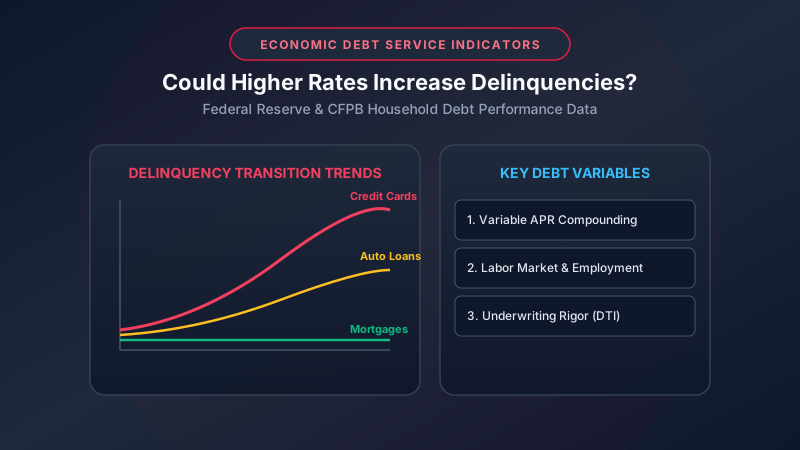
To see macro data on consumer defaults, see Could Higher Interest Rates Increase Delinquencies?.
MoneyTalkin' provides financial education, educational concepts, and general informational guides. Articles do not constitute personalized financial, investment, legal, or tax advice. Financial products, rates, terms, and regulatory rules change frequently; consult a qualified financial professional regarding your specific situation. Read our full Disclaimer Policy.
Written by MoneyTalkin'
MoneyTalkin' researches and publishes objective financial education content, money management fundamentals, and practical financial guides.