Credit Utilization Ratio Explained: How It Can Affect Your Credit Score
A comprehensive guide explaining revolving credit utilization, statement closing dates, scoring model impacts, and strategies to manage reported credit balances.
Credit Utilization Ratio Explained: How It Can Affect Your Credit Score
When financial institutions evaluate your creditworthiness, your credit score serves as a primary risk benchmark. Behind payment history, the single most influential factor shaping your credit score is your credit utilization ratio (accounting for approximately 30% of a FICO Score evaluation).
Despite its importance, credit utilization is frequently misunderstood. Misconceptions—such as the myth that carrying a monthly balance is necessary to build credit, or that a strict 30% rule applies universally across all scoring models—can lead consumers to pay unnecessary interest or make suboptimal payment decisions.
Understanding how credit utilization is calculated, how statement closing dates determine reported balances, how individual vs. aggregate utilization metrics operate, and how utilization differs from your debt-to-income (DTI) ratio is essential for managing credit health alongside guides like how credit scores work and building credit from scratch.
1. What Is the Credit Utilization Ratio?
Your credit utilization ratio measures the percentage of your available revolving credit lines currently in use.
Unlike installment loans (such as mortgages, auto loans, or student loans) that feature fixed principal balances and structured payoff schedules, revolving credit accounts (credit cards and HELOCs) allow you to borrow, repay, and re-borrow up to a designated credit limit.
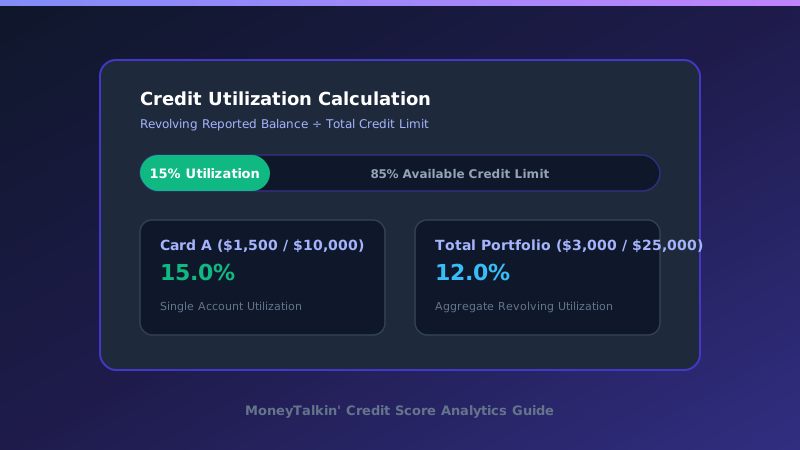
The basic credit utilization formula is:
$$\text{Credit Utilization Ratio} = \left( \frac{\text{Total Reported Revolving Balances}}{\text{Total Revolving Credit Limits}} \right) \times 100%$$
Because utilization measures reliance on revolving debt, higher utilization signals elevated risk to scoring models, whereas lower utilization demonstrates conservative credit management.
2. Individual Card Utilization vs. Overall (Aggregate) Utilization
Credit scoring algorithms (FICO and VantageScore) evaluate utilization on two levels:
A. Aggregate (Overall) Utilization
Aggregate utilization measures total combined credit card balances divided by total combined credit limits across all revolving accounts.
B. Individual Card Utilization
Individual utilization measures the balance-to-limit ratio on each single credit card account individually.
Hypothetical Calculation Example
Consider a cardholder with three revolving credit cards:
| Account Name | Reported Balance | Credit Limit | Individual Utilization |
|---|---|---|---|
| Card 1 (Rewards) | $1,800 | $2,000 | 90.0% (High Risk) |
| Card 2 (Store Card) | $200 | $3,000 | 6.7% (Low Risk) |
| Card 3 (Travel Card) | $0 | $15,000 | 0.0% (Zero Utilization) |
| TOTAL PORTFOLIO | $2,000 | $20,000 | 10.0% (Aggregate Ratio) |
In this example, aggregate utilization is a healthy 10.0% ($2,000 ÷ $20,000). However, Card 1 has an individual utilization of 90.0%.
Having a single card maxed out can trigger a negative score adjustment even if overall portfolio utilization is low. Maintaining low ratios on both individual cards and aggregate lines yields optimal results.
3. Statement Closing Dates vs. Payment Due Dates
A major point of confusion is when credit card balances are reported to bureaus.
Most card issuers report account data to Equifax, Experian, and TransUnion once a month on your statement closing date—not your payment due date.
[Cycle Starts] ➔ [Purchases Made] ➔ [Statement Closes & Balance Reported] ➔ [Due Date 21+ Days Later]
Managing Reported Balances
If your statement closes with a $1,500 balance on a $2,000 limit, a 75% utilization ratio is reported to credit bureaus—even if you pay that $1,500 balance in 100% full before the due date to avoid interest.
To display ultra-low reported utilization before major loan applications, make mid-cycle payments 2 to 3 days before your statement closing date to reduce ending statement balances.
4. Debunking Credit Utilization Myths
Myth 1: "You Must Carry a Monthly Balance to Build Credit"
FALSE. Carrying an unpaid balance from month to month does not help your credit score; it only incurs interest.
Scoring models evaluate reported statement balances, not whether you carried debt over from previous months. You can build excellent credit while paying statement balances in full every month and paying $0 in interest.
Myth 2: "The 30% Rule Is a Universal Cap"
MISLEADING. While educators recommend keeping utilization below 30% as a general rule, there is no single threshold where scores suddenly drop.
In reality:
- Credit utilization operates on a continuous slope; lower is generally better.
- Consumers with top-tier credit scores (800+) typically maintain single-digit aggregate utilization (often 1% to 9%).
- 0% reported utilization across all accounts can result in a slightly lower score than 1% to 3% utilization, as algorithms interpret zero utilization across all accounts as an absence of recent activity.
5. Memory-Less Nature of Credit Utilization
In traditional scoring models (FICO 8 and FICO 9), utilization is memory-less.
Traditional models evaluate only the most recently reported balance data. If your score drops due to a temporary balance spike, it recovers once you pay down the balance and the issuer reports the lower balance during the next cycle.
(Note: Newer models like VantageScore 4.0 and FICO 10 T analyze 24 months of trended balance data).
6. Credit Utilization Ratio vs. Debt-to-Income (DTI) Ratio
| Dimension | Credit Utilization Ratio | Debt-to-Income (DTI) Ratio |
|---|---|---|
| Formula | Revolving Balances ÷ Revolving Credit Limits | Total Monthly Debt Payments ÷ Gross Monthly Income |
| Data Source | Credit bureau credit reports | Underwriting verification (paystubs, tax returns) |
| Primary Evaluation | Credit scoring algorithms (FICO/Vantage) | Loan underwriting manual review |
| Income Factor | Ignores income completely | Directly incorporates income |
A borrower with high income and a $1,800 balance on a $2,000 card has a 90% credit utilization ratio (damaging scores) despite having a low DTI ratio.
7. Practical Strategies to Optimize Your Utilization
- Pay Balances Prior to Statement Closing Date: Make mid-cycle payments to report low balances.
- Request Credit Limit Increases: Raising credit limits expands your denominator, lowering utilization if spending remains constant.
- Spread Spending Across Cards: Avoid maxing out a single card.
- Keep Unused Cards Open: Closing old cards removes their credit limit from your total aggregate limit.
- Consider Consolidation: Restructuring revolving card debt into an installment personal loan reduces revolving utilization to 0%.
8. Summary Checklist for Credit Utilization
- Identify Statement Closing Dates: Note the closing date (not just due date) for each card.
- Monitor Individual & Aggregate Ratios: Calculate utilization per card and for your total portfolio.
- Target Single-Digit Utilization: Maintain 1% to 9% utilization before major loan applications.
- Never Carry Balances for Scoring: Pay 100% of statement balances monthly to eliminate interest.
- Track Reported Limits: Verify credit limits on reports via AnnualCreditReport.com.
Sources
- Consumer Financial Protection Bureau (CFPB): Credit Utilization and Scores https://www.consumerfinance.gov/consumer-tools/credit-reports-and-scores/
- FICO Score Guidelines: Amounts Owed in FICO Scores https://www.myfico.com/credit-education/whats-in-your-score
- VantageScore Solutions: Credit Utilization Impact https://vantagescore.com/
Educational Disclaimer
This guide is for educational and informational purposes only and does not constitute formal financial, credit counseling, or legal advice. Credit scoring algorithms and issuer reporting schedules vary. Consult a qualified financial advisor regarding your specific situation.
MoneyTalkin' provides financial education, educational concepts, and general informational guides. Articles do not constitute personalized financial, investment, legal, or tax advice. Financial products, rates, terms, and regulatory rules change frequently; consult a qualified financial professional regarding your specific situation. Read our full Disclaimer Policy.
Written by MoneyTalkin'
MoneyTalkin' researches and publishes objective financial education content, money management fundamentals, and practical financial guides.