Balance Transfer Credit Cards Explained: Fees, 0% APR Offers, and Risks
A comprehensive guide to balance transfer credit cards, detailing promotional APR windows, transfer fees, repayment math, deferred interest risks, and credit score impacts.
Balance Transfer Credit Cards Explained: Fees, 0% APR Offers, and Risks
Carrying high-interest credit card debt makes repayment difficult, as a substantial portion of each monthly payment goes toward compounding finance charges rather than principal.
To help consumers reduce interest costs and accelerate debt payoff, credit card issuers offer balance transfer credit cards. By transferring existing debt to an account offering a temporary 0% introductory Annual Percentage Rate (APR), borrowers can direct 100% of their payments toward principal reduction during the promotional window.
However, balance transfers are not free money. Evaluating transfer fees, understanding post-promotional rates, distinguishing 0% intro APRs from retail deferred interest agreements, and analyzing impacts on your credit utilization ratio are essential alongside guides like credit card APRs explained and debt consolidation options.
1. What Is a Balance Transfer?
A balance transfer moves an existing debt balance from one creditor to a new credit card account offering a lower interest rate or promotional 0% APR.
When you execute a transfer:
- The new issuer pays off your specified debt directly to your old creditor.
- The transferred balance is added to your new card account.
- The balance incurs 0% interest during the promotional intro period.
- An upfront balance transfer fee is added to your new balance upon transfer.
2. Key Terms in Balance Transfer Offers
- Promotional 0% APR Window: The specific number of months (typically 12 to 21 months, depending on issuer offers and credit profiles) during which no interest accrues on the transferred balance.
- Balance Transfer Fee: An upfront fee charged by the receiving card issuer to process the transfer. This fee is typically structured as 3% to 5% of the transferred amount (often with a $5 or $10 minimum fee).
- Post-Promotional Standard APR: The regular purchase or balance transfer APR that automatically applies to any remaining unpaid balance once the promotional 0% window expires.
- Transfer Deadline: Requirements to request transfers within a specific timeframe after account opening (such as within the first 60 to 90 days) to qualify for 0% introductory rates.
- Balance Transfer Credit Limit: The maximum dollar amount you are permitted to transfer. Issuers generally cap transfers below your total approved credit line, taking into account the upfront transfer fee.
Understanding these parameters allows borrowers to structure a realistic monthly repayment schedule designed to eliminate the debt completely before the promotional window ends and standard APRs apply.
3. 0% Introductory APR vs. Deferred Interest
A critical distinction under Consumer Financial Protection Bureau (CFPB) guidelines is separating true 0% Introductory APR from Deferred Interest:
[0% Intro APR] ➔ Promo Ends ➔ Pay Standard APR only on REMAINING balance
[Deferred Interest] ➔ Promo Ends ➔ Pay Retroactive Interest on ORIGINAL balance from Day 1
A. True 0% Introductory APR (Standard Major Cards)
Offered by major banks. If a balance remains when the 0% window ends, standard purchase APR applies only to the remaining balance going forward. You do not owe retroactive interest on paid-off principal.
B. Deferred Interest Promotions (Store Retail Cards)
Commonly offered by store credit cards. Interest accrues behind the scenes at a high rate (e.g., 29.99%). If you pay off 100% before the promo ends, interest is waived. However, if even $1 remains unpaid at expiration, the issuer retroactively charges full interest on the entire original purchase amount from day one.
4. How to Calculate Net Balance Transfer Savings (Hypothetical Example)
To determine whether a transfer saves money, compare the upfront balance transfer fee against the total interest you would pay on your current card.
Hypothetical Scenario Parameters
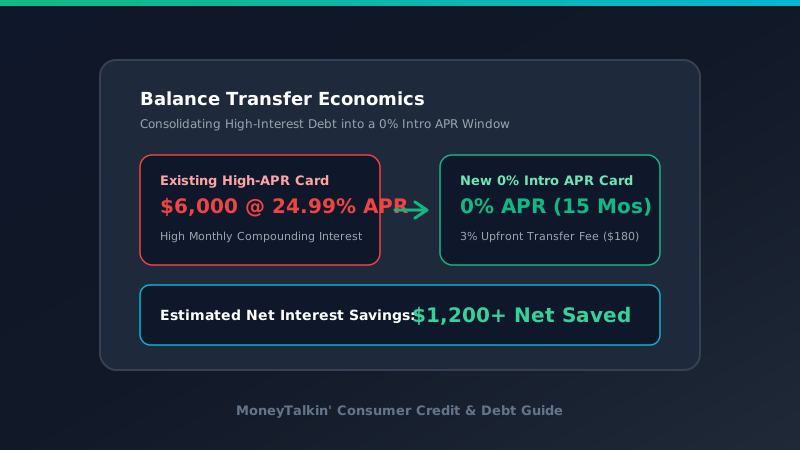
- Existing Debt Balance: $6,000
- Current Credit Card APR: 24.99%
- Target Payoff Horizon: 15 months
- New Balance Transfer Offer: 0% Intro APR for 15 months with a 3% balance transfer fee
Option A: Keeping Debt on the Current 24.99% Card
- Required monthly payment: approx. $470/month
- Total payments over 15 months: $7,050
- Total interest cost: $1,050
Option B: Executing the 0% Balance Transfer
- 3% Transfer Fee: $$6,000 \times 0.03 = \mathbf{$180}$
- New Starting Balance: $$6,000 + $180 = \mathbf{$6,180}$
- Required Monthly Payment (0% Interest for 15 Months): $$\text{Monthly Payment} = \frac{$6,180}{15} = \mathbf{$412 \text{ per month}}$$
- Total payments over 15 months: $6,180
- Total interest cost: $0
Net Savings Comparison
- Option A Interest Cost: $1,050
- Option B Fee Cost: $180
- Net Financial Savings: $$1,050 - $180 = \mathbf{$870 \text{ Net Savings}}$
5. Potential Risks and Pitfalls of Balance Transfers
- New Purchases on the Transfer Card: Adding new purchases can complicate payments. Under the CARD Act, payments above minimums apply to highest-APR balances first, but carrying purchase balances can forfeit your interest-free grace period on new transactions.
- Missing a Due Date: Late minimum payments can void promotional 0% rates, triggering immediate resets to standard or penalty APRs.
- Failing to Pay Off Balance Before Expiration: Standard rates (21.99% to 29.99%) resume on remaining principal after expiration.
- Re-accumulating Debt on the Old Card: Paying off an old card and then spending on it again doubles your total debt load.
6. How Balance Transfers Affect Your Credit Score
- Hard Credit Inquiry: Applying for a new card triggers a hard inquiry, temporarily lowering scores by a few points.
- New Account Age: Opening a new account lowers your average account age.
- Lower Credit Utilization: Adding a new credit line increases total aggregate credit limits. Keeping old cards open with zero balances lowers your aggregate credit utilization ratio, benefiting scores over time.
7. Step-by-Step Balance Transfer Action Plan
- Calculate Total Debt & Payoff Timeline: Determine exact balances and realistic monthly payment capacity.
- Compare 0% Offers & Fees: Review promo lengths (12 to 21 months) and transfer fees (3% vs. 5%).
- Submit Transfer Request: Provide old account numbers and transfer amounts during application.
- Pay Old Card Until Confirmed: Maintain minimum payments on old cards until transfers post and balances show $0.
- Set Up Auto-Pay: Divide new starting balance by promo months to ensure 100% payoff before expiration.
- Keep Old Accounts Open: Avoid closing old accounts unless they charge high annual fees, preserving credit history length.
Sources
- Consumer Financial Protection Bureau (CFPB): Credit Card Balance Transfers https://www.consumerfinance.gov/consumer-tools/credit-cards/
- Federal Reserve Board: CARD Act Rules & Disclosures https://www.federalreserve.gov/
- Federal Trade Commission (FTC): Managing Credit Card Debt https://consumer.ftc.gov/
Educational Disclaimer
This guide is for educational and informational purposes only and does not constitute formal financial, credit counseling, or legal advice. Balance transfer terms, promotional periods, fee structures, and credit approval guidelines vary by card issuer. Consult a qualified financial counselor regarding debt management decisions.
MoneyTalkin' provides financial education, educational concepts, and general informational guides. Articles do not constitute personalized financial, investment, legal, or tax advice. Financial products, rates, terms, and regulatory rules change frequently; consult a qualified financial professional regarding your specific situation. Read our full Disclaimer Policy.
Written by MoneyTalkin'
MoneyTalkin' researches and publishes objective financial education content, money management fundamentals, and practical financial guides.