Could Higher Interest Rates Increase Consumer Delinquencies? What the Data Shows
When interest rates rise, household debt servicing costs increase. Explore economic data on credit card, auto loan, and mortgage delinquency trends.
Could Higher Interest Rates Increase Consumer Delinquencies? What the Data Shows
When the Federal Reserve implements monetary tightening cycles to curb inflation, borrowing costs across consumer financial products rise. As interest rates remain elevated over extended periods, economists, financial institutions, and policy makers closely monitor consumer delinquency rates—the percentage of loan balances with past-due payments—to evaluate household financial health and broader economic stability.
According to household debt and credit reports published by the Federal Reserve Bank of New York and the Consumer Financial Protection Bureau (CFPB) as of September 2026, delinquency transition rates vary significantly across debt categories, age demographics, and income tiers. Examining empirical economic data clarifies how higher borrowing costs affect consumer credit performance, while highlighting why interest rates alone do not dictate default trends.
1. What Is a Consumer Delinquency?
In consumer credit reporting, an account is classified as delinquent when a borrower fails to make the contractually required minimum payment by the specified due date.
Payment Due Date Missed ──► 30 Days Past Due (Early Stage) ──► 60 Days Past Due ──► 90+ Days Past Due (Serious Delinquency) ──► Charge-Off / Default
- Early-Stage Delinquency (30–50 Days Past Due): Often reflects temporary cash flow timing issues, minor oversights, or emerging household financial strain.
- Serious Delinquency (90+ Days Past Due): Represents severe financial distress. Accounts at this stage face potential default, collection actions, vehicle repossession, or mortgage foreclosure.
When creditors report 30-day or 90-day late payments to major credit bureaus, credit scores drop significantly, making future credit access harder and more costly. Review details on credit reporting mechanics in our guide to credit report errors disputes explained.
2. The Transmission Mechanism: How Rates Pressure Debt Service
Elevated benchmark interest rates affect household delinquency risks through distinct financial channels depending on debt structure:
                  Monetary Tightening & Elevated Benchmark Rates
                                         │
        ┌────────────────────────────────┴────────────────────────────────┐
        ▼                                                                 ▼
Variable Debt (Credit Cards, HELOCs)                             Fixed Debt (Mortgages, Auto)
Immediate Increase in Monthly APR & Minimum Payments            New Borrowers Face Higher Debt Service
        │                                                                 │
        └────────────────────────────────┬────────────────────────────────┘
                                         ▼
                 Increased Total Household Debt Service Burden
                                         │
                                         ▼
            Potential Strain on Lower-Income / Low-Liquidity Households
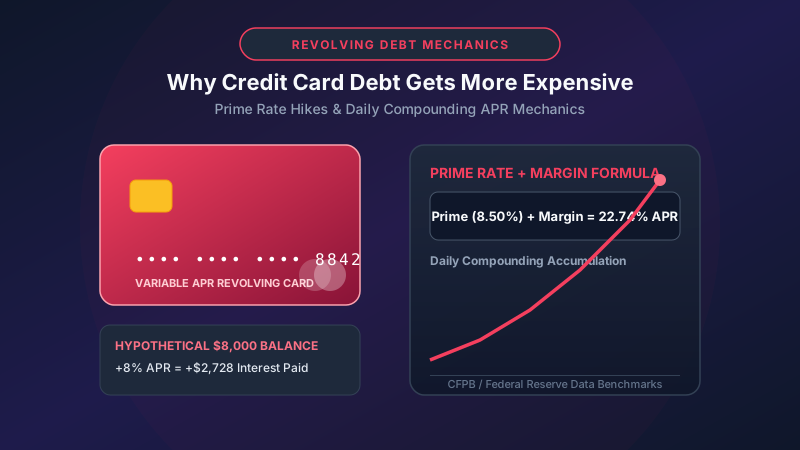
- Variable-Rate Credit Debt: Credit card APRs adjust automatically when central bank rates rise. Because minimum payments rise alongside APRs, households carrying revolving balances must allocate a larger share of monthly income purely to pay interest charges. Learn how APR adjustments operate in why credit card debt gets more expensive.
- New Fixed-Rate Borrowing: While existing fixed-rate mortgage holders are insulated from rate hikes, consumers purchasing homes or buying automobiles under high interest rates incur substantially higher monthly fixed debt service payments than previous vintage borrowers.
- Cumulative Debt Service Ratio: The Federal Reserve tracks the Debt Service Ratio (DSR)—the proportion of aggregate household disposable income obligated to mandatory debt payments. As DSR rises, household financial cushions contract.
3. Delinquency Trends Across Specific Loan Categories
Empirical credit data demonstrates that elevated interest rates do not affect all debt products uniformly.
| Debt Category | Interest Rate Structure | Relative Delinquency Sensitivity | Key Structural Drivers |
|---|---|---|---|
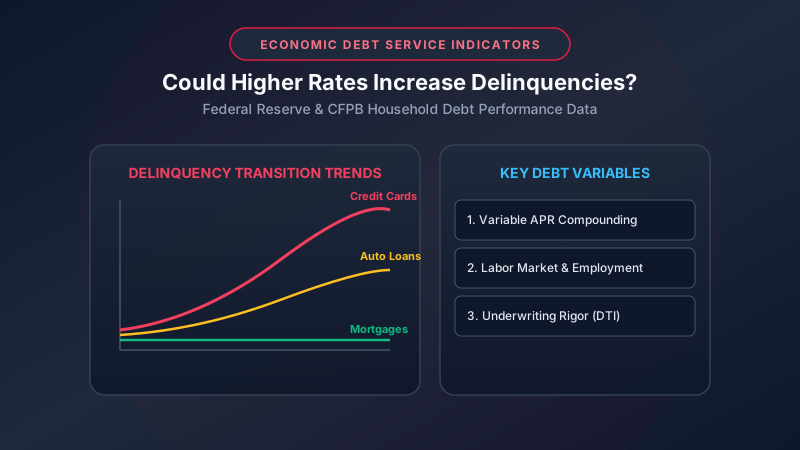
| Credit Cards | Variable (Adjusts automatically) | High | High APR compounding, inflation on everyday necessities |
| Auto Loans | Fixed (at origination) | Moderate-High | Vehicle price inflation, extended loan terms (72-84 mos) |
| Residential Mortgages | Primarily Fixed (30-Year) | Low | Strict underwriting (DTI caps), substantial home equity |
| Student Loans | Fixed & Income-Driven | Variable | Federal policy flexibilities & payment repayment plans |
Credit Card Delinquency Dynamics
Credit cards typically show the earliest rise in delinquency during tightening cycles. Younger borrowers (ages 18 to 29) and lower-income households holding revolving balances exhibit higher transition rates into 30-day and 90-day delinquencies when living expenses and interest costs rise simultaneously.
Auto Loan Distress Signals
Auto loan delinquencies have attracted increased scrutiny from credit rating agencies. Consumers who purchased vehicles at peak prices with extended loan terms face high monthly installment payments. When combined with vehicle depreciation, some borrowers face negative equity, increasing default risk if employment disruptions occur.
Student Loan Context
Following the resumption of federal student loan payments after pandemic-era pauses, household budgets faced an additional monthly debt obligation. For households managing combined credit card debt, auto loans, and student loans, total monthly debt servicing capacity was constrained.
4. Multi-Variable Economic Context: Why Rates Are Not the Sole Driver
A critical finding in economic literature is that elevated interest rates do not automatically cause widespread default crises on their own. Delinquencies are governed by an interplay of macroeconomic variables:
Delinquency Risk = Interest Rate Levels + Household Employment Status + Real Wage Growth + Debt Underwriting Rigor
- Employment & Labor Market Stability: Unemployment is the strongest historical predictor of consumer default. As long as labor markets remain robust and unemployment remains low, most households maintain the income necessary to service debt obligations, even at higher interest rates.
- Real Wage Growth: If wage growth matches or exceeds inflation and interest costs, real household debt-servicing capacity remains stable.
- Underwriting Standards: Post-2008 regulatory frameworks (such as the Dodd-Frank Act Ability-to-Repay rule) required mortgage lenders to verify borrower income and enforce strict debt-to-income ratio limits, preventing systemic predatory lending vulnerabilities.
5. Protective Actions for Strained Households
Consumers managing elevated debt service during high-rate periods can take proactive steps to protect credit standing:
- Prioritize High-Interest Balances: Direct available cash flow aggressively toward revolving credit cards using structured payoff methods.
- Engage Lenders Prior to Default: Contact loan servicers immediately if a payment will be missed. Lenders frequently offer temporary hardship forbearance, loan modification, or revised repayment plans to avoid formal credit reporting defaults.
- Maintain Emergency Cash Reserves: Preserving liquid cash buffers in high-yielding accounts insulates households from income shocks. Review optimal reserve structures in emergency fund amount explained.
6. Emerging Credit Risks: Buy Now Pay Later (BNPL) & Student Loan Repayments
In addition to traditional credit card and auto loan metrics, credit reporting agencies track emerging sources of household debt strain:
- Student Loan Repayment Pressures: The resumption of federal student loan obligations added a recurring monthly debt service expense for millions of households. For families managing existing credit card debt, student loan payments reduce discretionary cash flow buffers.
- Buy Now Pay Later (BNPL) Accumulation: Point-of-sale installment products (BNPL) permit consumers to split retail purchases into bi-weekly payments. Because BNPL loans are not always fully integrated into traditional credit bureau reporting, some households accumulate hidden debt service obligations that exacerbate credit card delinquency risks.
Monitoring total debt service across all liability channels prevents unexpected credit score damage.
7. Historical Comparisons: 2008 Financial Crisis vs. Current Cycle
To evaluate current delinquency data accurately, economists compare recent metrics against historical stress periods, particularly the 2008 Global Financial Crisis:
- 2008 Crisis Characteristics: Systemic mortgage defaults were driven by subprime lending, exotic adjustable-rate mortgages (Option ARMs), zero-down payment underwriting, and negative equity traps when real estate prices collapsed.
- Current Economic Cycle: Residential mortgage delinquencies remain near multi-decade lows due to strict underwriting rules, low fixed-rate locks, and solid home equity. Current financial strain is concentrated in revolving credit cards and auto loans among lower-income or liquidity-constrained households.
Understanding these structural differences explains why elevated interest rates have not triggered a broad mortgage default crisis comparable to 2008.
Summary Principles
- Vulnerabilities Vary by Product: Credit card and auto loan balances show higher delinquency sensitivity to rate hikes than fixed-rate residential mortgages.
- Labor Market Primacy: Employment levels remain the primary determinant of overall debt performance across national economies.
- Empirical Data Matters: Distinguish verified Federal Reserve and CFPB data reports from speculative commentary regarding consumer credit distress.
MoneyTalkin' provides financial education, educational concepts, and general informational guides. Articles do not constitute personalized financial, investment, legal, or tax advice. Financial products, rates, terms, and regulatory rules change frequently; consult a qualified financial professional regarding your specific situation. Read our full Disclaimer Policy.
Written by MoneyTalkin'
MoneyTalkin' researches and publishes objective financial education content, money management fundamentals, and practical financial guides.
Related Technical Articles
Explore related topics in this cluster to deepen your understanding.