Why CD Rates Are Moving Again: What Deposit Savers Should Understand
Certificate of Deposit yields move alongside broader interest-rate shifts. Here is what deposit savers should understand about CD pricing, ladders, and risks.
Why CD Rates Are Moving Again: What Deposit Savers Should Understand
Certificates of Deposit (CDs) represent one of the most familiar fixed-income deposit products available to retail banking clients in the United States. When interest rate environments shift—driven by Federal Reserve policy adjustments, banking sector liquidity demands, and broader macroeconomic conditions—CD yields across short- and long-term maturities move in response.
According to national deposit rate benchmarks published by the Federal Deposit Insurance Corporation (FDIC) as of September 2026, advertised CD yields vary substantially across online banks, traditional branch networks, and credit unions. For cash savers, navigating changing CD rates requires understanding how fixed yields function, how early withdrawal penalties operate, and how strategy frameworks like CD laddering protect capital.
1. What Is a Certificate of Deposit?
A Certificate of Deposit is a time-deposit agreement between an individual saver and an insured financial institution. In exchange for agreeing to leave a specified amount of money on deposit for a predetermined period (the "term" or "maturity"), the institution pays a fixed rate of interest, expressed as an Annual Percentage Yield (APY).
CD terms typically range from short-duration options (3 months, 6 months, 12 months) to multi-year maturities (2 years, 3 years, 5 years).
Fixed Yield Protection
Unlike variable-rate deposit vehicles—such as liquid savings accounts—a standard fixed-rate CD locks in your APY for the full duration of the term. Even if market interest rates fall sharply while your CD is active, the issuing bank is legally obligated to pay the contracted rate until maturity. Conversely, if market interest rates rise during your term, your funds remain locked at the lower agreed rate.
Understanding the mathematical distinction between nominal rate and compounding yield, as outlined in our guide on APY vs. interest rate explained, is essential when evaluating advertised CD offers.
2. Why CD Rates Move: Fed Policy and Bank Liquidity
CD interest rates do not move in isolation. They are governed by two primary economic drivers: Federal Reserve monetary policy and bank funding requirements.
Fed Funds Target Range & Treasury Benchmark Yields
                      │
                      ▼
        Bank Liquidity & Funding Needs
                      │
                      ▼
     Advertised CD APYs Across Terms (Short vs. Long)
- Federal Reserve Policy: When the Fed raises or lowers its target federal funds range, wholesale borrowing costs across the banking system shift. Commercial banks adjust deposit rates to maintain competitive capital structures.
- Bank Liquidity Competition: Online banks and credit unions frequently raise CD yields above national averages when they seek to attract new core deposits to fund loan growth. Conversely, institutions with excess cash reserves may lower yields even if central bank rates remain steady.
- Yield Curve Shape: In a standard upward-sloping yield curve, longer-term CDs (e.g., 5-year) offer higher APYs than short-term CDs to compensate savers for locking up liquidity. However, during periods of yield curve inversion—often occurring during central bank tightening cycles—short-term CDs (6 to 12 months) may yield significantly more than 5-year CDs.
3. Key CD Features and Structural Terms
When selecting a CD, savers must look beyond the advertised APY and evaluate specific contractual terms:
| CD Characteristic | Key Considerations | Impact on Saver |
|---|---|---|
| Maturity Term | Duration ranging from 3 months to 5+ years | Dictates liquidity lock-up period |
| Early Withdrawal Penalty | Forfeiture of a set number of months' interest | Reduces returns if redeemed early |
| Compounding Frequency | Daily, monthly, or quarterly compounding | Determines effective APY yield |
| Callable CDs | Issuer option to redeem CD before maturity | Exposes saver to reinvestment risk |
| Brokered CDs | CDs bought through brokerage accounts | Tradable on secondary market before maturity |
Early Withdrawal Penalties (EWPs)
If a saver needs to withdraw principal before the CD maturity date, banks assess an early withdrawal penalty. This fee typically forfeits a specified portion of accrued interest:
- Short-Term CDs (e.g., 12 months): Penalty often equals 3 months of simple interest.
- Long-Term CDs (e.g., 5 years): Penalty may equal 6 to 12 months of interest.
In severe cases where a CD is broken shortly after opening, early withdrawal penalties can consume accrued interest and slightly erode original principal.
Callable CDs vs. Standard Fixed CDs
Callable CDs—frequently sold through investment brokers—give the issuing institution the right to terminate the CD early if interest rates decline. If rates drop, the bank calls the CD and returns your principal, leaving you to reinvest at current, lower market rates (reinvestment risk). Standard bank CDs are non-callable.
4. CD Laddering: Managing Interest Rate & Liquidity Risk
Because committing funds to a single long-term CD exposes savers to liquidity risk, many depositors use a strategy known as a CD Ladder.
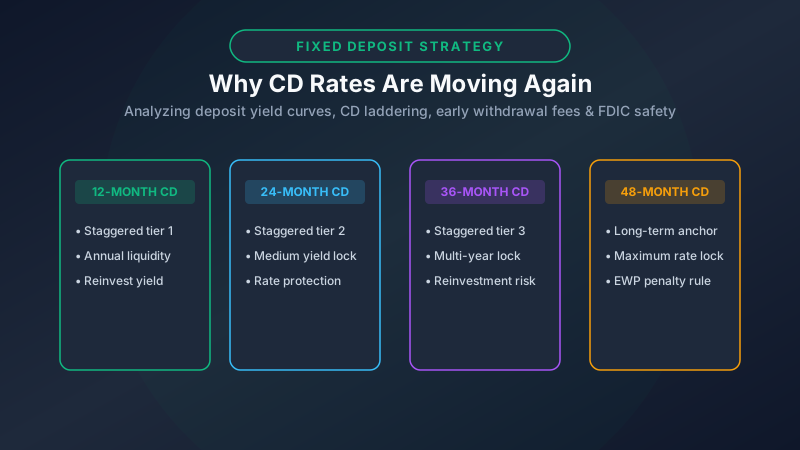
A CD ladder splits a total cash allocation across multiple CDs with staggered maturity dates.
Hypothetical Example: $20,000 4-Year CD Ladder
Instead of depositing $20,000 into a single 4-year CD, a saver divides capital into four equal $5,000 tranches across different maturities:
Year 1: [$5,000 - 1-Yr CD] ──► Matures ──► Reinvest into new 4-Yr CD
Year 2: [$5,000 - 2-Yr CD] ──► Matures ──► Reinvest into new 4-Yr CD
Year 3: [$5,000 - 3-Yr CD] ──► Matures ──► Reinvest into new 4-Yr CD
Year 4: [$5,000 - 4-Yr CD] ──► Matures ──► Reinvest into new 4-Yr CD
Benefits of CD Laddering
- Regular Liquidity: A portion of your total capital matures every 12 months, providing cash access without incurring early withdrawal penalties.
- Yield Optimization: Once established, every maturing tranche is rolled into a long-term CD (e.g., 4 years), capturing higher long-term yields while retaining annual liquidity.
- Interest Rate Flexibility: If market interest rates rise, maturing tranches can be reinvested at higher APYs. If rates fall, the existing locked-in CDs protect overall portfolio yield.
For more details on structuring deposit portfolios, read our complete breakdown on CD laddering explained.
5. CDs vs. Alternative Cash Products
Before locking capital into a Certificate of Deposit, savers should compare CDs against alternative low-risk cash holding vehicles:
- High-Yield Savings Accounts (HYSAs): Offer full liquidity with variable APYs that can fluctuate at any time. Learn more about high-yield savings accounts explained.
- Money Market Accounts (MMAs): Provide check-writing access or debit cards paired with variable yields. See money market accounts explained.
- Treasury Bills (T-Bills): Short-term debt obligations issued by the U.S. federal government. T-Bills are backed by the full faith and credit of the U.S. government and are exempt from state and local income taxes. Read our detailed comparison on bank CDs vs Treasury bills.
6. Federal Deposit Insurance: FDIC and NCUA
Standard CDs issued by participating banks are insured by the Federal Deposit Insurance Corporation (FDIC) up to $250,000 per depositor, per insured bank, for each account ownership category.
CDs purchased through credit unions receive equivalent federal protection through the National Credit Union Administration (NCUA) via the National Credit Union Share Insurance Fund (NCUSIF).
Savers holding large cash reserves across multiple institutions should confirm that deposits remain within statutory federal insurance coverage limits.
Key Takeaways for Savers
- Match CD Terms to Goals: Only deposit money into CDs if you are confident you will not need liquidity prior to maturity.
- Evaluate Early Withdrawal Terms: Read institution disclosures to understand penalty calculations before opening an account.
- Consider Tax Implications: CD interest is taxable as ordinary income in the year it is earned, even if the interest remains inside the CD until maturity.
MoneyTalkin' provides financial education, educational concepts, and general informational guides. Articles do not constitute personalized financial, investment, legal, or tax advice. Financial products, rates, terms, and regulatory rules change frequently; consult a qualified financial professional regarding your specific situation. Read our full Disclaimer Policy.
Written by MoneyTalkin'
MoneyTalkin' researches and publishes objective financial education content, money management fundamentals, and practical financial guides.
Related Technical Articles
Explore related topics in this cluster to deepen your understanding.