How AI and Digital Assets Could Change Financial Services
An educational exploration of how Artificial Intelligence and digital assets intersect across automated compliance, fraud detection, risk analytics, and smart contract rails.
How AI and Digital Assets Could Change Financial Services
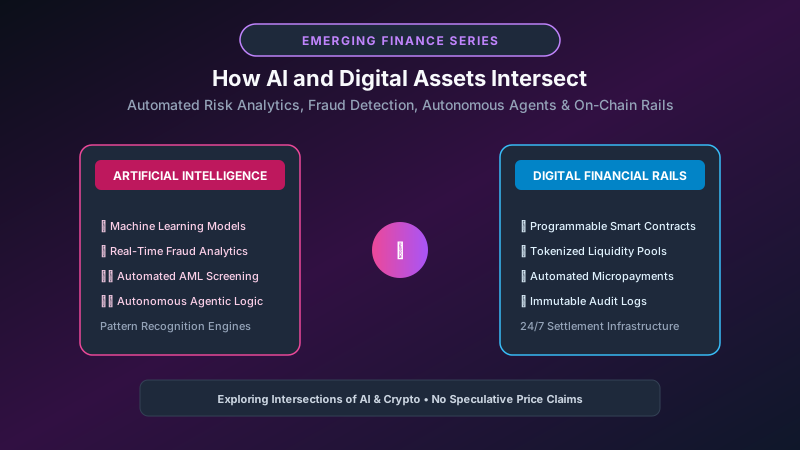
Two of the most transformative technology trends in modern finance are Artificial Intelligence (AI) and Digital Assets powered by what-is-blockchain. While AI excels at processing vast datasets, detecting patterns, and executing automated decisions, digital asset rails provide programmable, 24/7 global settlement infrastructure.
The intersection of these technologies creates new possibilities for financial services, ranging from automated fraud detection to autonomous transaction execution. This article explores how AI and digital assets converge across financial infrastructure while clearly distinguishing established applications from emerging possibilities.
1. Core Intersections of AI and Digital Assets
                       ┌── 1. Automated Fraud Detection & AML Analytics
                       │
AI + Digital Asset ────┼── 2. Smart Contract Audit & Code Verification
Intersections          │
                       ├── 3. Autonomous AI Agent Payment Rails (Micropayments)
                       │
                       └── 4. Predictive Risk Management & Portfolio Analytics
1. Automated Fraud Detection & On-Chain Analytics
Machine learning algorithms analyze public blockchain ledgers in real time. By identifying transaction anomalies, tracking stolen funds across complex wallet hops, and flagging addresses associated with illicit activity, AI enhances security across exchange platforms. Review protection strategies in common-cryptocurrency-scams.
2. Smart Contract Audit & Security Verification
Smart contracts execute automatically once deployed, making coding errors catastrophic. Financial developers use AI code analysis models to scan smart contract logic for security vulnerabilities, reentrancy bugs, and edge cases prior to deployment.
3. Autonomous AI Agent Payment Rails
As autonomous AI software agents manage tasks on behalf of users, they require seamless, programmatic payment rails. what-are-stablecoins and digital assets provide 24/7 API-accessible units of exchange that allow AI agents to pay for computing resources, data feeds, or services without human credit card inputs. Read more in autonomous-ai-agents-finance.
4. Tokenization & Market Infrastructure Analytics
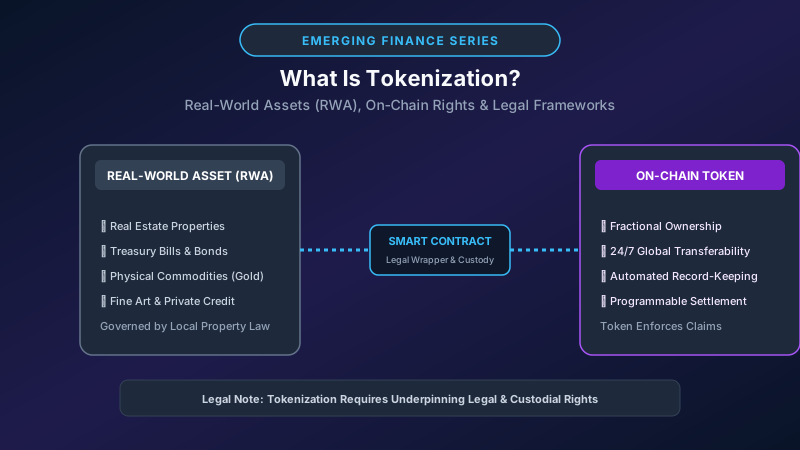
Combining machine learning risk models with tokenized real-world assets enables dynamic risk assessment for private credit portfolios and automated asset servicing. Learn how asset tokenization operates in what-is-tokenization.
2. Established Applications vs. Emerging Possibilities
Established Applications ────────────────────────► Emerging / Experimental Possibilities
  • AI Blockchain Fraud Screening (AML)           • Fully Autonomous AI Trading Agents
  • Automated Smart Contract Lashing Code          • Machine-to-Machine Micro-Economy Settlement
  • Algorithmic Market Making & Sentiment Tracking • Self-Governing AI Portfolio Rebalancing
| Domain | Current Production Implementation | Emerging / Experimental Use Cases |
|---|---|---|
| Compliance & AML | Real-time address risk scoring and transaction monitoring. | Automated regulatory reporting and cross-border compliance. |
| Trading & Liquidity | Institutional algorithmic market making and execution. | Autonomous multi-agent DEX arbitrage engines. |
| Payments | Credit card fraud detection and API banking gateways. | Machine-to-machine micropayments using stablecoin rails. |
| Securities | Quantitative portfolio risk analytics. | Smart contracts dynamically adjusting collateral ratios via AI. |
To understand how traditional automated advisory platforms compare with human advisors, explore ai-financial-advisors-vs-human-advisors.
3. Risks, Challenges, and Governance
The combination of autonomous AI decision-making and irreversible digital asset settlement introduces significant financial and technological risks:
- Algorithmic Hallucination & Trading Losses: AI models can misinterpret market signals, leading to rapid automated liquidations or execution errors.
- Security & Prompt Injection Risks: Malicious actors can target AI agent financial systems with prompt injection attacks to trigger unauthorized API transfers.
- No Price Guarantees: AI models cannot remove inherent market volatility or guarantee investment returns in speculative asset markets. See cryptocurrency-vs-traditional-investments.
4. Key Takeaways
- AI provides intelligent data analysis, whereas digital assets offer programmable 24/7 payment infrastructure.
- Current production uses center on real-time fraud screening, smart contract auditing, and algorithmic market liquidity.
- Emerging use cases include machine-to-machine micropayments and autonomous agentic workflows.
- AI cannot eliminate market risk or accurately predict crypto prices; human oversight remains essential.
5. Frequently Asked Questions
How does central bank rate policy impact AI and tech valuations?
Central bank interest rate decisions influence risk-on liquidity, affecting capital flows to both artificial intelligence and digital asset markets. Read our guide on bitcoin-interest-rates-explained.
Where can I learn more about how crypto transactions work?
For a step-by-step technical walkthrough of digital asset transfers, view how-cryptocurrency-transactions-work.
Educational Disclaimer
This article is provided for educational and informational purposes only. MoneyTalkin' does not provide investment, software engineering, or financial planning advice. MoneyTalkin' makes no price predictions or investment recommendations. AI and digital asset systems carry technical, operational, and financial risks.
MoneyTalkin' provides financial education, educational concepts, and general informational guides. Articles do not constitute personalized financial, investment, legal, or tax advice. Financial products, rates, terms, and regulatory rules change frequently; consult a qualified financial professional regarding your specific situation. Read our full Disclaimer Policy.
Written by MoneyTalkin'
MoneyTalkin' researches and publishes objective financial education content, money management fundamentals, and practical financial guides.
Related Technical Articles
Explore related topics in this cluster to deepen your understanding.