AI Financial Advisors vs. Human Advisors: How the Two Approaches Differ
A comprehensive, objective comparison of AI financial algorithms and human fiduciary advisors, covering cost structures, emotional coaching, complex estate planning, and regulatory standards.
AI Financial Advisors vs. Human Advisors: How the Two Approaches Differ
The financial services industry is undergoing a structural shift as artificial intelligence models evolve from basic automated portfolio rebalancers into sophisticated financial advisory tools. Investors evaluating how to manage their personal wealth increasingly face a choice—or a hybrid combination—between AI-driven financial platforms and traditional human financial advisors.
Rather than declaring one model universally superior, an objective evaluation requires analyzing how these two approaches differ across core structural dimensions: fee models, legal fiduciary standards, behavioral coaching, handling of complex non-standard assets, tax and estate planning capabilities, and regulatory accountability.
1. Fee Structures and Accessibility
One of the most immediate operational differences between AI financial advisors and human wealth managers is the cost structure and barrier to entry.
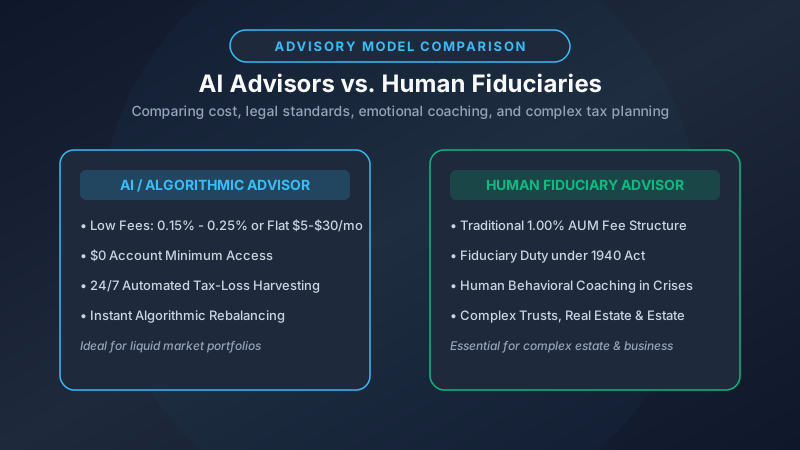
Traditional human financial advisors commonly charge an annualized fee based on a percentage of Assets Under Management (AUM). A standard industry benchmark for full-service human advisory services is approximately 1.00% of AUM per year, though tiered fee schedules may reduce this percentage to 0.50% or lower for larger portfolios exceeding $1 million.
In contrast, AI-driven advisory platforms typically charge significantly lower fee structures. Pure algorithmic platforms—building upon the foundational model of robo-advisors-decade-later—often charge between 0.15% and 0.25% of AUM annually, or utilize flat monthly subscription fees ranging from $5 to $30 per month regardless of portfolio size.
Furthermore, human advisors often enforce account minimums—frequently requiring $100,000, $250,000, or more in investable assets to engage their services. AI advisory platforms generally operate with zero minimum balance requirements, democratizing access to structured portfolio management for early-stage investors.
2. Legal Standards: Fiduciary Duty and Regulatory Oversight
A critical distinction lies in the legal framework governing advisory recommendations.
Human financial planners operating as Registered Investment Advisors (RIAs) are bound by the fiduciary standard under the U.S. Investment Advisers Act of 1940. This legal duty requires advisors to act solely in the best interest of the client at all times, eliminate or disclose all conflicts of interest, and recommend the optimal financial instruments regardless of advisor compensation.
AI financial platforms operate under regulatory oversight from the Securities and Exchange Commission (SEC) or the Financial Industry Regulatory Authority (FINRA) as registered entities or broker-dealer technology providers. However, applying legal fiduciary concepts to autonomous software presents unique regulatory challenges.
While an AI algorithm is programmed to execute mathematical optimizations—such as low-cost index allocation or tax-loss harvesting—it lacks subjective ethical judgment. If an AI system is trained on biased financial data or deployed by a firm that embeds subtle commercial preferences (such as prioritizing proprietary funds or cash-sweep yield spreads), algorithmic recommendations could reflect hidden conflicts of interest unless strictly audited by regulatory authorities.
3. Behavioral Coaching and Emotional Discipline
Financial market research repeatedly demonstrates that investor returns are heavily influenced by behavioral discipline. During periods of severe market volatility, such as a major equity drawdown, retail investors frequently experience panic selling, turning temporary paper losses into permanent realized capital losses.
Human advisors provide crucial behavioral coaching—acting as an emotional circuit breaker. A human advisor can speak directly with a client, contextualize market downturns within their long-term financial plan, and prevent emotionally driven liquidations. Studies by financial research institutions indicate that behavioral coaching represents a substantial portion of the net value added by human planners.
AI advisors, while immune to human fear and panic, communicate primarily through automated notifications, interactive dashboards, or conversational interfaces. While an AI tool can present logical data showing that historical markets recover from pullbacks, an app notification may lack the empathetic persuasion required to soothe a panicked investor during a severe liquidity shock.
4. Complex Estate, Tax, and Multi-Generational Planning
Where human advisors maintain a distinct operational advantage is in navigating highly complex, non-standard financial situations. While AI models excel at standardized calculations—such as modeling retirement withdrawal rates or calculating traditional-ira-vs-roth-ira conversions—human life frequently introduces multi-faceted variables that resist standardization.
Examples of complex financial planning scenarios include:
-
Estate Planning and Trusts: Structuring irrevocable trusts, business succession plans, and legacy wealth transfer across multiple generations.
-
Specialized Tax Strategies: Navigating state-specific tax liabilities, executive stock options (ISO/NSO vesting schedules), and real estate 1031 exchanges.
-
Illiquid Asset Integration: Incorporating privately held business equity, commercial real estate, or family farms into a holistic financial roadmap.
Human advisors synthesize legal counsel, tax professionals (CPAs), and subjective family dynamics to craft bespoke estate plans. AI platforms, while improving in natural language analysis, are generally restricted to standardized public securities (ETFs, mutual funds, individual stocks) and cannot execute legal trust documentation or negotiate complex family governance.
5. Algorithmic Optimization and Customization
AI financial advisors demonstrate unmatched efficiency in data processing and continuous portfolio monitoring. An AI system can analyze real-time market data across thousands of securities simultaneously, executing precise rebalancing tasks instantly when asset weights drift beyond pre-set tolerance bands—a process covered in asset-allocation-rebalancing-explained.
Additionally, AI platforms can perform automated daily tax-loss harvesting across taxable brokerage accounts, identifying micro-opportunities to realize capital losses that human advisors might only review on a quarterly or annual schedule. Furthermore, as emerging autonomous-ai-agents-finance evolve, AI systems can process holistic cash flow data from linked bank accounts to dynamically optimize spending and savings targets.
6. Data Privacy, Cybersecurity, and System Resilience
Engaging an AI financial advisor requires sharing aggregation credentials or linking accounts through open banking APIs. While modern technology platforms utilize encryption and tokenized authentication, digital aggregation exposes investors to potential cybersecurity threats, prompt injection risks, or platform downtime.
Human advisors, while also utilizing software infrastructure to house client data, maintain physical office locations and direct personal relationships. If a technological blackout occurs, a client can communicate directly with their human advisor via phone or in-person meetings, ensuring continuity of service.
Comparative Overview: AI vs. Human Advisors
To evaluate how these approaches compare across key financial categories, consider the following detailed breakdown:
| Feature / Dimension | AI Financial Advisor | Human Fiduciary Advisor |
| :--- | :--- | :--- |
| Typical Cost Structure | 0.15% - 0.25% AUM or $5-$30/mo flat fee | 0.75% - 1.25% AUM annually or hourly |
| Account Minimums | Typically $0 access threshold | Frequently $100k - $250k+ minimum balance |
| Availability | 24/7 instant digital dashboard access | Business hours / scheduled consultations |
| Legal Standard | Programmed logic & SEC/FINRA rules | Personal fiduciary duty under 1940 Act |
| Behavioral Coaching | Automated alerts & systemic notifications | Direct human empathy & 1-on-1 consultation |
| Complex Situations | Standardized public assets & index funds | Trusts, business sales, private real estate |
| Tax Optimization | Continuous automated algorithmic TLH | Strategic tax, estate & CPA coordination |
Choosing the Right Approach for Your Financial Goals
Ultimately, the choice between an AI financial advisor and a human financial planner is not mutually exclusive. Many investors utilize a hybrid advisory model—relying on low-cost AI algorithms for automated portfolio construction, rebalancing, and tax efficiency, while consulting a fee-only human fiduciary planner on an hourly or project basis for major life events, estate planning, or business transitions.
Investors with straightforward wealth accumulation goals—such as saving for retirement using liquid market index funds—often find that AI advisors offer exceptional value at a fraction of the cost. Conversely, high-net-worth individuals, business owners, and families navigating complex legal structures continue to benefit from the nuanced judgment and personal relationship provided by experienced human advisors.
MoneyTalkin' provides financial education, educational concepts, and general informational guides. Articles do not constitute personalized financial, investment, legal, or tax advice. Financial products, rates, terms, and regulatory rules change frequently; consult a qualified financial professional regarding your specific situation. Read our full Disclaimer Policy.
Written by MoneyTalkin'
MoneyTalkin' researches and publishes objective financial education content, money management fundamentals, and practical financial guides.
Related Technical Articles
Explore related topics in this cluster to deepen your understanding.