Robo-Advisors Are About a Decade Old: What Have They Actually Delivered?
A 10-year retrospective analysis evaluating automated robo-advisory platforms, inspecting their promised benefits—low fees, tax-loss harvesting, and automatic rebalancing—against real-world investor results.
Robo-Advisors Are About a Decade Old: What Have They Actually Delivered?
Over a decade ago, independent financial technology startups launched robo-advisors—automated wealth management platforms promising to disrupt traditional financial planning. By leveraging software algorithms to construct index fund portfolios, rebalance assets, and harvest tax losses automatically, pioneer platforms like Betterment and Wealthfront sought to lower investing costs for everyday retail consumers.
Ten years after robo-advisory entered mainstream finance, major institutional firms—including Vanguard, Charles Schwab, and Fidelity—have launched their own automated platforms. Evaluating this decade-long track record requires analyzing what robo-advisors successfully delivered, where their limitations emerged, and how the industry evolved.
1. Core Value Delivered: Low Fees and Portfolio Democratization
The primary contribution of robo-advisors was the dramatic reduction in asset management fees.
Prior to the rise of automated platforms, retail investors seeking professional portfolio management typically paid human financial advisors annual advisory fees averaging 1.00% of Assets Under Management (AUM), often subject to high minimum balance thresholds ($100,000+).
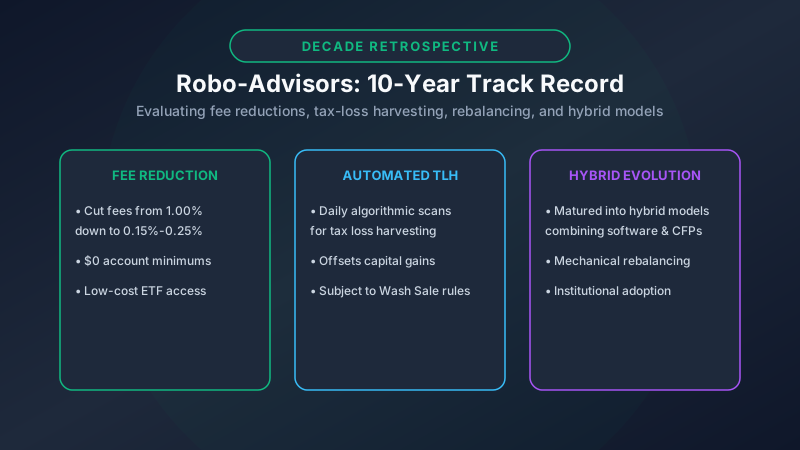
Robo-advisors introduced an industry standard advisory fee structure of 0.15% to 0.25% of AUM annually, with low or zero account minimums. For an investor with a $50,000 portfolio, an annual advisory fee dropped from $500 per year (under a 1% human advisor) to $125 per year (under a 0.25% robo-advisor). This fee reduction allowed retail investors to compound a significantly larger portion of their investment returns over long horizons.
Furthermore, robo-advisors standardized low-cost Modern Portfolio Theory (MPT) asset allocation. Instead of stock picking or market timing, robo-advisors allocate capital across diversified, low-cost Exchange-Traded Funds (ETFs) covering broad U.S. equities, international developed markets, emerging markets, and fixed income—principles detailed in index-fund-vs-etf-explained.
2. Automated Rebalancing: Mechanical Consistency
A second major success of robo-advisors was automating routine portfolio maintenance. Over time, market movements cause asset classes to drift from target allocations. For instance, a strong stock market rally might push an investor's target 80/20 stock-to-bond portfolio into an 88/12 allocation, increasing risk exposure.
Robo-advisors monitor portfolios continuously, executing mechanical threshold rebalancing whenever an asset class strays beyond predefined tolerance bands (e.g., +/- 5%). By selling overperforming asset classes and purchasing underperforming ones, automated rebalancing enforces disciplined 'buy low, sell high' execution without emotional bias, as explained in asset-allocation-rebalancing-explained.
3. Automated Tax-Loss Harvesting (TLH): Benefits and Realities
Robo-advisors heavily marketed automated tax-loss harvesting in taxable brokerage accounts. TLH algorithms continuously scan portfolios for positions holding unrealized capital losses, automatically selling those ETFs to realize tax losses while immediately purchasing alternative, non-substantially identical ETFs to maintain target asset exposure.
These realized losses can offset capital gains or up to $3,000 of ordinary income annually on U.S. tax returns.
Important Nuance: Wash Sale Rule Risks
While tax-loss harvesting is valuable in taxable accounts, its real-world efficacy involves key caveats:
-
The IRS Wash Sale Rule (IRC Sec. 1091): Disallows tax loss deductions if a 'substantially identical' security is purchased within 30 days before or after the sale. If an investor holds a robo-advisor account alongside an independent IRA or spouse's account that buys the same ETF, an uncoordinated wash sale can inadvertently disqualify the loss.
-
Tax Deferral, Not Elimination: Tax-loss harvesting lowers the cost basis of the newly purchased replacement ETF. When the investor eventually liquidates the portfolio in retirement, larger capital gains tax liabilities will be due. TLH primarily provides a tax deferral value, allowing funds to compound in the interim.
4. Industry Evolution and Conflict Points
Over ten years, the robo-advisory sector matured, revealing certain business model tensions and regulatory scrutiny:
-
Cash Sweep Yield Conflicts: To generate revenue beyond low 0.25% advisory fees, some automated platforms allocated high percentages of client portfolios (e.g., 6% to 12%) into low-yielding proprietary bank cash sweeps. In 2022, the SEC penalized a major robo-advisor $187 million for failing to disclose that these mandatory cash allocations dragged down overall investor returns while benefiting the firm's cash interest spreads.
-
Shift Toward Hybrid Advisory Models: Pure algorithmic platforms discovered that as client accounts grew, investors increasingly demanded human consultation for major life events. Consequently, major platforms introduced hybrid tiers—combining automated software rebalancing with on-demand access to Certified Financial Planners (CFPs) for fees around 0.30% to 0.40% AUM.
5. Behavioral Discipline During Market Drawdowns
An important test for robo-advisors was how investors behaved during market crashes, such as the March 2020 market decline. While the software itself executed rebalancing flawlessly, industry data showed that some retail clients logged into app dashboards and manually overrode automated portfolios, panic selling into cash. This highlighted that software automation must be paired with investor discipline to achieve long-term wealth targets.
10-Year Track Record Overview
The table below summarizes what robo-advisors successfully delivered versus their key limitations:
| Feature / Dimension | Real-World Delivery | Known Limitations |
| :--- | :--- | :--- |
| Low Advisory Fees | Delivered 0.15%-0.25% standard fees | Underlying ETF expense ratios still apply |
| Automated Rebalancing| Flawless mechanical risk control | Cannot prevent broad market drawdowns |
| Tax-Loss Harvesting | Effective in active taxable accounts| Limited utility in tax-deferred IRAs/401ks |
| Asset Allocation | Standardized MPT index portfolios | Standardized risk questionnaires can miss nuance |
| Conflict Transparency| High overall transparency | Cash sweep yield spreads required SEC scrutiny |
The Verdict: A Permanent Improvement to Retail Investing
Ten years later, robo-advisors have proven to be a highly successful financial innovation. They successfully forced the broader wealth management industry to slash fees, eliminate trade commissions, and make disciplined index-based portfolio management accessible to retail investors of all wealth levels.
While robo-advisors cannot eliminate broad market volatility or replace complex estate planning, they remain an exceptional, cost-effective foundation for long-term wealth accumulation.
6. Performance in Changing Macroeconomic Environments
A key lesson from the 10-year track record of robo-advisors is how automated algorithms handle shifting macroeconomic regimes.
During the decade of low interest rates following the 2008 financial crisis, classic 60/40 equity-to-bond portfolios managed by robo-advisors produced steady, predictable returns. However, during the rapid interest rate hike cycle of 2022, both equities and fixed-income bonds experienced simultaneous drawdowns.
Robo-advisors programmed with static fixed-income allocations could not dynamically shift capital into short-term cash equivalents or Treasury bills—a strategy explored in bank-cd-vs-treasury-bills. This demonstrated that while robo-advisors excel at disciplined index rebalancing, they are not designed to execute active macro sector tactical tilts.
7. Comparative Assessment of Automated vs. Traditional Portfolio Management
A comprehensive review of the 10-year robo-advisory track record demonstrates that automated portfolio management is highly effective for core equity accumulation.
While human financial advisors retain distinct advantages in complex estate planning and emotional crisis coaching, robo-advisors successfully proved that low-cost, algorithmically rebalanced index fund portfolios deliver outstanding long-term results for disciplined investors. As hybrid models continue to combine low-cost software with on-demand human fiduciary advice, retail investors benefit from unprecedented flexibility, transparent fee pricing, and institutional-quality portfolio management.
For a comparison with generative AI models, see our analysis on AI Financial Advisors vs. Human Advisors.
MoneyTalkin' provides financial education, educational concepts, and general informational guides. Articles do not constitute personalized financial, investment, legal, or tax advice. Financial products, rates, terms, and regulatory rules change frequently; consult a qualified financial professional regarding your specific situation. Read our full Disclaimer Policy.
Written by MoneyTalkin'
MoneyTalkin' researches and publishes objective financial education content, money management fundamentals, and practical financial guides.
Related Technical Articles
Explore related topics in this cluster to deepen your understanding.