Do AI Trading Agents Amplify Momentum and Market Crashes?
An objective analysis of algorithmic momentum and market stability, examining AI model homogeneity, correlated exit strategies, market reflexivity, and liquidity vacuums.
Do AI Trading Agents Amplify Momentum and Market Crashes?
As autonomous AI agents gain adoption across institutional quantitative funds and retail trading platforms, financial economists and market regulators are actively studying their impact on market stability.
A central question in modern market structure research is whether widespread deployment of AI trading agents could exacerbate market momentum during rallies—and accelerate cascading price drops during market downturns.
Historically, quantitative algorithmic trading (such as high-frequency statistical arbitrage and trend-following algorithms) has contributed to rapid market events, including the famous May 2010 Flash Crash. As AI models evolve from simple rule-based algorithms to LLM-driven autonomous agents, new dynamics emerge.
Crucially, rigorous market analysis requires distinguishing between observed correlation, plausible theoretical mechanisms, and verified causal evidence. This article provides an objective examination of how correlated AI trading models operate, the concept of market reflexivity, liquidity withdrawal dynamics, and current regulatory risk assessments.
1. Algorithmic Momentum & The Speed of Execution
Momentum trading is an established investment strategy based on buying assets that demonstrate upward price trends and selling assets exhibiting downward trends.
Initial Price Movement -> AI Agent Sentiment & Technical Detection -> Automated Order Placement -> Price Acceleration -> Additional Agent Execution
The Amplification Mechanism
When autonomous AI agents monitor market feeds, they process news sentiment, social mention velocity, and technical price indicators continuously. When multiple independent AI agents detect positive momentum in a stock simultaneously, their automated orders execute in milliseconds:
- Pre-Emptive Order Flow: High-speed agent execution accelerates the upward trajectory of a stock price, causing the asset to reach target price levels far faster than in manual, human-driven markets.
- Overshooting Fundamental Valuations: Rapid automated buying can cause prices to overshoot intrinsic economic values, creating fragile valuation spikes vulnerable to sudden reversals.
2. Model Homogeneity: The Risk of Correlated AI Herding
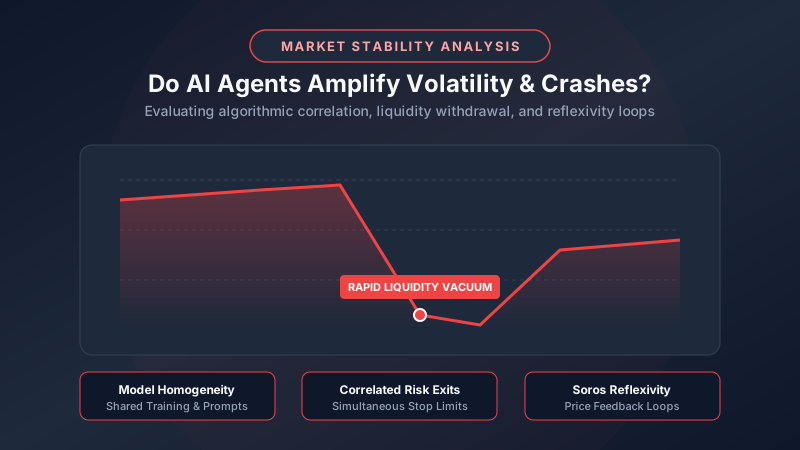
A major systemic concern identified by financial stability boards (including the Bank for International Settlements and the SEC) is model homogeneity—the risk that many different AI agents rely on similar underlying architecture:
- Shared Foundation Models: Many commercial AI trading tools are built on a small cluster of dominant Large Language Models (e.g., OpenAI, Anthropic, or open-source Llama variants). If these base models evaluate market risk using similar underlying training data and reasoning frameworks, they may arrive at identical trading decisions.
- Standardized Risk Guardrails: Quantitative risk management systems frequently enforce standardized stop-loss rules (e.g., automatically liquidating positions if portfolio drawdown exceeds 3%).
- Correlated Herd Behavior: When a negative market event occurs, thousands of AI agents with correlated risk thresholds may attempt to sell the exact same assets simultaneously.
Negative Market Event -> Correlated Model Logic -> Simultaneous Stop-Loss Execution -> Liquidity Vacuum -> Flash Crash
3. Reflexivity in Automated Markets
The concept of reflexivity—developed by investor and economic theorist George Soros—posits that financial market prices do not merely passively reflect underlying economic reality; rather, market prices actively influence the fundamentals that determine future prices.
How Reflexivity Operates in AI Agent Systems
- Feedback Loops: If an AI agent's sentiment scraper views a declining stock price as a negative fundamental signal, it issues a sell order. The resulting sell order depresses the stock price further, which other AI agents interpret as confirmation of worsening fundamentals, triggering additional sell orders.
- Self-Fulfilling Prophecies: Automated systems can transform temporary liquidity imbalances into sustained market crashes through self-reinforcing algorithmic feedback loops.
4. The Liquidity Illusion & Market Flash Crashes
During periods of severe market stress, automated market makers and AI trading agents often exhibit the liquidity illusion:
Illiquidity During Stress Events
In calm markets, automated agents provide deep bid-ask quotes, creating the appearance of robust market liquidity. However, when market volatility exceeds pre-set risk limits, automated algorithms are programmed to pull their quotes instantly to preserve capital.
When liquidity vanishes, even small market sell orders drop through wide bid-ask gaps, causing rapid intraday price drops known as flash crashes.
4. Case Study: The May 2010 Flash Crash & Algorithmic Cascade
The May 6, 2010 Flash Crash remains the primary historical benchmark for studying automated cascade risks:
- The $4.1 Billion Algorithmic Order: A single mutual fund complex deployed an automated sell algorithm to sell 75,000 E-Mini S&P 500 futures contracts ($4.1 billion value) over a short timeframe.
- HFT Cross-Market Contagion: Automated high-frequency algorithms absorbed the sell order and immediately executed short-term trades to pass the inventory across equity markets, creating a feedback loop.
- The Dow’s 1,000-Point Drop: Within 36 minutes, the Dow Jones Industrial Average dropped nearly 1,000 points (about 9%) before recovering most of the decline as market-wide liquidity resumed.
5. Differentiating Causation from Plausible Mechanism
When evaluating claims that AI agents "cause market crashes," analysts apply strict evidentiary standards:
| Evidence Tier | Current Status | Description |
|---|---|---|
| Plausible Theoretical Mechanism | Established | Mathematical models demonstrate how correlated algorithms create liquidity vacuums and reflexivity loops |
| Observed Correlation | Documented | Historical quantitative trading (e.g., 2010 Flash Crash, 2018 volatility spikes) proves algorithmic speed amplifies intraday swings |
| Empirical Causal Proof for LLM Agents | Unproven / Evolving | Large Language Model (LLM) agents currently represent a minor fraction of total institutional market volume compared to HFT/quant algorithms |
Current evidence indicates that while LLM-driven AI agents present plausible theoretical mechanisms for amplifying momentum, traditional high-frequency trading (HFT) and quantitative index funds still dominate total market volume.
6. Regulatory Responses & Circuit Breakers
To mitigate algorithmic feedback risks, U.S. exchanges and regulators maintain structural safety guardrails:
- Market-Wide Circuit Breakers (MWCB): The SEC mandates exchange-wide trading halts if the S&P 500 Index drops 7% (Level 1), 13% (Level 2), or 20% (Level 3) relative to the previous day's close, halting automated trading to allow human participants to evaluate market fundamentals.
- Limit-Up / Limit-Down (LULD) Bands: Prevents individual stock trades from executing outside specified price bands (typically 5% or 10% around the rolling 5-minute average price), preventing flash crashes in single equities.
- SEC Rule 15c3-5 (Market Access Rule): Mandates that broker-dealers providing market access must maintain pre-trade risk controls that automatically block erroneous orders, restrict single-order dollar limits, and prevent orders that exceed pre-set capital thresholds.
- SEC Algorithmic Oversight Proposals: Proposed regulatory frameworks require quantitative firms utilizing machine learning to maintain comprehensive algorithmic audit logs, test models under simulated market stress conditions, and deploy automated kill-switches.
7. Strategic Summary for Individual Investors
For retail investors managing long-term capital across index funds vs. individual stocks or exploring autonomous AI agents in finance:
- Short-Term Volatility Is Not Always Fundamental: Rapid intraday price drops are often driven by temporary algorithmic liquidity vacuums rather than structural corporate decline.
- Avoid Algorithmic Squeezes: Chasing high-frequency momentum trades exposes retail investors to automated front-running and sudden liquidity withdrawals.
- Explore Related AI Analyses: Review detailed studies on AI agent Solana DEX trading volume, legal frameworks governing AI agent financial liability, and differences between an AI assistant vs. autonomous agent to navigate modern market technology safely.
For modern automated capabilities, consult AI Trading Agents in 2026.
MoneyTalkin' provides financial education, educational concepts, and general informational guides. Articles do not constitute personalized financial, investment, legal, or tax advice. Financial products, rates, terms, and regulatory rules change frequently; consult a qualified financial professional regarding your specific situation. Read our full Disclaimer Policy.
Written by MoneyTalkin'
MoneyTalkin' researches and publishes objective financial education content, money management fundamentals, and practical financial guides.
Related Technical Articles
Explore related topics in this cluster to deepen your understanding.