AI Assistant vs. Autonomous Financial Agent: What's the Difference?
Learn the critical distinctions between conversational AI assistants and autonomous execution agents in personal finance, including permission scopes, guardrails, and audit trails.
AI Assistant vs. Autonomous Financial Agent: What's the Difference?
As artificial intelligence becomes deeply embedded in financial technology, the terms AI assistant and autonomous AI agent are frequently used interchangeably in software marketing materials. However, in financial systems architecture, these two concepts represent fundamentally different technical paradigms with distinct permission scopes, user involvement levels, error profiles, and legal accountability frameworks.
Understanding the clear distinction between a passive conversational assistant and an active execution agent is essential for consumers, software engineers, financial advisors, and regulators evaluating modern money management applications.
1. Core Structural Definition: Passive Response vs. Active Execution
At its core, the primary operational distinction between an AI assistant and an autonomous financial agent lies in where the decision-making authority and transaction execution power reside:
-
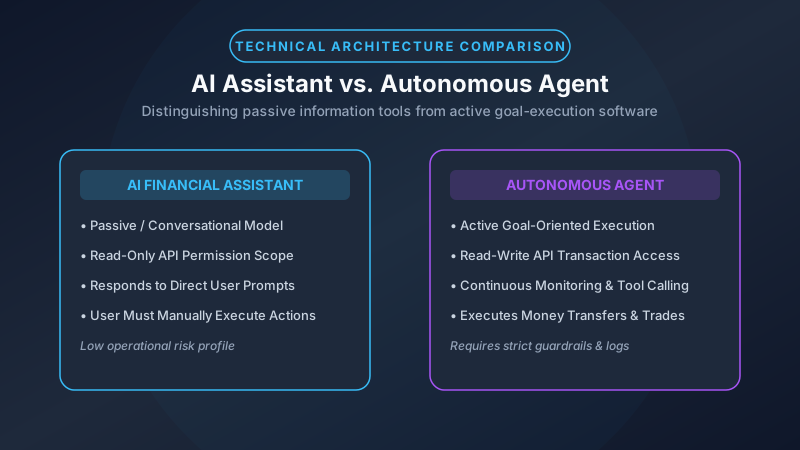
AI Financial Assistant (Passive / Informational): An AI assistant is designed to receive user inquiries, process financial data, synthesize complex concepts, and present tailored recommendations or calculations back to the user. The assistant operates reactively, waiting for the human user to initiate interactions. Crucially, the assistant cannot perform financial transactions independently; it relies entirely on the human user to manually review its suggestions and click 'confirm' or execute trades directly within their broker interface.
-
Autonomous Financial Agent (Active / Executable): An autonomous financial agent is assigned a high-level goal (for example: 'maintain $5,000 in checking and automatically sweep all excess cash into a high-yield-savings-account-explained'). Once configured, the agent independently monitors financial conditions, invokes external financial tools via APIs, evaluates decision trees, and executes real-world financial transactions directly without requiring real-time human confirmation for every individual step.
2. Technical Architecture and Tool Calling Frameworks
To understand how autonomous financial agents operate beyond simple conversational chatbots, it is necessary to examine their underlying software architecture.
A conversational AI assistant primarily utilizes Large Language Models (LLMs) to perform natural language parsing, retrieval-augmented generation (RAG) over financial documentation, and data formatting. When a user asks, 'How much did I spend on dining out this month?', the assistant queries an aggregated transaction database, calculates the totals, and formats a clear summary response.
In contrast, an autonomous financial agent integrates an LLM reasoning engine with an orchestration framework capable of tool calling, dynamic API function execution, and persistent state management. As explored in our dedicated breakdown of autonomous-ai-agents-finance, an execution agent operates in a continuous closed control loop:
-
Perceive: Continuously reads real-time account balances, credit lines, and pending transactions via secure financial endpoints, such as those governed by open-banking-apis-explained.
-
Reason: Evaluates current account data against predefined goal constraints, user risk parameters, and logical safety rules.
-
Act: Dynamically invokes external banking or brokerage API endpoints to submit ACH transfers, adjust payment schedules, or rebalance portfolio holdings.
-
Verify: Confirms transaction success receipts from the API host, updates internal state logs, and sends a post-execution summary to the user dashboard.
3. Permission Scopes: Read-Only vs. Read-Write API Access
The operational boundaries of AI financial software are strictly defined by their underlying API access permissions:
Read-Only OAuth Scopes: AI assistants typically operate under read-only permissions. They can view transaction histories, account balances, and credit reports, but lack the cryptographic or technical credentials to move funds, alter account settings, or initiate payments. This drastically limits potential financial harm if the software encounters an error, hallucination, or data parsing issue.
Read-Write OAuth Scopes: Autonomous agents require write access to execute real-world actions. This includes initiating bank debits, submitting stock buy/sell orders, or authorizing recurring bill payments. Granting write permissions drastically elevates the required security baseline, as any software glitch or malicious prompt injection could directly result in unauthorized asset transfers.
4. Safety Guardrails, Confirmation Steps, and Audit Logs
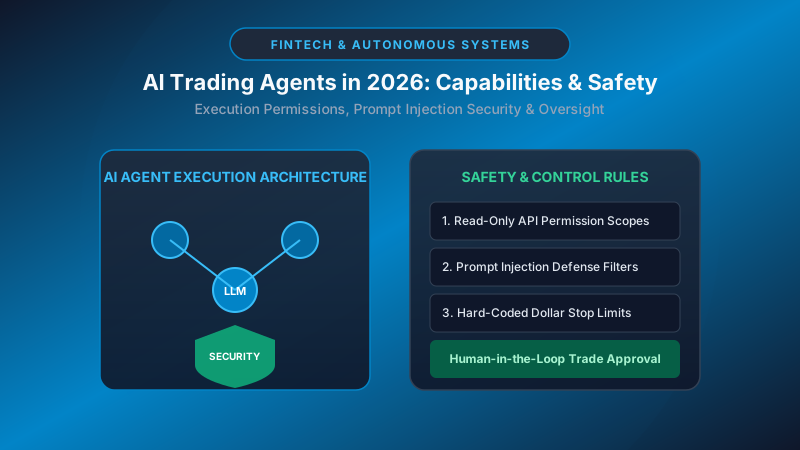
Because autonomous financial agents possess direct execution capabilities, robust system design requires strict safety guardrails to prevent runaway transactions, logic loops, or catastrophic asset depletion.
Key architectural safeguards for autonomous financial agents include:
-
Human-in-the-Loop (HITL) Thresholds: For high-stakes transactions—such as money transfers exceeding a specific dollar amount ($1,000)—the agent pauses execution and triggers a push notification requiring explicit biometric or hardware-token confirmation from the user.
-
Daily Transaction Velocity Limits: Hard coding maximum daily transfer volume limits ensures an agent cannot exhaust account balances during an algorithmic loop failure.
-
Immutable Audit Logs: Every decision step, API payload, and execution receipt must be written to an immutable log. If an unexpected transaction occurs, clear audit trails enable developers and financial institutions to investigate the root cause, a key factor in establishing ai-agent-financial-liability.
-
Deterministic Fallback Constraints: If market volatility or API latency exceeds predefined safety limits, the agent automatically drops back to a passive alert state, deferring execution back to the human supervisor.
5. Risk Profiles, User Responsibility, and Regulatory Oversight
The legal and compliance considerations for these two software types are vastly different under U.S. financial regulations:
AI assistants are typically evaluated under consumer protection standards regarding informational accuracy and misleading statements. Because the human user retains final execution authority, liability for bad investment choices generally remains with the user, assuming the app did not provide illegal unregistered investment advice.
Autonomous agents, however, trigger complex questions under Regulation E (electronic fund transfers) and broker-dealer execution rules. If an autonomous agent executes a trade or transfer that results in financial loss or overdraft penalties, regulators must determine whether the developer, the partner bank, or the user bears financial responsibility.
Furthermore, consumers utilizing autonomous agents must accept a higher degree of ongoing supervisory oversight. While an AI assistant can be checked casually once a week, an active agent requires periodic auditing of transaction logs and active API permissions to verify that autonomous execution aligns with long-term financial objectives.
Comparative Workflow Overview
The table below illustrates the structural differences across key functional dimensions:
| Operational Dimension | AI Financial Assistant | Autonomous Financial Agent |
| :--- | :--- | :--- |
| Primary Function | Answer queries, synthesize data | Execute goal-oriented workflows |
| Trigger Mechanism | User prompt / direct inquiry | Scheduled loop / event monitoring |
| API Scopes | Read-only access permissions | Read-write transaction access |
| Execution Authority| None (User executes manually) | Delegated execution authority |
| User Role | Active decision maker | Supervisor / rule definer |
| Primary Risk | Hallucination / inaccurate advice | Unintended transactions / bad execution |
| Required Oversight| Verification of output accuracy | Audit log review & safety limits |
Practical Guidance: Evaluating Automated Financial Applications
When selecting financial software, consumers should evaluate whether an application functions as an assistant or an agent by reviewing its onboarding permissions. If an app requests full transaction credentials or bank transfer access, verify that it provides granular velocity controls, biometric transaction confirmations, and clear audit history logs before granting read-write privileges.
Summary: Complementary Tools in Modern Money Management
Neither paradigm is inherently superior; rather, they serve distinct roles in digital financial management. AI assistants empower consumers to gain deeper clarity over their personal balance sheets by summarizing complex tax rules or breaking down budget categories. Autonomous financial agents eliminate administrative friction by executing repetitive financial mechanics, such as sweeping excess cash into yield-bearing accounts or paying credit cards before interest accrues. As autonomous tools mature, establishing transparent permission controls and clear execution guardrails remains essential for maintaining consumer trust.
MoneyTalkin' provides financial education, educational concepts, and general informational guides. Articles do not constitute personalized financial, investment, legal, or tax advice. Financial products, rates, terms, and regulatory rules change frequently; consult a qualified financial professional regarding your specific situation. Read our full Disclaimer Policy.
Written by MoneyTalkin'
MoneyTalkin' researches and publishes objective financial education content, money management fundamentals, and practical financial guides.