Who Is Liable When an AI Agent Makes a Bad Financial Decision?
A detailed legal and regulatory breakdown examining liability when autonomous AI agents make financial errors, covering Reg E, contracts, and software disclaimers.
Who Is Liable When an AI Agent Makes a Bad Financial Decision?
As autonomous AI agents assume greater responsibility in personal finance—moving cash between bank accounts, managing credit card payments, or placing stock trades—a fundamental legal question arises: If an AI agent executes an erroneous, harmful, or unintended financial transaction, who bears legal and financial responsibility?
If a human stockbroker executes an unauthorized trade, existing securities regulations provide clear legal recourse. But when software operates under delegated user authority, the legal boundaries blur.
Does responsibility lie with the consumer who authorized the agent, the software developer who wrote the code, the AI platform provider powering the Large Language Model (LLM), or the financial institution that executed the API transaction?
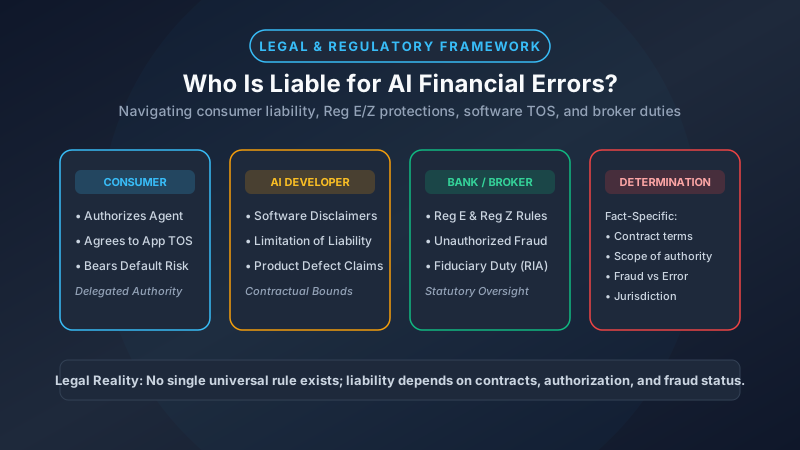
There is no single, universal answer. Legal liability depends on jurisdiction, contract terms, authorization levels, applicable consumer banking regulations, and specific facts. This article examines how current U.S. legal frameworks evaluate AI financial liability.
1. The Four Key Stakeholders in Agentic Finance
When an AI agent executes a financial transaction, four distinct entities are involved:
[Consumer] -> Grants Authority -> [AI App Developer] -> Uses Base Model -> [AI Platform (LLM)] -> Calls API -> [Financial Institution]
- The Consumer: The account owner who granted the AI agent access permissions to manage funds or trade assets.
- The AI Application Developer: The fintech company that designed the financial agent's specific user interface, guardrails, and API integration logic.
- The Base AI Platform Provider: The technology company providing the underlying Large Language Model (e.g., OpenAI, Anthropic, or Google).
- The Financial Institution / Brokerage: The bank, broker-dealer, or payment network processing the resulting financial transaction.
2. Consumer Responsibility & Delegated Authority
In standard civil law, when a principal delegates authority to an agent (human or software), the principal generally remains bound by the actions performed by that agent within the scope of authorized power.
Authorized vs. Unauthorized Transactions
Under federal consumer protection laws, the distinction between authorized and unauthorized transactions is paramount:
- Regulation E (Electronic Fund Transfers Act): Protects consumers against unauthorized electronic fund transfers (such as a hacker stealing debit card credentials). If a consumer reports unauthorized fraud promptly, bank liability caps consumer loss at $50. However, if a consumer intentionally grants a software program permission to access their account and initiate transfers, transactions executed by that program are generally classified as authorized, limiting Regulation E protections.
- Regulation Z (Truth in Lending Act): Governs credit card transactions. Similar to Regulation E, Regulation Z limits consumer liability for unauthorized credit card charges to $50, but authorized charges—even if executed poorly by a delegated agent—remain consumer obligations.
3. Developer Liability & Terms of Service (TOS) Disclaimers
Consumers seeking recourse against fintech software developers face formidable contractual hurdles.
1. Limitation of Liability Clauses
Virtually all consumer software applications include explicit Terms of Service (TOS) disclaimers stating that the software is provided "as is" and "with all faults." These contracts typically contain clauses waiving consequential damages and limiting developer liability to the total subscription fees paid by the user over the preceding 12 months.
2. Product Liability vs. Software Services
Historically, U.S. courts have treated software as a service rather than a tangible product, making traditional strict product liability claims (which hold manufacturers liable for defective physical products regardless of fault) difficult to apply to financial software bugs or algorithmic hallucinations.
3. The Negligence Exception
A software developer may face legal liability if a plaintiff proves gross negligence or intentional misrepresentation—for example, if the developer failed to implement standard software security practices, ignored known critical vulnerabilities, or falsely advertised that the agent possessed advertised risk-free capabilities.
4. CFPB Guidance & Regulatory Consumer Protection Rules
The Consumer Financial Protection Bureau (CFPB) has issued specific administrative guidance regarding automated financial decisioning and software oversight:
- CFPB Circular 2022-03 (Adverse Action Notices): Confirms that financial institutions utilizing complex algorithms or automated software must provide clear, specific reasons when denying credit or altering financial terms. The CFPB established that institutions cannot evade disclosure requirements by asserting that an AI model's decisioning logic is a black box.
- Unfair, Deceptive, or Abusive Acts or Practices (UDAAP): Under Title X of the Dodd-Frank Act, the CFPB regulates financial software features that mislead consumers about automated execution risks or obscure continuous fees as potential UDAAP violations.
5. Base AI Platform Providers & Model Disclaimers
Major AI foundation model providers explicitly disclaim financial liability in their developer API agreements:
- No Financial Advice Disclaimers: AI platform providers mandate that their base models are general-purpose technology and must not be marketed as registered financial advisors or automated legal representatives without human oversight.
- Non-Deterministic Software Nature: Because LLMs are non-deterministic (generating probabilistic responses rather than static calculations), platform providers explicitly warn developers against deploying un-guarded LLM inference directly into high-stakes financial execution systems.
5. Financial Institutions & Registered Investment Advisor (RIA) Duties
The legal duty of banks and broker-dealers depends heavily on their legal registration status:
Standard Banks & Execution Brokers
Traditional banks executing API calls initiated by a user-authorized app act primarily as custodians and execution venues. So long as the bank verifies valid authentication credentials (e.g., via OAuth 2.0 tokens), it holds no independent duty to evaluate whether the user's software made a prudent financial choice.
Registered Investment Advisors (RIAs) & Fiduciary Duty
If a fintech firm operates as an SEC-registered Registered Investment Advisor (RIA), it owes a strict fiduciary duty to its clients under the Investment Advisers Act of 1940:
- Duty of Care & Loyalty: An RIA utilizing automated or AI-driven investment tools must ensure that algorithmic trading strategies are suitable for the client's financial profile.
- Algorithmic Supervision: The SEC has made clear that RIAs cannot disclaim fiduciary duty by pointing to third-party AI software. If an RIA's automated system executes unsuitable trades, the firm remains legally liable for breaching its fiduciary obligation.
6. How Liability Varies by Failure Scenario
| Scenario | Primary Liable Party | Key Legal Principle |
|---|---|---|
| Hacker Breaches Agent Server (Stolen Credentials) | Bank / Financial Institution (Partially) | Regulation E / Z unauthorized transaction protections |
| Agent Hallucinates Math (Transfers Too Much Cash) | Consumer | Delegated authority; software TOS disclaimers |
| Prompt Injection Exploit (Malicious PDF Exploit) | App Developer (Under Negligence) | Failure to implement standard security sanitization |
| Registered AI Robo-Advisor Executes Unsuitable Trade | Registered Investment Advisor (RIA) | SEC Fiduciary Duty breach under Advisers Act |
7. Strategic Conclusions for Consumers
Navigating legal liability in the age of agentic finance requires proactive risk management:
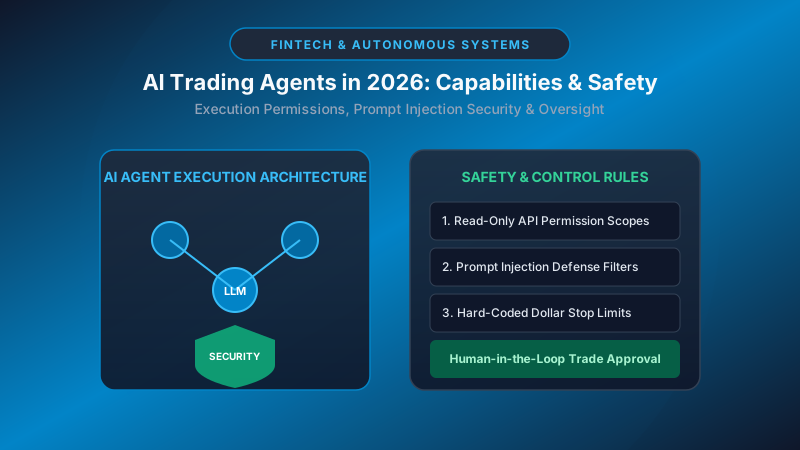
- Read Permission Scopes Carefully: Review exactly what access rights an AI application requests before granting read-write bank permissions.
- Never Grant Unlimited Wires: Keep automated agents isolated to low-dollar checking accounts or internal bank transfers.
- Explore Related AI Analyses: Review our detailed studies on autonomous AI agents in finance, on-chain automated trading in Solana AI agent DEX volume, market volatility impacts in do AI agents amplify crashes, and structural differences between an AI assistant vs. autonomous agent to protect your financial interests.
- Consult Legal Professionals: Seek guidance from qualified consumer advocacy or financial legal counsel if significant losses occur due to algorithmic errors.
For consumer credit risks with autonomous software, see Could an AI Agent Get You Into Debt?.
MoneyTalkin' provides financial education, educational concepts, and general informational guides. Articles do not constitute personalized financial, investment, legal, or tax advice. Financial products, rates, terms, and regulatory rules change frequently; consult a qualified financial professional regarding your specific situation. Read our full Disclaimer Policy.
Written by MoneyTalkin'
MoneyTalkin' researches and publishes objective financial education content, money management fundamentals, and practical financial guides.