AI Trading Agents in 2026: What They Can Actually Do With Your Money
Autonomous AI agents are transforming financial technology. Discover what current financial AI tools can execute, key security risks, and oversight rules.
AI Trading Agents in 2026: What They Can Actually Do With Your Money
The rapid deployment of Large Language Models (LLMs) and autonomous software agent architectures has expanded across consumer finance and wealth management. Headlines and product announcements frequently promote "AI financial agents" capable of analyzing markets, optimizing budgets, and executing trades autonomously on behalf of retail investors.
However, as documented in technology assessments and financial industry security guidelines published as of September 2026, there is a substantial difference between conversational AI financial assistants and fully autonomous execution agents. Understanding what current AI systems can safely accomplish—alongside the critical security, legal, and operational risks involved in granting AI software access to financial accounts—is essential for consumers evaluating modern fintech tools.
1. Distinguishing AI Assistants from Autonomous Trading Agents
To evaluate modern financial AI tools accurately, users must distinguish conversational tools from execution-enabled agents.
Conversational AI Assistant ──► Information Retrieval & Portfolio Analysis (Read-Only)
                                         │
                                         ▼
Autonomous AI Trading Agent ──► Brokerage API Integration & Automated Trade Execution (Write/Execute)
1. Conversational AI Assistants (Read-Only / Advisory)
Most consumer-facing financial AI systems function as conversational assistants. Operating in read-only mode, these tools connect to bank and brokerage accounts via aggregator APIs (such as Plaid or MX) to perform administrative and analytical tasks:
- Parsing bank transaction histories and categorizing household spending.
- Summarizing corporate earnings reports, SEC filings, and financial news.
- Simulating asset allocation scenarios based on user-defined inputs.
Conversational assistants cannot place orders, move funds, or alter account holdings. For a deeper comparison of advisory software, read our analysis on ai assistant vs autonomous financial agent.
2. Autonomous Execution Agents (API Write & Trade Access)
Autonomous trading agents represent a software architecture where an AI model is granted write-access API keys or OAuth execution permissions for brokerage or cryptocurrency exchange accounts.
- These systems ingest real-time market data feeds, evaluate predefined strategies or LLM reasoning prompts, and execute buy, sell, or rebalancing orders automatically without requiring manual human confirmation for every transaction.
- Learn about the foundational principles of agentic finance in our overview of autonomous ai agents finance.
2. What AI Trading Systems Can Actually Do in 2026
Modern execution-oriented financial AI tools operate within specific technological boundaries:
| AI Capability | Technical Implementation | Current Real-World Scope |
|---|---|---|
| Portfolio Rebalancing | Automated rules triggered by target asset drift | Adjusts index fund allocations to target percentages |
| Tax-Loss Harvesting | Algorithmic scanning for unrealized losses | Sells losing positions to offset gains within IRS guidelines |
| Sentiment Analysis | Natural Language Processing of news & social feeds | Scans unstructured text for market sentiment signals |
| Automated Order Execution | Brokerage API order submission (Limit / Market) | Submits trades within predefined position limits |
Quantitative Algorithms vs. LLM Trade Execution
It is important to distinguish traditional quantitative algorithmic trading from LLM-driven agentic trading:
- Quantitative Algorithms: Rules-based mathematical software routines (used for decades by institutional funds) that execute trades based on strict quantitative parameters without probabilistic reasoning.
- LLM Agents: Generative AI models that parse text, code, and multimodal inputs to generate trading decisions. Because LLMs operate on probabilistic prediction models, their outputs carry unique risks, including reasoning errors and hallucinations.
3. Security Risks of Granting AI Agents Financial Permissions
Granting software agents direct access to execute financial transactions introduces severe security and operational risks that consumers must carefully evaluate:
                            AI Agent Execution Pipeline
                                         │
        ┌────────────────────────────────┼────────────────────────────────┐
        ▼                                ▼                                ▼
Prompt Injection Attacks            LLM Hallucination Risks          API Security & Scope Risk
Malicious instructions embedded     Incorrect data interpretation    Over-privileged API keys
in web text trigger unauthorized    leads to unintended trade        allow unintended withdrawal
trade orders                        executions                       or transfer permissions
1. Prompt Injection Vulnerabilities
Prompt injection is a major security flaw in LLM applications. If an AI agent scans external web content, news articles, or financial forums for trading signals, malicious actors can embed hidden text instructions designed to manipulate the LLM. An injected prompt could instruct the agent to sell existing assets or purchase specific illiquid tokens without the account owner's knowledge. Read our analysis on software safeguards in ai agent financial liability.
2. LLM Hallucinations and Reasoning Failures
Generative AI models occasionally generate incorrect assertions or misinterpret numeric data (such as confusing a company's quarterly net income with total revenue). In an autonomous trading context, a data hallucination can trigger unintended trade orders, executing buy or sell orders based on false assumptions.
3. API Permission Over-Privileging
Brokerage APIs feature tiered permission scopes (e.g., Read-Only, Trading Access, Withdrawal Access). If a user mistakenly grants an third-party AI agent API keys that include withdrawal permissions, any security breach of the agent software could result in permanent loss of funds.
4. Human-in-the-Loop Safeguards & Risk Controls
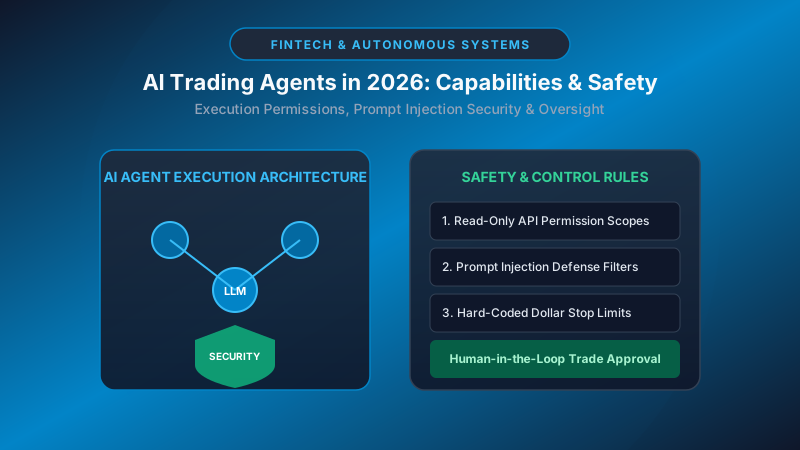
To protect capital, institutional risk managers enforce strict Human-in-the-Loop (HITL) architecture and hard-coded risk boundaries around financial AI deployments:
AI Model Generates Strategy ──► Hard-Coded Risk Filter Check ──► Human Manual Approval ──► Brokerage Execution
- Hard Risk Controls: Trade execution systems should feature hard-coded software limits that cannot be overridden by the LLM prompt—such as maximum trade size caps, daily loss stop-outs, and restricted asset blacklists.
- Human Approval Thresholds: Requiring manual human confirmation for orders exceeding specific dollar thresholds prevents runaway automated trading losses.
- Immutable Audit Logs: Comprehensive logging of all prompt inputs, model reasoning chains, and API responses ensures full auditability in the event of trade discrepancies.
5. Regulatory Disclaimers and Account Safety Rules
Financial regulators, including the SEC and FINRA, maintain strict rules regarding automated trade execution, fiduciary duty, and customer software suitability.
- No Performance Guarantees: No AI trading product can guarantee positive investment returns or eliminate market volatility.
- Protect Account Credentials: Never share primary banking passwords or unrestricted API keys with unverified AI applications.
- Maintain Self-Directed Control: For long-term wealth accumulation, broad-based index strategies held within traditional accounts remain the foundation of personal finance. Review core portfolio rules in asset allocation rebalancing explained.
6. SEC & FINRA Regulatory Rules on Financial AI
Financial regulators enforce strict oversight standards regarding automated execution, advisory algorithms, and customer account safety:
- Fiduciary Duty Rules: The Securities and Exchange Commission (SEC) requires registered investment advisers using AI models to ensure that automated recommendations act strictly in the client's best financial interest, free from conflicts of interest.
- Algorithmic Trading Compliance: FINRA rules mandate that broker-dealers deploying algorithmic trading tools conduct rigorous pre-trade testing, establish hard risk limits, and maintain continuous operational oversight.
- Customer Account Safety Audit: Consumers evaluating third-party AI financial tools should complete a 3-point security audit:
- Confirm the tool uses Read-Only API permissions unless explicit execution is intended.
- Verify that two-factor authentication (2FA) is enabled on primary brokerage accounts.
- Ensure hard-coded daily loss limits and human manual approval thresholds are active.
Summary Principles
- Distinguish Info from Execution: Separate read-only conversational financial tools from write-enabled trade execution agents.
- Enforce Strict API Limits: Never grant withdrawal access to third-party software tools; restrict permissions to read-only or scoped trading.
- Demand Human Oversight: Keep human approval gates in place for all automated trade executions to insulate capital from model error and prompt injection attacks.
MoneyTalkin' provides financial education, educational concepts, and general informational guides. Articles do not constitute personalized financial, investment, legal, or tax advice. Financial products, rates, terms, and regulatory rules change frequently; consult a qualified financial professional regarding your specific situation. Read our full Disclaimer Policy.
Written by MoneyTalkin'
MoneyTalkin' researches and publishes objective financial education content, money management fundamentals, and practical financial guides.