Why Many NFT “Utility” Promises Never Materialized
An objective breakdown of why early NFT "utility" promises fell short, examining upfront capital structures, game development friction, and misaligned developer incentives.
Why Many NFT “Utility” Promises Never Materialized
During the 2021–2022 digital asset expansion, creator teams and startups launched thousands of non-fungible token (NFT) projects. To justify high mint prices (often ranging from $200 to over $1,000 per token), project marketing shifted away from simple digital art collecting toward promises of long-term "utility."
Promised roadmaps included custom 3D metaverse worlds, play-to-earn video games, exclusive physical event access, continuous secondary token air-drops, and revenue-sharing member clubs.
By 2023, however, the vast majority of these utility promises had failed to deliver. Hundreds of projects were quietly abandoned, metaverse virtual lands remained vacant, and secondary token valuations collapsed.
Rather than attributing these outcomes to simple bad faith alone, this article examines the structural, financial, and technical reasons why early NFT utility roadmaps failed—including misaligned upfront capital incentives, software development friction, treasury depletion, and speculative market dynamics.
1. Upfront Capital Misalignment: The Core Economic Flaw
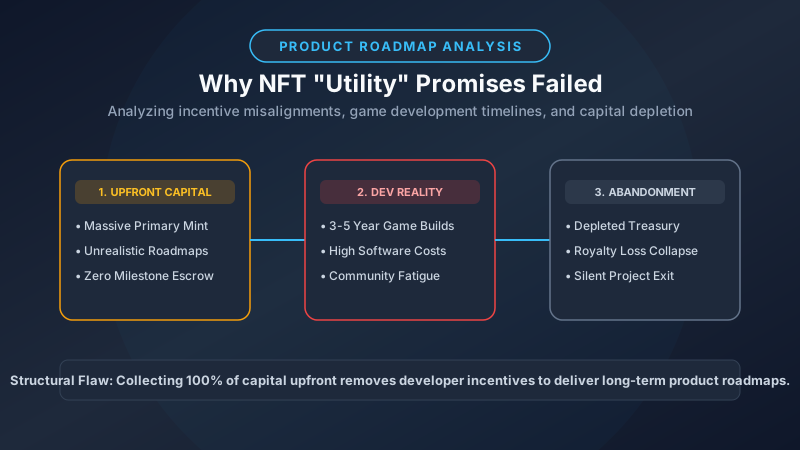
The most significant structural flaw in early NFT utility models was the upfront capital allocation structure.
Traditional Tech Funding: Seed Capital -> Milestone Releases -> VC Board Oversight -> Product Launch
Early NFT Utility Funding: 100% Upfront Mint Raise -> Zero Milestone Escrow -> Immediate Founder Payout
Traditional Startup vs. NFT Mint Funding
- Traditional Venture Capital: Startups receive capital in staged tranches tied to strict operational milestones. If a software team fails to deliver product prototypes, future funding rounds are withheld, aligning founder incentives with product execution.
- NFT Primary Mint Sales: Project teams collected 100% of their multi-million dollar capital raises on Day 1 during the primary mint sale. Because capital was delivered upfront without escrow or board oversight, project founders faced no financial obligation to complete multi-year development roadmaps.
Once speculative secondary trading cooled and secondary royalty fees dropped, teams that had exhausted initial mint funds lacked ongoing revenue mechanisms to sustain expensive software engineering teams.
2. Software & Video Game Development Realities
Many early NFT utility roadmaps promised high-end 3D multiplayer video games or immersive virtual reality metaverses to be delivered within 6 to 12 months.
The Game Development Friction
Traditional AAA video games require:
- Capital Budgets: Tens to hundreds of millions of dollars.
- Development Timelines: 3 to 7 years of continuous engineering, 3D asset modeling, server optimization, and playtesting by experienced game studios.
In contrast, early Web3 project teams often consisted of digital artists, social media marketers, and smart contract developers without prior experience building complex multiplayer game engines. When faced with the immense technical requirements of game development, early progress stalled, leading to community frustration and developer burnout.
3. Speculative Demand vs. True Utility Consumption
Another fundamental issue was the mismatch between investor expectations and utility consumption:
Investors Posing as Utility Users
- Speculative Buyers: The majority of individuals purchasing early utility NFTs were short-term speculators seeking financial returns, not genuine consumers interested in using the promised software or attending events.
- The "Utility Friction" Paradox: When a project launched a token-gated community or digital event, speculative holders frequently complained that participating in events or using software did not automatically increase the secondary floor price of their token.
When speculative price appreciation ceased, token holders abandoned the community, rendering token-gated features inactive despite the underlying software functioning as designed.
4. Token-Gated Friction & Niche Market Size
Token-gating—restricting access to websites, chat channels, or events to holders of a specific token—was widely marketed as a revolutionary membership model.
Operational Barriers
- Wallet Connection Friction: Requiring users to connect Web3 wallets, sign cryptographic messages, and pay gas fees created high friction compared to standard web logins.
- Artificial Audience Capping: Capping a community at 10,000 token holders severely limited the potential user base of any resulting software or media product. Businesses require scaling user bases to achieve network effects; artificially restricting user counts to a small pool of token holders impaired product adoption.
4. Revenue-Sharing & SEC Howey Test Legal Challenges
Many projects attempted to offer "utility" in the form of passive income, promising token holders a percentage of secondary marketplace fees, treasury investment yields, or commercial licensing revenue.
- The SEC Howey Test Risk: In the United States, promising passive financial returns derived from the managerial efforts of a centralized team meets the legal definition of an investment contract under the SEC's Howey Test.
- Regulatory Enforcement Actions: When the SEC issued enforcement actions against projects offering yield-generating NFTs (such as Impact Theory and Stoner Cats for offering unregistered securities), project founders were forced to disable revenue-sharing features, instantly neutralizing their primary advertised utility.
5. Case Study: The Play-to-Earn (P2E) Hyperinflationary Collapse
The failure of Play-to-Earn (P2E) gaming utility illustrates the danger of unsustainable in-game tokenomics:
- Dual-Token Hyperinflation: P2E games rewarded players with in-game utility tokens for winning matches or completing daily tasks. To attract new users, early token rewards were high.
- The Worker-Player Dilemma: As thousands of players joined primarily to extract daily cash earnings rather than enjoy gameplay, they continuously dumped earned tokens onto open markets to realize fiat income.
- Token Death Spiral: Without organic demand from players willing to spend money purely for entertainment, in-game token prices collapsed by over 95%, causing player bases to evaporate and destroying the game's advertised financial utility.
6. Structural Breakdown of NFT Utility Categories
| Promised Utility Category | Primary Failure Mechanism | Ultimate Outcome |
|---|---|---|
| Play-to-Earn (P2E) Gaming | Unsustainable token hyper-inflation & basic gameplay | Token economies collapsed as player selling outpaced new buyers |
| Metaverse Virtual Land | Lack of active users, high rendering friction, empty spaces | Virtual land valuations fell 90%+; platforms remained vacant |
| Physical Event Access | High venue booking costs relative to low secondary royalties | Events cancelled after initial mint funds were depleted |
| Revenue-Sharing Clubs | Securities law compliance issues (SEC Howey test) | Projects shut down or altered terms to avoid unregistered securities charges |
6. Differentiating Project Failures from Protocol Building
While early consumer utility roadmaps largely failed, it is essential to separate unviable project economics from underlying blockchain protocol technology:
As explored in our analysis of the NFT market after the downturn and NFTs beyond art explained, enterprise organizations are shifting away from high-priced speculative membership roadmaps toward low-cost, invisible infrastructure—such as digital event ticketing, verified academic credentials, and tokenized real-world assets (RWA).
7. Lessons for Digital Asset Observers
The collapse of early NFT utility roadmaps provides valuable lessons for evaluating emerging digital technology products:
- Beware of 100% Upfront Funding: Never assume an unbuilt software roadmap will be completed when developers receive full payment before building starts.
- Evaluate Team Technical Credentials: Distinguish between experienced software engineering studios and social marketing campaigns.
- Analyze Economic Sustainability: Ensure a product generates recurring operational revenue rather than relying solely on speculative secondary trading fees.
- Evaluate Regulatory Compliance: Verify whether advertised yield features violate unregistered securities laws before assuming passive income promises can be sustained legally.
- Explore Core Concepts: Review foundational economics regarding digital scarcity and mechanics of fractionalized NFTs to build a disciplined framework for evaluating emerging financial technology developments objectively.
MoneyTalkin' provides financial education, educational concepts, and general informational guides. Articles do not constitute personalized financial, investment, legal, or tax advice. Financial products, rates, terms, and regulatory rules change frequently; consult a qualified financial professional regarding your specific situation. Read our full Disclaimer Policy.
Written by MoneyTalkin'
MoneyTalkin' researches and publishes objective financial education content, money management fundamentals, and practical financial guides.
Related Technical Articles
Explore related topics in this cluster to deepen your understanding.