Fractionalized NFTs Explained: Owning a Slice of a Digital Asset
A comprehensive, objective breakdown of fractionalized NFTs, detailing vault smart contract mechanics, buyout auctions, liquidity benefits, and SEC securities law risks.
Fractionalized NFTs Explained: Owning a Slice of a Digital Asset
During the peak of the digital asset boom, individual non-fungible tokens (NFTs) representing high-profile collectibles or virtual real estate sold for hundreds of thousands—or even millions—of dollars. For average retail investors, purchasing an entire high-value asset outright was financially unfeasible.
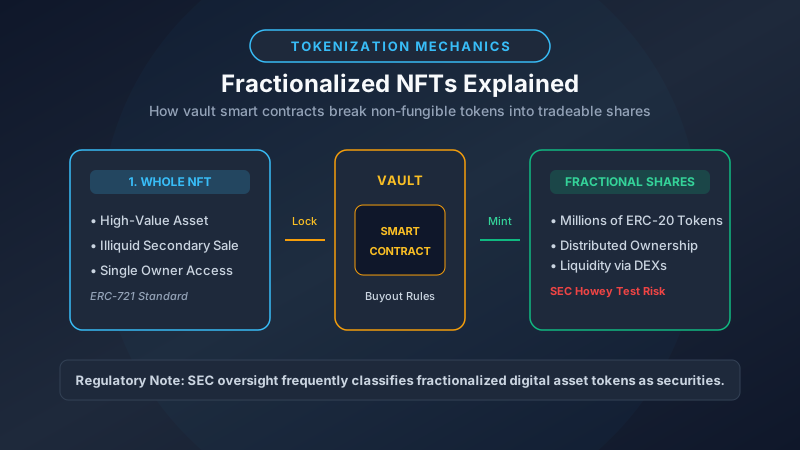
To increase access and liquidity, smart contract developers created fractionalized NFTs (F-NFTs). Fractionalization involves locking a single non-fungible token into a smart contract vault and issuing thousands or millions of fungible ERC-20 tokens that represent fractional ownership stakes in the underlying asset.
While fractionalization lowers capital barriers and improves market liquidity, it introduces significant technical complexity, governance challenges, and securities law risks under U.S. regulatory frameworks.
This article provides an educational analysis of fractionalized NFTs—explaining vault smart contract mechanics, buyout auction mechanisms, liquidity benefits, and the critical legal distinctions that separate fractionalized digital tokens from traditional corporate equity.
1. How Fractionalization Works: Vault Smart Contracts
Fractionalizing a digital asset relies on interaction between two distinct token standards: ERC-721 (the standard non-fungible token) and ERC-20 (the standard fungible token).
[Original NFT (ERC-721)] -> Locked in Vault Contract -> Mints 1,000,000 Fractional Tokens (ERC-20) -> Traded on DEXs
The Step-by-Step Fractionalization Process
- Vault Creation: The owner of an NFT transfers the asset into a specialized smart contract vault.
- Token Minting: The vault smart contract locks the original NFT and automatically mints a fixed supply of fungible tokens (e.g., 1,000,000 ERC-20 tokens) representing proportional claims on the vault contents.
- Distribution & Secondary Trading: The original owner can sell these fractional tokens to multiple buyers on decentralized exchanges (DEXs).
- Custody & Lockup: The original NFT remains locked inside the smart contract vault until a buyout mechanism is triggered.
2. Unlocking the Vault: Buyout Mechanisms & Reserve Prices
A critical technical challenge in fractionalization is determining how to reconstitute the original NFT if a single buyer wants to acquire 100% of the asset.
Smart contracts handle this through buyout auctions:
Reserve Price Aggregation
Fractional token holders vote on a reserve price—the minimum total valuation at which they are willing to allow a buyout of the locked NFT. The smart contract calculates a weighted average reserve price based on the token balances of participating voters.
The Buyout Auction Process
- Initiating a Bid: A prospective buyer deposits ETH equal to or greater than the current aggregated reserve price into the vault contract.
- Auction Window: The deposit triggers an automated timed auction (e.g., lasting 3 days), allowing other interested buyers to place higher bids.
- Auction Settlement:
- If the Bid Succeeds: The high bidder receives the original non-fungible token unlocked from the vault. The winning ETH deposit is distributed proportionally to all fractional token holders, who can redeem their ERC-20 tokens for cash.
- If the Bid Fails: The deposit is returned to the bidder, and the NFT remains locked in the vault.
3. Benefits vs. Structural Risks of Fractionalization
| Aspect | Potential Advantages | Structural Risks & Limitations |
|---|---|---|
| Liquidity | Converts illiquid $1M asset into tradeable $1 shares | Thin trading volume can cause high price slippage on DEXs |
| Capital Access | Enables small investors to gain price exposure to high-value assets | No direct physical custody or exclusive personal usage rights |
| Price Discovery | Frequent trading of fractional shares helps estimate asset market value | Fractional token trading prices can detach from whole-asset value |
| Smart Contract Security | Automated execution without human intermediaries | Vulnerable to smart contract bugs, exploit hacks, or buyout manipulation |
4. Smart Contract Vulnerabilities & Flash Loan Buyout Risks
Fractionalization vaults rely entirely on automated code execution:
- Flash Loan Attacks: Attackers can utilize uncollateralized flash loans to temporarily borrow millions of dollars in cryptocurrency within a single blockchain transaction block, execute a reserve price buyout, claim the vaulted NFT, and return the flash loan—all in seconds—bypassing standard retail bidding periods if vault parameters are poorly configured.
- Reentrancy Bugs: Faulty vault contract code can allow malicious actors to repeatedly trigger withdrawal functions during redemption processes, draining vault collateral before state variables update.
4. Fractional Tokens vs. Traditional Equity & REITs
Comparing fractionalized digital tokens to traditional fractional investment structures highlights key legal differences:
| Dimension | Fractionalized Digital Tokens | Real Estate Investment Trusts (REITs) | Traditional Corporate Stock |
|---|---|---|---|
| Legal Framework | Smart contract code execution | SEC-registered corporate trust structure | State corporate law (e.g., Delaware General Corporation Law) |
| Investor Rights | Code-defined buyout redemption rights | Statutory dividend distributions & shareholder voting | Voting rights, dividend claims & legal standing |
| Regulatory Filing | Frequently unregistered | Full SEC Registration & Form 10-K disclosures | Full SEC Registration & Form 10-K disclosures |
| Custody & Vaulting | Cryptographic smart contract vault | Insured institutional custodian | Transfer agent & SEC-cleared custodian |
5. The Critical Regulatory Boundary: SEC Securities Law & The Howey Test
The most significant legal risk facing fractionalized NFTs is U.S. securities regulation.
SEC Howey Test: Investment of Money + Common Enterprise + Expectation of Profit + Derived from Managerial Efforts of Others
Why Fractionalized NFTs Often Constitute Securities
While a whole non-fungible token representing a unique digital collectible or physical artwork may not be classified as a security, fractionalizing the asset fundamentally alters its legal status:
- Investment Contract Structure: Selling 1,000,000 fractional tokens to passive retail buyers who expect the value of their tokens to appreciate based on market promotion constitutes an investment contract under the SEC's Howey Test.
- SEC Enforcement Statements: SEC commissioners and enforcement divisions have explicitly noted that offering fractionalized digital tokens to the public generally meets the definition of an unregistered securities offering.
- Legal Distinctions: Fractionalized tokens do not confer the legal protections of corporate stock shares, such as SEC registration disclosures, corporate voting rights under state law, or bankruptcy priority.
5. Valuation Challenges & Thin Liquidity Realities
In practice, fractionalized tokens frequently suffer from severe valuation divergence:
- The Illiquidity Discount: If secondary trading volume for a fractionalized token is low, a small sell order can depress the token's market price significantly below the implied value of the underlying whole asset.
- Buyout Exploitation Risks: Capital-rich market participants can manipulate reserve price voting by accumulating large blocks of fractional tokens at depressed prices, enabling them to initiate a buyout auction and acquire a high-value asset at a substantial discount.
6. Strategic Summary for Observers
Fractionalized NFTs represent a fascinating technical experiment in converting illiquid assets into tradeable digital shares. However, technical risks and strict securities regulations present major hurdles:
- Understand that fractional tokens are complex financial derivatives, not standard digital collectibles.
- Recognize that U.S. regulators frequently classify fractionalized tokens as unregistered securities.
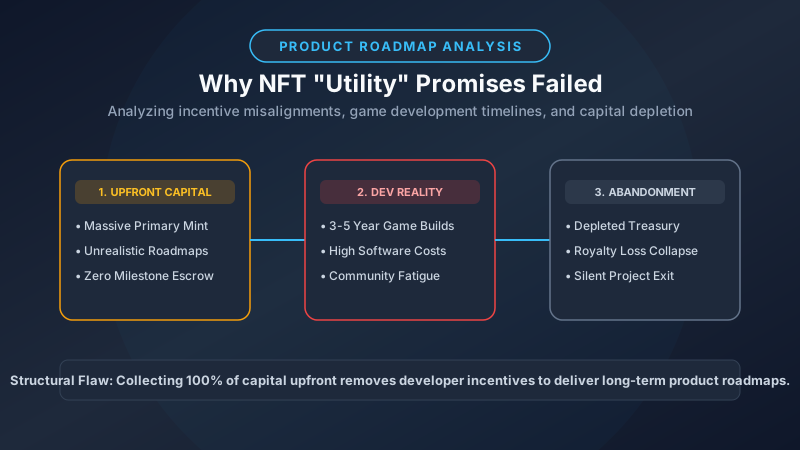
- Review related educational articles analyzing the post-downturn NFT market, functional applications of NFTs beyond art, why early NFT utility roadmaps failed, and foundational concepts of digital scarcity.
- Consult Legal Disclosures: Verify whether tokenized asset structures maintain registered broker-dealer or transfer agent agreements to avoid participating in unregistered securities distribution.
- Prioritize Security Standards: Always inspect smart contract audit reports and vault parameter configurations to evaluate smart contract exposure before purchasing fractional digital tokens.
MoneyTalkin' provides financial education, educational concepts, and general informational guides. Articles do not constitute personalized financial, investment, legal, or tax advice. Financial products, rates, terms, and regulatory rules change frequently; consult a qualified financial professional regarding your specific situation. Read our full Disclaimer Policy.
Written by MoneyTalkin'
MoneyTalkin' researches and publishes objective financial education content, money management fundamentals, and practical financial guides.
Related Technical Articles
Explore related topics in this cluster to deepen your understanding.