Digital Scarcity as an Economic Concept: Does It Make Sense?
A foundational economic analysis of digital scarcity, examining zero marginal reproduction costs, blockchain provenance, artificial constraints, and Metcalfe’s Law.
Digital Scarcity as an Economic Concept: Does It Make Sense?
For most of economic history, the concept of scarcity was inextricably linked to physical reality. Physical goods—such as gold, land, timber, or oil—are inherently limited by geography, extraction costs, and natural resource availability.
The advent of the internet created an environment of digital abundance. Digital files—whether text documents, JPEGs, MP3s, or software code—can be reproduced an infinite number of times at near-zero marginal cost. If one person emails a digital photo to a friend, both individuals possess an identical, pixel-for-pixel copy without depleting the original file.
However, the creation of distributed blockchain ledgers introduced a novel economic concept: cryptographically enforced digital scarcity. By combining peer-to-peer networks, public-key cryptography, and consensus mechanisms, blockchains enforce strict supply caps on digital ledger entries.
This article provides an educational economic evaluation of digital scarcity—examining how artificial scarcity functions, how it differs from physical scarcity, the role of network effects, and why scarcity alone does not guarantee economic value.
1. Physical vs. Digital Economics: Marginal Cost of Reproduction
To evaluate digital scarcity, economists start with fundamental production cost dynamics:
Physical Goods: High Marginal Cost of Production & Natural Supply Caps
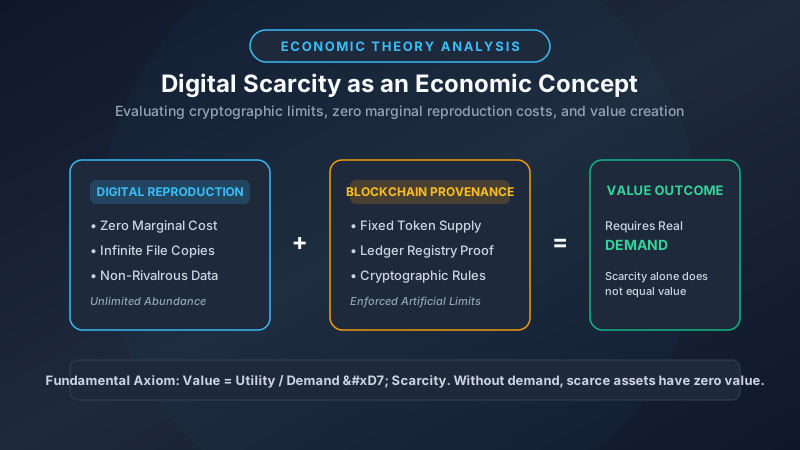
Legacy Digital Goods: Zero Marginal Cost of Reproduction & Infinite Abundance
Blockchains: Zero Reproduction Cost for Files + Fixed Supply Cap for Ledger Entries
The Non-Rivalrous Nature of Information
In classical economics, digital information is classified as a non-rivalrous good. A good is non-rivalrous if one person’s consumption does not reduce another person’s ability to consume it simultaneously:
- Physical Asset (Rivalrous): If you are driving an automobile, another person cannot drive that exact same vehicle at the same time.
- Digital File (Non-Rivalrous): A million users can stream the same digital audio file simultaneously without degrading the file's quality or availability.
Because digital information is non-rivalrous, attempting to restrict access to digital files historically failed unless enforced by centralized licensing servers or digital rights management (DRM) software.
2. How Blockchain Provenance Creates Digital Scarcity
Blockchains do not make digital files themselves rivalrous. A JPEG attached to a digital token can still be copied, downloaded, or screenshot by anyone with an internet connection.
Instead, blockchain technology introduces cryptographic provenance—the ability to verify indisputable ownership of a specific ledger entry:
- Fixed Supply Rules: Consensus rules mathematically limit the total number of tokens that can ever exist on a specific ledger (e.g., Bitcoin’s 21 million supply cap, or a smart contract minting exactly 1,000 token entries).
- Unforgeable Ownership Records: Public-key cryptography ensures that only the holder of a private key can transfer ownership of a specific token entry.
- Distinguishing the Container from the Content: Digital scarcity applies to the on-chain token registry entry, not to the off-chain digital media file. Owning a token entry is economically analogous to owning an autographed original baseball card; millions of identical printed reprints exist, but only one card carries the original authenticated signature.
3. Artificial Scarcity vs. Natural Economic Scarcity
Economists distinguish between natural scarcity and artificial scarcity:
1. Natural Scarcity
Applies to physical resources limited by nature. Refining gold requires real-world labor, heavy machinery, and environmental energy. Even if gold prices triple, total global gold extraction increases only incrementally due to physical geological limits.
2. Artificial Scarcity
Occurs when a supply limit is intentionally constructed by rules or software code despite zero physical constraint on production:
- Software License Keys: Software companies create artificial scarcity by requiring paid license keys to activate software that costs nothing to replicate.
- Token Supply Caps: A developer can write a smart contract limiting a digital token collection to 100 items or 100,000 items with identical effort. The scarcity is defined purely by software parameters.
4. The Fundamental Economic Axiom: Scarcity $\neq$ Value
A central misconception in speculative digital asset markets is assuming that scarcity automatically creates economic value.
Economic Value = (Utility + Subjective Desire) x Effective Demand
The Supply and Demand Reality
In market economics, price is determined by the intersection of supply and demand:
- Scarcity Only Controls Supply: A fixed supply cap ensures that supply cannot expand infinitely. However, supply is only one half of the pricing equation.
- Demand Determines Realized Value: If there is zero consumer desire or utility for a scarce item, its economic value is $0.00, regardless of how scarce it is.
Example: A person can create a unique, one-of-a-kind digital drawing that is cryptographically limited to a single token. Because the item is unique, its supply is perfectly scarce (1 of 1). However, if no one in the world desires to own it, the token commands no economic value.
5. Network Effects & Metcalfe's Law
When digital scarcity does successfully generate long-term economic value, it is usually supported by strong network effects:
Metcalfe's Law
Metcalfe’s Law states that the financial value ($V$) of a telecommunications or social network is proportional to the square of the number of connected users ($n$):
$$V \propto n^2$$
When a digitally scarce protocol (such as Bitcoin or Ethereum) attracts millions of users, developers, and payment integrations, the underlying network becomes increasingly useful. The digital token functions as the native settlement asset of that expanding network. In this scenario, value is created by network utility, not by software-enforced scarcity alone.
6. Monetary Velocity & The Equation of Exchange ($MV = PQ$)
Economists also evaluate digital token scarcity using classical monetary economics, specifically Irving Fisher’s Equation of Exchange:
$$M \cdot V = P \cdot Q$$
Where:
- $M$: Total money supply (the quantity of scarce digital tokens in circulation).
- $V$: Velocity of money (how frequently each token changes hands over a year).
- $P$: Price level of goods and services settled on the network.
- $Q$: Quantity of real goods and services transacted on the network.
Velocity & Value Retention
If a digital token has a strictly capped supply ($M$), but its holders trade it continuously at high speed without retaining positions ($V$ is extremely high), the required market cap to settle network transactions remains low. Conversely, when users hold a scarce token for long-term store-of-value purposes (reducing velocity $V$), the purchasing power per token must expand to accommodate transaction volume ($P \cdot Q$).
7. Ownership Rights vs. Access Rights
Digital scarcity has altered how economists view digital property:
| Model | Ownership Rights | Access Rights | Scalability |
|---|---|---|---|
| Traditional SaaS / Streaming | None (user rents access from central server) | Conditional (revocable upon subscription lapse) | Controlled by vendor |
| Pirated Digital Media | None (unauthorized copy) | Unrestricted local file access | Infinite zero-cost copying |
| Cryptographic Digital Tokens | Self-custodial ledger ownership | Publicly viewable content; exclusive token control | Enforced by blockchain consensus |
7. Strategic Conclusions for Observers
Analyzing digital scarcity through established economic principles provides clarity when evaluating emerging financial assets:
- Separate Token Registry from Media Files: Recognize that cryptographic scarcity protects the ledger entry, not the underlying digital file.
- Never Equate Scarcity with Value: Always evaluate consumer demand, network utility, and adoption metrics before assuming a scarce asset holds value.
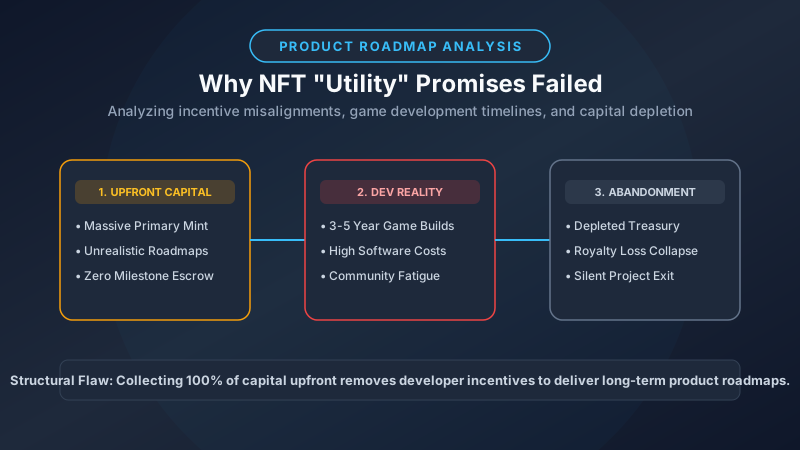
- Explore Related Analyses: Review detailed studies on post-downturn NFT market data, functional applications of NFTs beyond art, why early NFT utility roadmaps failed, and legal structures surrounding fractionalized NFTs.
MoneyTalkin' provides financial education, educational concepts, and general informational guides. Articles do not constitute personalized financial, investment, legal, or tax advice. Financial products, rates, terms, and regulatory rules change frequently; consult a qualified financial professional regarding your specific situation. Read our full Disclaimer Policy.
Written by MoneyTalkin'
MoneyTalkin' researches and publishes objective financial education content, money management fundamentals, and practical financial guides.
Related Technical Articles
Explore related topics in this cluster to deepen your understanding.