Options Trading Went Mainstream: Why Retail Traders Are Using Tools Built for Professionals
A comprehensive, objective breakdown of retail options trading, explaining option mechanics, leverage risks, time decay, 0DTE options, and approval levels.
Options Trading Went Mainstream: Why Retail Traders Are Using Tools Built for Professionals
Historically, equity options were utilized primarily by institutional fund managers, market makers, and professional hedgers to manage portfolio risk or execute complex yield strategies. Over the past several years, however, mobile trading applications, zero-commission structures, and social communities have brought options trading firmly into the retail mainstream.
According to data from the Options Clearing Corporation (OCC), annual U.S. options contract clearing volume reached historic highs in recent years, driven largely by retail participation in short-dated options, including 0DTE (Zero Days to Expiration) contracts.
While options offer capital leverage and strategic flexibility, they are significantly more complex than buying standard shares of stock. This article provides an educational breakdown of how options work, key risk factors such as time decay and implied volatility collapse, brokerage approval tiers, and why options carry severe capital loss potential.
1. Options Basics: Calls, Puts, and Contracts
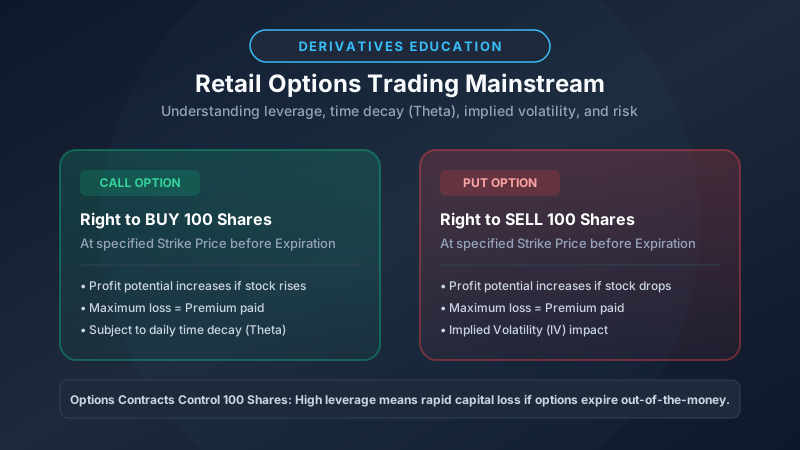
An option is a financial derivative contract that grants the buyer the right—but not the obligation—to buy or sell an underlying security at a specified price within a set timeframe.
1 Options Contract = Control of 100 Shares of Underlying Stock
Key Terminology
- Underlying Asset: The equity, ETF, or index upon which the option contract is based.
- Strike Price: The predetermined fixed price at which the option buyer can exercise their contract to buy or sell the underlying asset.
- Expiration Date: The final date on which the option contract is valid. After this date, unexercised options expire worthless.
- Premium: The price paid by the buyer to the seller (writer) to acquire the option contract.
Call Options vs. Put Options
| Option Type | Buyer's Right | Market Outlook | Maximum Risk (Buyer) |
|---|---|---|---|
| Call Option | Right to BUY 100 shares at strike price | Bullish (expects price rise) | 100% of Premium paid |
| Put Option | Right to SELL 100 shares at strike price | Bearish (expects price fall) | 100% of Premium paid |
2. Why Retail Traders Are Drawn to Options: Leverage & Low Capital Outlay
The primary factor driving retail options adoption is embedded leverage.
Rather than purchasing 100 shares of a $100 stock outright—which requires $10,000 of upfront capital—a trader might purchase a 30-day Call Option with a $105 strike price for a premium of $2.00 per share ($200 total contract cost).
The Appeal of Asymmetric Capital Allocation
- Capital Efficiency: The investor controls the price movement of 100 shares for $200 instead of $10,000.
- Magnified Percentage Gains: If the underlying stock rises 10% from $100 to $110, the call option's value might increase from $2.00 to $6.00—a 200% gain on the option premium compared to a 10% gain on holding spot stock.
However, leverage works equally in reverse. If the stock remains at $100 or drops, the option can lose 100% of its value rapidly, leaving the buyer with a total loss of their $200 investment.
3. The Core Hidden Risks: Time Decay & Implied Volatility
Unlike standard stocks—which can be held indefinitely in a taxable brokerage account while waiting for business recovery—options are decaying assets governed by option pricing models (such as the Black-Scholes model).
1. Time Decay (Theta Risk)
Option value erodes continuously as the contract approaches its expiration date. This rate of decay is known as Theta:
- Accelerating Decay Curve: Time decay is non-linear. Decay accelerates significantly during the final 30 days before expiration.
- The "Ticker Clock": Even if an investor correctly predicts the direction of a stock's movement, if the movement occurs after the option expires, the option still expires worthless.
Options Value = Intrinsic Value + Extrinsic (Time & Volatility) Value
* Extrinsic Value Decays to $0.00 at Expiration *
2. Implied Volatility (IV) & "IV Crush"
Implied Volatility (IV) reflects the market's expectation of future price swings. Option premiums expand when IV is high (such as immediately before an earnings report) and shrink when IV falls:
- IV Crush: Following a major anticipated event (like an earnings announcement), implied volatility drops sharply. An investor who buys a call option before earnings may see their contract lose value the next morning even if the stock price moved slightly higher, because the collapse in IV erased the option's extrinsic time value.
4. Understanding Option "Greeks"
Professional options traders use key risk metrics called the Option Greeks to quantify contract sensitivity:
- Delta ($\Delta$): Measures how much an option's price is expected to change per $1.00 move in the underlying stock. A call option with a 0.50 Delta will increase in value by $0.50 for every $1.00 increase in the stock.
- Gamma ($\Gamma$): Measures the rate of change of Delta for every $1.00 move in the stock. High Gamma means Delta changes rapidly, accelerating option price swings.
- Theta ($\Theta$): Measures daily time decay. A Theta of -0.05 indicates the option loses $0.05 in value per share each day, holding all else constant.
- Vega ($V$): Measures sensitivity to changes in implied volatility. A Vega of 0.15 means the option premium gains $0.15 for every 1-percentage-point increase in IV.
5. Option Assignment & Exercise Mechanics
Understanding how options contracts settle at expiration is critical for risk management:
- In-The-Money (ITM) Automatic Exercise: Options that expire even $0.01 in-the-money are automatically exercised by clearing firms unless explicitly instructed otherwise.
- Assignment Risk: Writers (sellers) of options can be assigned at any time before expiration, requiring them to deliver 100 shares of stock (for call sellers) or buy 100 shares of stock (for put sellers) at the agreed strike price.
- Pin Risk: If an underlying stock trades right near the strike price at market close on expiration day, traders face uncertainty over whether their option will be assigned or expire, creating potential unexpected margin position exposure over the weekend.
6. The Rise of 0DTE (Zero Days to Expiration) Options
A defining trend in modern markets is the growth of 0DTE options—contracts that expire on the same day they are traded.
- Ultra-Short Horizon: 0DTE contracts allow traders to speculate on intraday price swings for minimal upfront premium.
- High Volatility & Rapid Loss: Because 0DTE options have zero remaining time value buffer, minor intraday price reversals cause 0DTE option values to fluctuate by 50% to 100% within minutes, creating extreme risks akin to short-term gambling.
5. Brokerage Options Approval Tiers
To fulfill regulatory suitability obligations, brokerages assign account owners specific options approval levels based on self-reported investment experience, liquid net worth, and risk tolerance:
- Level 1 (Covered Writing): Writing covered calls or cash-secured puts (low risk, fully collateralized).
- Level 2 (Long Options): Buying long call and long put options (risk limited to premium paid).
- Level 3 (Spreads): Executing multi-leg option spreads (e.g., vertical spreads, iron condors).
- Level 4 (Uncovered / Naked Options): Writing uncovered call or put options (extreme risk; theoretical infinite loss potential).
6. Options Trading vs. Standard Equity Investing
| Feature | Standard Stock Shares | Long Options Contracts |
|---|---|---|
| Ownership | Direct equity stake in company | Contractual right to trade underlying stock |
| Time Horizon | Indefinite (hold as long as desired) | Strict expiration date (days, weeks, or months) |
| Dividend Rights | Entitled to receive declared dividends | No dividend rights |
| Loss Profile | Maximum loss = 100% if company defaults | 100% loss occurs frequently if out-of-the-money at expiration |
| Complexity | Simple (buy/sell spot price) | High (requires understanding Delta, Theta, IV) |
7. Strategic Conclusions for Individual Investors
While options serve valid financial functions for portfolio hedging and institutional risk management, using them for retail speculation introduces substantial risk.
For investors focusing on building long-term wealth—whether analyzing the GameStop saga years later, evaluating short squeezes, or building a diversified foundation of index funds vs. individual stocks—understanding option mechanics helps clarify why derivatives are high-risk financial instruments requiring rigorous risk management.
MoneyTalkin' provides financial education, educational concepts, and general informational guides. Articles do not constitute personalized financial, investment, legal, or tax advice. Financial products, rates, terms, and regulatory rules change frequently; consult a qualified financial professional regarding your specific situation. Read our full Disclaimer Policy.
Written by MoneyTalkin'
MoneyTalkin' researches and publishes objective financial education content, money management fundamentals, and practical financial guides.
Related Technical Articles
Explore related topics in this cluster to deepen your understanding.