Short Squeezes Explained Without Jargon
A clear, jargon-free guide to short squeezes, explaining how short sellers borrow shares, how margin calls force buying, and why squeeze momentum eventually collapses.
Short Squeezes Explained Without Jargon
In financial news, few terms generate as much excitement—or confusion—as a short squeeze. When a short squeeze occurs, a company's stock price can double, triple, or surge even higher in a matter of days, often catching traditional market analysts by surprise.
While short squeezes appear chaotic on the surface, they are driven by specific structural rules governing how shares are borrowed, traded, and settled in equity markets.
This article breaks down the mechanics of short selling, explains how a short squeeze becomes a self-reinforcing feedback loop, examines key short interest metrics, provides a hypothetical numerical example, and highlights the substantial risks involved for both short sellers and retail buyers.
1. The Foundation: How Short Selling Works
To understand a short squeeze, you must first understand short selling.
When a standard investor buys shares of stock (going "long"), they purchase shares expecting the price to rise so they can sell at a profit later:
Standard Long Trade: Buy Low -> Wait for Price Growth -> Sell High = Profit
A short seller does the exact opposite. They bet that a stock’s price will decline:
Short Sale Trade: Borrow Shares -> Sell High Immediately -> Buy Back Low Later ("Cover") -> Return Shares = Profit
The Step-by-Step Short Sale Mechanics
- Borrowing Shares: A short seller borrows shares of stock from an existing shareholder (facilitated through their brokerage account).
- Selling on the Open Market: The short seller immediately sells those borrowed shares on the open market at the current market price, receiving cash proceeds.
- Buying Back ("Covering"): To close the position, the short seller must eventually purchase an equal number of shares on the open market and return them to the original lender.
- Profit or Loss:
- If the stock price falls, the short seller buys back the shares for less money than they sold them for, pocketing the difference.
- If the stock price rises, buying back the shares costs more than the sale proceeds, resulting in a loss.
2. What Triggers a Short Squeeze?
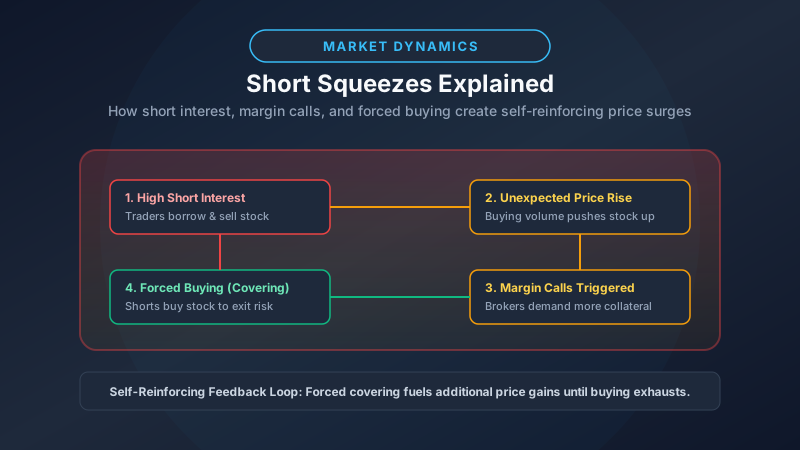
A short squeeze happens when a stock with high short interest experiences a sudden price increase. Because short sellers face unlimited theoretical loss potential, rising prices force them to buy shares quickly to exit their positions—a process called covering.
When hundreds of short sellers buy shares simultaneously to cover their positions, their buying adds to normal demand, driving the price even higher.
The Self-Reinforcing Feedback Loop
Stock Price Increases -> Short Sellers Face Losses -> Brokers Issue Margin Calls -> Short Sellers Buy Shares to Cover -> Buying Volume Drives Price Higher -> Repeat
- Initial Catalyst: Positive news, strong earnings, or a surge in retail buying interest causes a shorted stock's price to tick upward.
- Unrealized Losses Accumulate: As the price rises, short sellers accumulate growing paper losses.
- Margin Calls Triggered: Brokerages require short sellers to maintain minimum cash collateral (margin). If losses exceed available collateral, the broker issues a margin call, demanding additional cash or automatically liquidating the position by buying back shares.
- Forced Buying Spikes Price: Automatic covering orders flood the market, competing for a limited pool of available shares.
- Cascading Squeeze: The price surge triggers margin calls for short sellers with higher price thresholds, perpetuating the squeeze until buying volume is exhausted.
3. Key Short Interest Metrics Explained
Investors analyze several data metrics to evaluate a stock's squeeze potential:
Short Interest (SI)
The total number of shares that have been sold short but not yet covered, expressed either as a raw number or as a percentage of the company’s public float (the total shares available for public trading).
- Example: A stock with 10 million float shares and 3 million shorted shares has a 30% short interest.
- High short interest (typically above 20% of float) indicates significant bearish sentiment—and high potential squeeze fuel if sentiment shifts.
Days to Cover (Short Interest Ratio)
Calculated by dividing total shorted shares by the stock's average daily trading volume:
$$\text{Days to Cover} = \frac{\text{Total Shorted Shares}}{\text{Average Daily Volume}}$$
If a stock has 10 million shorted shares and average daily volume is 2 million shares, the Days to Cover is 5 days. A higher ratio means it would take longer for short sellers to buy back their positions without dramatically pushing up the share price.
Short Borrow Fees (Hard-to-Borrow Rates)
Short sellers must pay an annual fee to borrow shares, known as the borrow fee or hard-to-borrow (HTB) rate. For liquid stocks, borrow fees are low (e.g., 0.3% per year). However, when demand to short a stock is extremely high relative to available shares, borrow fees can spike to 50%, 100%, or more annualized. High borrow fees increase holding costs, pressuring short sellers to cover even if the stock price remains unchanged.
Regulation SHO Threshold Security List
Under SEC Regulation SHO, if a security experiences persistent failed-to-deliver (FTD) positions above specific thresholds for five consecutive settlement days, it is placed on the Threshold Security List. Inclusion signals severe liquidity constraints in borrowing physical shares, often serving as an early indicator of squeeze potential.
4. Hypothetical Numerical Example
Hypothetical example for illustrative purposes only:
- Company ABC Stock Price: $10 per share.
- Trader Shorting: Trader X borrows 1,000 shares of Company ABC and sells them on the market for $10,000 in cash proceeds.
- Market Surprise: Unexpected positive clinical trial results cause Company ABC stock to surge from $10 to $30 per share over two trading sessions.
Outcome Scenarios:
-
If Trader X Cores at $30: To return the 1,000 borrowed shares, Trader X must buy them on the open market for $30,000. $$\text{Loss} = $10,000 \text{ (Initial Proceeds)} - $30,000 \text{ (Covering Cost)} = -$20,000 \text{ Loss}$$ Trader X loses 200% of their original position value.
-
If Trader X Cannot Meet Margin Call: Their broker forcibly buys the shares at $30 on the market, contributing to the buying pressure that pushes the next investor's covering price to $35 or $40.
5. Major Risks for All Market Participants
While headlines often celebrate massive short squeeze returns, participating in or chasing a short squeeze carries extreme financial risk for both sides of the trade:
Risks for Short Sellers: Asymmetric Risk
When buying a stock, the maximum you can lose is 100% of your investment (if the stock goes to $0). However, because a stock's price has no theoretical upper ceiling, short selling carries unlimited potential losses.
Risks for Long Retail Buyers: The Collapse Phase
Short squeezes are inherently temporary. Once short sellers finish covering their positions and speculative retail buying momentum cools, the artificial demand vanishes. Stocks that spiked from $10 to $100 on squeeze mechanics frequently crash back toward fundamental levels just as quickly, leaving late-arriving buyers with severe capital losses.
6. Short Squeeze vs. Ordinary Volatility
| Feature | Short Squeeze | Ordinary Volatility |
|---|---|---|
| Primary Driver | Forced covering by short sellers due to margin calls | News, earnings updates, or broad economic sentiment |
| Price Speed | Extreme, vertical intraday price spikes | Gradual or moderate price swings over time |
| Volume Pattern | Dramatic volume spikes followed by abrupt drops | Consistent volume tied to news flow |
| Long-Term Sustainability | Low; prices usually collapse after covering ends | Varies based on corporate fundamentals |
7. Strategic Conclusions for Investors
For individuals maintaining a disciplined approach to building long-term wealth—whether using a taxable brokerage account, navigating payment for order flow, or building a portfolio of index funds vs. individual stocks—short squeezes represent high-risk market anomalies rather than sustainable wealth-building strategies.
Understanding short squeeze mechanics provides clarity when reading financial news, helping investors recognize that vertical price spikes are driven by short-term structural margin calls rather than sudden changes in corporate business quality.
MoneyTalkin' provides financial education, educational concepts, and general informational guides. Articles do not constitute personalized financial, investment, legal, or tax advice. Financial products, rates, terms, and regulatory rules change frequently; consult a qualified financial professional regarding your specific situation. Read our full Disclaimer Policy.
Written by MoneyTalkin'
MoneyTalkin' researches and publishes objective financial education content, money management fundamentals, and practical financial guides.
Related Technical Articles
Explore related topics in this cluster to deepen your understanding.