Payment for Order Flow Explained: Why 'Free' Trading Apps Aren't Really Free
A comprehensive, balanced guide explaining Payment for Order Flow (PFOF), detailing wholesale market makers, bid-ask spreads, execution quality, and SEC regulations.
Payment for Order Flow Explained: Why "Free" Trading Apps Aren't Really Free
The widespread transition to zero-commission stock trading in 2019 revolutionized retail investing in the United States. Today, individual investors can buy and sell equities and exchange-traded funds without paying a $4.95 or $6.95 per-trade transaction fee.
However, operating a brokerage platform involves significant infrastructure, clearing, and regulatory costs. To fund operations and generate profit without charging commissions, many retail brokerages rely on a revenue-sharing model known as Payment for Order Flow (PFOF).
Under PFOF, brokers route retail customer trade orders to wholesale market-making firms—such as Citadel Securities or Virtu Financial—rather than executing them directly on public exchanges like the NYSE or Nasdaq. In exchange for receiving this order flow, market makers pay the broker a small fee per share or contract.
This article provides an objective breakdown of how PFOF functions, the mechanics of market maker internalization, potential conflicts of interest, regulatory disclosures, and arguments surrounding total execution cost.
1. How Payment for Order Flow Works
To understand PFOF, it is essential to follow an order’s lifecycle from trade placement to execution:
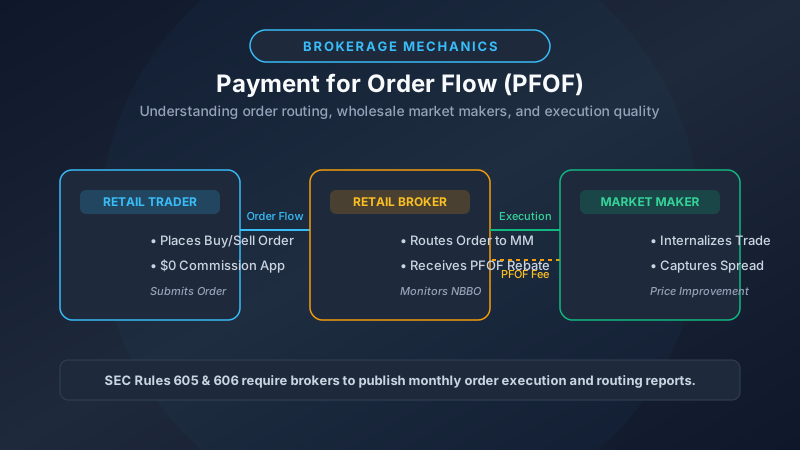
[Retail Investor] -> Places Order -> [Retail Broker] -> Routes Order + Receives Fee -> [Market Maker] -> Internalizes & Captures Spread
- Trade Placement: A retail investor enters an order to buy 100 shares of a stock on a zero-commission trading application.
- Order Routing: Rather than sending the order directly to a public stock exchange, the retail broker routes the order to a wholesale market maker under an existing PFOF agreement.
- Execution & Internalization: The market maker executes the trade out of its own inventory or by pairing it against another order, capturing the bid-ask spread.
- Rebate Payment: The market maker pays the retail brokerage a small fraction of a cent per share (e.g., $0.001 to $0.002 per share) or per options contract for directing the trade to them.
2. Market Maker Mechanics & The Bid-Ask Spread
Wholesale market makers are financial firms that stand ready to buy and sell securities continuously. They earn profit primarily through the bid-ask spread:
- Bid Price: The highest price a buyer is willing to pay for a stock.
- Ask Price: The lowest price a seller is willing to accept.
- Spread Profit: If a stock’s bid is $50.00 and its ask is $50.02, the spread is $0.02. A market maker buying at $50.00 and selling to another party at $50.02 captures the $0.02 difference.
Why Market Makers Value Retail Order Flow
Retail orders are considered "uninformed" or "non-toxic" relative to institutional orders. Institutional investors (such as pension funds or hedge funds) execute massive block trades that can move market prices against a market maker. Retail orders, by contrast, are small, diverse, and rarely move overall market prices. Market makers can safely internalize retail orders with minimal inventory risk, allowing them to pay brokers a small rebate while still profiting from the spread.
3. Price Improvement vs. Potential Conflicts of Interest
The debate surrounding PFOF centers on balancing price improvement against routing conflicts of interest.
The Case for PFOF: Price Improvement & Low Cost
Proponents of PFOF argue that the system provides net economic benefits to retail investors:
- Better Than NBBO Execution: Federal regulations enforce the National Best Bid and Offer (NBBO) rule, requiring trades to be executed at prices at least as favorable as the best available public bid or ask. Market makers frequently fill retail orders inside the spread, providing price improvement (e.g., executing a buy order at $50.01 when the public ask is $50.02).
- Zero Direct Commissions: Eliminating flat $6.95 commission fees saves buy-and-hold retail investors substantial money over time, enabling dollar-cost averaging in small dollar amounts.
- High Fill Rates: Wholesale market makers offer near-instantaneous execution speed and high order fill rates.
The Case Against PFOF: Hidden Costs & Routing Incentives
Critics argue that PFOF creates structural conflicts of interest and hidden execution costs:
- Order Routing Bias: Brokers might be incentivized to route customer orders to whichever market maker offers the highest PFOF rebate rather than the firm offering the absolute best execution quality.
- Wider Spreads: If retail order flow is siphoned away from public exchanges to off-exchange dark pools, public exchange order books become less liquid, potentially widening bid-ask spreads across the broader market.
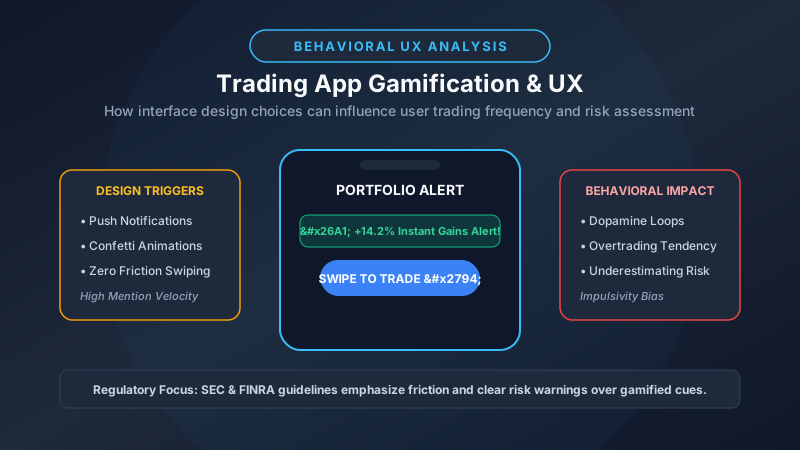
- Gamification Incentives: Because brokers earn revenue on trade volume via PFOF, business models are inherently aligned with encouraging higher trading frequency, as discussed in trading app gamification psychology.
4. SEC Rules & Regulatory Transparency
To protect investors and ensure market integrity, the U.S. Securities and Exchange Commission (SEC) mandates strict disclosure requirements:
SEC Rule 605: Execution Quality Reporting
Broker-dealers and market centers must publish monthly public reports detailing order execution quality. Rule 605 metrics include:
- Execution speed
- Rate of price improvement versus the NBBO
- Average effective spread paid by customers
SEC Rule 606: Order Routing Disclosures
Under Rule 606, brokerages must publish quarterly reports disclosing:
- The top venues to which non-directed customer orders were routed
- The net dollar amount of PFOF payments received from each market maker
- Any material profit-sharing arrangements with execution venues
5. Market Orders vs. Limit Orders Under PFOF
How your trade is routed and filled under PFOF depends significantly on the order type selected:
- Market Orders: An order to buy or sell immediately at the best available price. Market orders are most frequently routed to wholesale market makers under PFOF arrangements because market makers can capture the spread while offering minor price improvement.
- Limit Orders: An order to buy or sell at a specified price or better. Limit orders are often routed to public exchanges or display venues to join the public order book if the limit price is not immediately executable by an internalizing market maker.
- Marketable Limit Orders: A limit order set at a price that matches or exceeds current market prices, treated similarly to market orders for execution and PFOF rebate purposes.
6. PFOF Around the World & Regulatory Debate
Regulatory approaches to PFOF vary significantly across global jurisdictions:
- United Kingdom: The Financial Conduct Authority (FCA) banned PFOF in 2012, citing inherent conflicts of interest regarding best execution duties.
- European Union: The EU approved a phased ban on PFOF across member states as part of MiFIR reforms, taking full effect by 2026.
- United States: PFOF remains legal under SEC oversight. In late 2022, the SEC proposed major market structure reforms, including an "order competition rule" that would require individual retail orders to be routed through transparent, open auctions before internalizing them off-exchange.
6. Evaluating Total Trading Cost
When investing in a taxable brokerage account or constructing long-term portfolios of index funds vs. individual stocks, investors should evaluate total transaction cost rather than commission fees alone:
Total Trading Cost = Commission Fee + Bid-Ask Spread Cost − Price Improvement
For a buy-and-hold investor purchasing index funds or stocks infrequently, zero-commission trading under PFOF generally results in a significant net cost reduction compared to legacy $7 per-trade fee models. However, for active traders or high-frequency options users, minor differences in execution speed, price improvement, and spread width can aggregate into meaningful costs.
7. Summary Checklist for Investors
- Understand that "commission-free" means brokers earn revenue through alternative channels like PFOF, margin interest, and cash sweep interest.
- Review your brokerage's SEC Rule 606 disclosures if you want transparency regarding order routing partners.
- Prioritize long-term investing over high-frequency trading to minimize exposure to bid-ask spreads.
MoneyTalkin' provides financial education, educational concepts, and general informational guides. Articles do not constitute personalized financial, investment, legal, or tax advice. Financial products, rates, terms, and regulatory rules change frequently; consult a qualified financial professional regarding your specific situation. Read our full Disclaimer Policy.
Written by MoneyTalkin'
MoneyTalkin' researches and publishes objective financial education content, money management fundamentals, and practical financial guides.
Related Technical Articles
Explore related topics in this cluster to deepen your understanding.