How Reddit and Social Sentiment Can Move Stocks Faster Than Earnings Reports
An analysis of how social media sentiment drives short-term equity volatility, examining natural language processing, institutional sentiment tracking, and the mechanics of sentiment decay.

How Reddit and Social Sentiment Can Move Stocks Faster Than Earnings Reports
Historically, stock price movements were primarily dictated by fundamental economic data—such as quarterly earnings reports, revenue guidance, profit margins, and macroeconomic interest rate announcements. However, the rise of zero-commission trading apps and financial social media communities has created a secondary driver of short-term volatility: social sentiment.
Online platforms like Reddit’s r/wallstreetbets, X (formerly Twitter), StockTwits, and Discord now allow retail investors to aggregate interest around specific equities in real time. When viral social momentum concentrates on a single ticker, order flow can spike significantly before traditional fundamental data changes.
This article examines how social sentiment impacts short-term price discovery, how quantitative funds track social data, the essential distinction between correlation and causation, and why sentiment-driven rallies frequently decay.
1. The Mechanics of Social Sentiment Dynamics
Social sentiment in financial markets refers to the aggregated mood, tone, and mention velocity surrounding a specific asset across digital communications channels.
Mention Velocity & Ticker Density
Unlike traditional news outlets that produce articles periodically, social platforms generate continuous discussion streams. Key metrics measured by market tracking algorithms include:
- Mention Volume: The total number of times a stock ticker (e.g.,
$GME,$AMC,$TSLA) is referenced over a specific timeframe (e.g., per minute or per hour). - Sentiment Ratio: The proportion of positive or bullish terms (e.g., "buy," "call," "moon") relative to negative or bearish terms (e.g., "sell," "put," "short").
- Author Diversity: Whether chatter is generated by thousands of unique accounts or artificially concentrated across a small group of active posters.
When mention velocity increases exponentially, retail buy orders often follow rapidly, accelerating short-term price momentum as examined in our review of the GameStop saga years later.
2. How Institutional Markets React to Social Sentiment
Social media activity does not occur in an institutional vacuum. Quantitative hedge funds, high-frequency trading (HFT) firms, and market makers actively monitor social networks to capture trading edge:
Natural Language Processing (NLP) Scraping
Institutional quants utilize Natural Language Processing (NLP) algorithms to continuously scrape public forums and social feeds. These systems parse text for ticker symbols and evaluate contextual sentiment using custom financial dictionaries:
- Lexicon-Based Sentiment Scoring: Models analyze specific keyword frequencies (e.g., "bullish," "calls," "breakout" versus "short," "put," "overvalued") to generate a real-time sentiment score ranging from -1.0 to +1.0.
- BERT & Large Language Models: Modern quantitative infrastructure employs transformer-based LLMs trained specifically on financial syntax to detect subtle sarcasm, meme terminology (such as "diamond hands" or "tendies"), and coordinated posting campaigns that simple keyword scrapers miss.
Algorithmic Momentum Amplification
High-frequency market participants often deploy momentum-following algorithms. When automated systems detect unusual retail buying pressure alongside high sentiment scores, they execute automated buy orders to capitalize on short-term price momentum, further inflating trade volume before closing positions when velocity slows.
Social Discussion Spike -> NLP & LLM Model Processing -> HFT Order Execution -> Short-Term Volatility
3. How Sentiment Indexing Tools Measure Market Mood
In recent years, commercial data vendors and financial media platforms have developed public social sentiment indices to quantify retail market mood:
- Social Volume Indicators: Track the aggregate number of social posts referencing a specific stock symbol over rolling 24-hour windows relative to historical 30-day baseline averages.
- Sentiment Divergence Metrics: Identify scenarios where a company's stock price declines while social media sentiment remains extremely positive, or vice versa, signaling potential mispricings or upcoming speculative volatility.
- Retail Flow Tracking: Institutional data providers correlate social media mention spikes with actual retail broker order execution data to verify whether online chatter is translating into real capital deployment.
4. Correlation vs. Causation: A Critical Distinction
A common misconception among retail traders is assuming that high social media sentiment causes long-term equity appreciation. Academic research and historical market observations emphasize the critical boundary between correlation and causation:
- Correlation: Increased social chatter and rising stock prices often happen simultaneously during an upward trend. High prices attract social attention, which generates more social posts, creating a feedback loop.
- Causation: Social media posts do not create fundamental cash flows, corporate revenues, or intrinsic business value. While social interest can cause short-term buying pressure, it does not sustain a company’s operational balance sheet.
When corporate fundamentals fail to support a sentiment-driven price spike, stock prices historically revert toward fundamental valuation baselines once buying volume cools.
4. Case Studies: Viral Sentiment in Action
Several real-world examples illustrate the spectrum of sentiment-driven market behavior:
Bed Bath & Beyond (2022)
In mid-2022, Bed Bath & Beyond experienced massive surges in social media mention volume despite worsening financial distress and declining store sales. Retail buying pushed the stock price up several hundred percent over a few weeks. However, because the underlying business was burning cash, the stock eventually plummeted as the company filed for Chapter 11 bankruptcy in 2023, wiping out equity holders who bought near the peak.
Hertz Global Holdings (2020)
Following its bankruptcy filing in May 2020, Hertz stock surged dramatically due to intense retail social media interest. While equity in bankrupt companies is typically rendered worthless, Hertz later benefited from a post-pandemic car rental shortage that allowed it to exit bankruptcy successfully—a rare exception driven by macroeconomic recovery rather than initial retail chatter alone.
5. Why Social Sentiment Fades Quickly
Rallies powered by social sentiment are prone to sudden, steep declines due to several structural limitations:
- Short Attention Spans: Social media attention cycles move rapidly. As discussion shifts to new trending topics, fresh retail buying capital dries up.
- Capital Fatigue: Buying pressure requires continuous inflows of new money. Once retail participants have deployed available capital, upward momentum stalls.
- Institutional Profit-Taking: Sophisticated traders and short sellers step in when equity valuations become extreme, shorting overvalued positions or selling held shares into retail demand.
- Fundamental Anchor: Over multi-year horizons, equity prices correlate strongly with earnings growth, cash flow, and return on capital, eroding non-fundamental sentiment premiums.
6. Risks of Trading Based on Social Sentiment
- Misinformation & Manipulation: Public online forums are vulnerable to organized "pump-and-dump" schemes where early buyers promote a low-liquidity stock to inflate its price before dumping shares on late-arriving retail buyers.
- Severe Execution Slippage: Buying a stock during a viral sentiment spike often results in executing trades at peak market prices with wide bid-ask spreads.
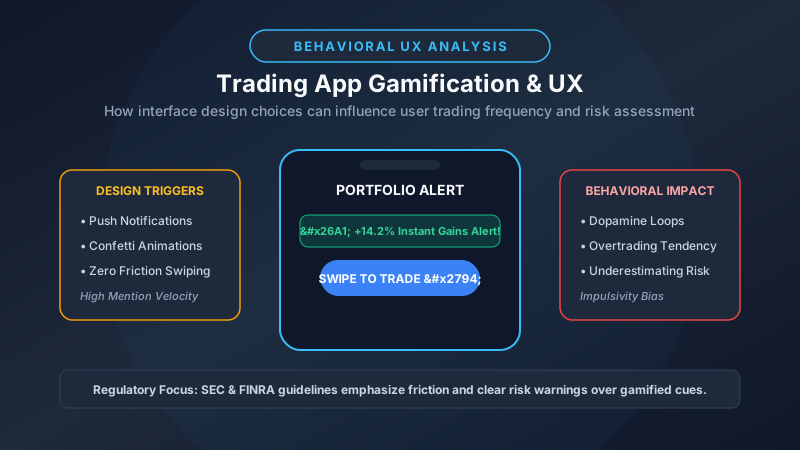
- Psychological FOMO: Fear Of Missing Out (FOMO) encourages emotional trading, causing investors to abandon disciplined long-term strategies in pursuit of volatile short-term gains.
7. Strategic Takeaways for Investors
For individuals managing long-term wealth across index funds vs. individual stocks or implementing consistent strategies like dollar-cost averaging, understanding social sentiment dynamics provides valuable perspective:
- Separate Noise from Fundamentals: Treat social media metrics as indicators of short-term market noise rather than reliable signals of long-term investment quality.
- Never Trade Solely on Mention Count: A sudden spike in social volume indicates high volatility, not necessarily a buying opportunity.
- Focus on Cash Flows: Long-term returns are driven by earnings, business moats, and disciplined asset allocation, not viral online trends.
Read what happened to retail retail favorites in Meme Stock Survivors vs. Casualties.
MoneyTalkin' provides financial education, educational concepts, and general informational guides. Articles do not constitute personalized financial, investment, legal, or tax advice. Financial products, rates, terms, and regulatory rules change frequently; consult a qualified financial professional regarding your specific situation. Read our full Disclaimer Policy.
Written by MoneyTalkin'
MoneyTalkin' researches and publishes objective financial education content, money management fundamentals, and practical financial guides.
Related Technical Articles
Explore related topics in this cluster to deepen your understanding.