Meme Stock Survivors vs. Casualties: What Happened to the Companies and Investors?
An objective, case-study-driven analysis of post-2021 meme stocks, examining how companies used elevated valuations to raise capital, manage debt, or undergo Chapter 11 restructuring.
Meme Stock Survivors vs. Casualties: What Happened to the Companies and Investors?
The 2021 retail trading surge brought unprecedented attention to a select group of public companies labeled by market media as "meme stocks." Characterized by high short interest, retail social media momentum, and extreme intraday price volatility, these companies saw their market capitalizations swing by billions of dollars within days.
Years after the initial trading frenzy, public companies that experienced meme stock status have taken vastly different operational pathways. Some leveraged elevated share prices to raise equity capital and pay down debt, while others faced severe financial distress, bankruptcy proceedings, or major corporate restructuring.
Rather than ranking companies as "winners" or "losers," this article presents objective case studies analyzing how corporate management teams utilized elevated stock valuations, the mechanics of At-The-Market (ATM) share dilution, and how timing dictated investor outcomes.
1. Differentiating Corporate Survival from Shareholder Return
When evaluating post-meme stock outcomes, analysts separate company performance from stock price performance and investor returns:
- Corporate Operational Survival: Refers to whether the underlying business remains solvent, maintains liquid cash reserves, and operates as a going concern.
- Stock Market Performance: Refers to how the company's equity trades relative to peak squeeze pricing over multi-year horizons.
- Investor Outcomes: Refers to individual financial results, which vary dramatically depending on whether shares were acquired before, during, or after price spikes.
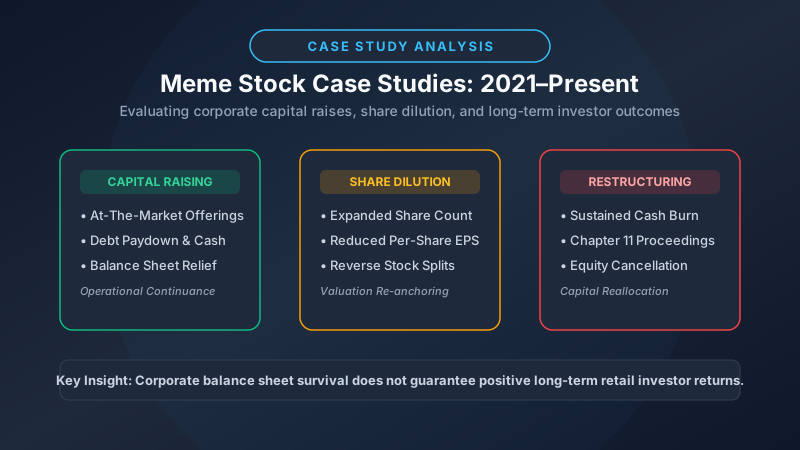
Elevated Share Price -> At-The-Market (ATM) Equity Offering -> Cash Reserves Raised -> Debt Paid Down -> Operating Runway Extended
2. Case Study 1: GameStop Corp. (Balance Sheet Stabilization via Equity Sales)
GameStop Corp. presents an example of a retail company that utilized elevated stock prices to overhaul its corporate balance sheet.
Capital Raising via At-The-Market (ATM) Offerings
During 2021 and subsequent periods of volatility, GameStop's management executed multiple At-The-Market (ATM) equity offerings. By selling millions of newly issued shares directly into market demand at elevated prices, the company raised over $2 billion in gross cash proceeds.
Operational Impact
- Debt Elimination: GameStop utilized equity proceeds to pay off nearly all long-term debt (excluding a low-interest French government COVID-19 response loan).
- Cash Reserve Cushion: The capital injection provided a substantial cash and short-term investment reserve, allowing the company time to pare down unprofitable retail stores and transition toward operational profitability.
Investor Implications
While the company's balance sheet became significantly more resilient, the issuance of millions of new shares increased total share count (dilution). Investors who purchased shares near peak 2021 high points experienced significant paper losses as share prices adjusted toward post-squeeze fundamental valuations.
3. Case Study 2: AMC Entertainment Holdings (Capital Raising Amid High Debt & Dilution)
AMC Entertainment Holdings, the world's largest movie theater chain, faced acute liquidity challenges in early 2021 due to pandemic-related theater closures and high debt loads.
Aggressive Equity Issuance & Debt Restructuring
AMC's management aggressively issued new equity and preferred equity units (AAPE) to capture retail demand:
- Liquidity Lifeline: Equity sales generated billions of dollars, enabling AMC to avoid immediate bankruptcy, satisfy deferred rent payments, and fund theater operations.
- Significant Share Dilution: To maintain solvency, AMC expanded its total outstanding share count multiple times over. In 2023, the company executed a 1-for-10 reverse stock split alongside converting preferred units to common stock.
Operational Impact & Market Realities
While equity raises prevented Chapter 11 filing, the massive increase in share count meant each individual share represented a smaller percentage of overall corporate value. Despite returning theater attendance, AMC's stock price experienced steep long-term declines from its peak meme trading levels as per-share earnings metrics reflected diluted share counts.
4. Case Study 3: Bed Bath & Beyond (Insolvency & Chapter 11 Restructuring)
Bed Bath & Beyond illustrates a scenario where social media sentiment was unable to prevent corporate insolvency.
Operational Decline & Debt Burden
Unlike companies that successfully executed large equity raises early in 2021, Bed Bath & Beyond suffered from declining store sales, supply chain disruptions, and heavy debt obligations.
Delayed Capital Raises & Bankruptcy Filing
When the company attempted complex preferred share financing deals in late 2022 and early 2023, market conditions had deteriorated, and share prices had fallen dramatically. In April 2023, Bed Bath & Beyond filed for Chapter 11 bankruptcy.
Equity Cancellation
During Chapter 11 liquidation proceedings, senior debt holders and lenders receive priority repayment. In late 2023, Bed Bath & Beyond’s equity shares were officially canceled without distribution to common shareholders—a stark reminder that equity holders sit last in corporate capital structure priority.
5. Case Study 4: BlackBerry Ltd. (Operational Pivot vs. Legacy Valuation)
BlackBerry Ltd. represents a company whose shares surged during early 2021 meme stock volatility based on nostalgia and speculative interest in its software security business:
- Operational Reality: BlackBerry had long transitioned away from consumer smartphone manufacturing into enterprise cybersecurity and automotive software (QNX).
- Corporate Response: Management chose a conservative path, avoiding aggressive new equity issuance while focusing on software licensing and patent portfolio monetization.
- Valuation Re-anchoring: After the 2021 price spike subsided, BlackBerry's stock price returned to trade based on enterprise software revenue growth and competitive cybersecurity dynamics rather than meme trading momentum.
6. How At-The-Market (ATM) Offerings Function
Understanding At-The-Market (ATM) equity offerings is central to analyzing corporate meme stock responses:
- Shelf Registration (SEC Form S-3): A company files a shelf registration statement with the SEC, allowing it to issue new shares periodically up to a aggregate dollar limit.
- Sales Agent Execution: The company contracts with an investment bank acting as a sales agent. The agent sells newly minted shares directly into the secondary market at prevailing market prices.
- Capital Flexibility: Unlike traditional underwritten public offerings that require fixed pricing and roadshows, ATM offerings allow companies to capture sudden, unexpected price spikes within hours.
7. Key Financial Concepts in Post-Meme Outcomes
Understanding these corporate finance concepts clarifies why company outcomes diverged:
| Concept | Description | Financial Impact |
|---|---|---|
| At-The-Market (ATM) Offering | Selling new shares incrementally onto open markets at current prices | Generates cash for company; dilutes existing shareholder ownership |
| Share Dilution | Increasing total shares outstanding | Reduces Per-Share Earnings (EPS) and book value per share |
| Reverse Stock Split | Combining multiple shares into one share (e.g., 1-for-10) | Increases share price proportionally without changing total market cap |
| Capital Structure Hierarchy | Secured debt > Unsecured debt > Preferred equity > Common stock | In bankruptcy, common shareholders only receive value if senior debt is fully repaid |
6. Survivorship Bias in Meme Stock Narratives
When analyzing meme stock history, investors must beware of survivorship bias—the cognitive error of focusing only on companies that survived while ignoring those that went bankrupt or were delisted.
Promoting stories of companies that raised cash while ignoring firms that filed for bankruptcy creates an inaccurate perception of trading risk.
7. Strategic Conclusions for Individual Investors
For investors structuring long-term portfolios across index funds vs. individual stocks or reviewing market dynamics following the GameStop saga years later:
- Balance Sheets Matter: High share prices provide a temporary opportunity for companies to raise cash, but long-term solvency depends on generating positive operating cash flows.
- Dilution Directly Affects Value: A company can survive operationally by issuing shares while individual share value declines due to share count expansion.
- Understand Entry Point Risk: Investor outcomes are defined by buy price, share dilution, and fundamental valuation—not social media sentiment alone.
MoneyTalkin' provides financial education, educational concepts, and general informational guides. Articles do not constitute personalized financial, investment, legal, or tax advice. Financial products, rates, terms, and regulatory rules change frequently; consult a qualified financial professional regarding your specific situation. Read our full Disclaimer Policy.
Written by MoneyTalkin'
MoneyTalkin' researches and publishes objective financial education content, money management fundamentals, and practical financial guides.
Related Technical Articles
Explore related topics in this cluster to deepen your understanding.