Overdraft Protection Explained: How It Works, Fees, and Alternatives
A comprehensive guide explaining overdraft protection, Regulation E opt-in choices, linked savings backup transfers, overdraft fees, and fee-free account alternatives.
Overdraft Protection Explained: How It Works, Fees, and Alternatives
Managing transaction flows in a checking account requires monitoring pending debits, auto-pays, and debit card purchases. When an account balance drops below zero, the transaction triggers an overdraft.
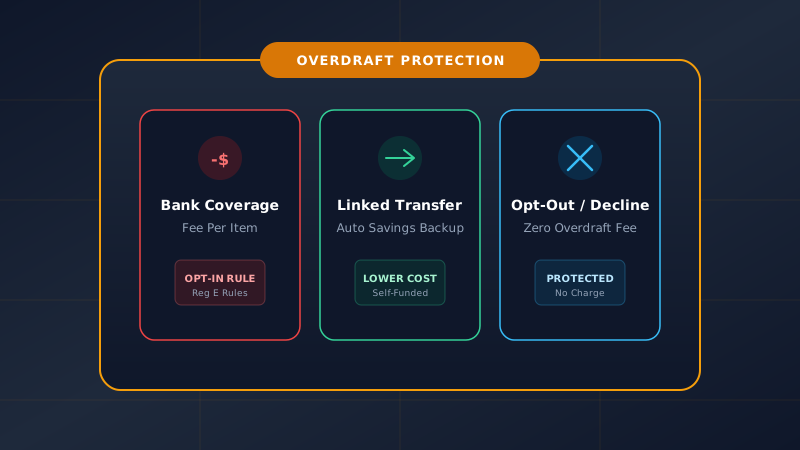
Financial institutions offer various services under the umbrella term overdraft protection. However, these services operate in fundamentally different ways, ranging from automatic transfers from a linked savings account to fee-based courtesy coverage by the bank.
Understanding how overdraft protection functions—including Regulation E opt-in rules, overdraft vs. nonsufficient funds (NSF) distinctions, transaction processing order, and fee-free account alternatives—helps consumers avoid unnecessary bank charges alongside guides on evaluating checking account fees, maintaining a bank account security checklist, and building an emergency fund.
1. What Is an Overdraft?
An overdraft occurs when a payment (such as a check, electronic ACH transfer, or debit purchase) is presented against a checking account lacking sufficient available funds to cover the transaction.
When an overdraft occurs, the bank handles the transaction in one of two ways:
- Pay the Item (Overdraft): The bank advances funds to cover the transaction, creating a negative balance and usually assessing an overdraft fee.
- Decline/Return the Item (Unpaid / NSF): The bank rejects the transaction. For checks or ACH payments, this historically incurred a nonsufficient funds (NSF) fee. For debit card purchases, the item is declined at the register with zero fee.
2. Primary Types of Overdraft Protection Services
Banks offer several distinct arrangements for handling transactions that exceed available account balances:
[Transaction Exceeds Balance]
  ├── A. Linked Savings Transfer ➔ Funds moved from savings ➔ Minimal or $0 fee
  ├── B. Overdraft Line of Credit ➔ Borrowed from credit line ➔ Interest + transfer fee
  └── C. Courtesy Overdraft       ➔ Bank covers negative balance ➔ Per-item overdraft fee
A. Linked Savings Account Transfer
With a linked savings transfer, you authorize your bank to automatically transfer funds from your primary savings or money market account to your checking account whenever an overdraft occurs.
- Cost: Many banks offer linked transfers for $0 or a nominal transfer fee ($3 to $10), which is far less expensive than a standard courtesy overdraft fee.
- Requirement: You must maintain sufficient available cash in the linked savings account to cover the shortfall.
B. Overdraft Line of Credit
Some banks offer an approved overdraft line of credit (a revolving loan linked directly to your checking account).
- Cost: If an overdraft occurs, the bank automatically draws against the credit line to cover the transaction. You pay interest on the borrowed amount (and potentially a small transfer fee) until the balance is repaid.
C. Standard Courtesy Overdraft Coverage
Under standard courtesy overdraft coverage, the bank pays the transaction at its own discretion, allowing your checking account balance to go negative.
- Cost: The bank charges a per-item overdraft fee for each transaction paid while the account remains negative.
- Discretionary Nature: Banks are not legally obligated to cover overdrafts. If the bank chooses not to cover the item, the transaction is declined or returned unpaid.
3. Federal Regulation E Opt-In Rules
Federal law under Regulation E (12 CFR § 1005.17), enforced by the Consumer Financial Protection Bureau (CFPB), grants consumers specific legal rights regarding overdraft coverage on everyday debit card purchases and ATM withdrawals.
The Opt-In Requirement
Under Regulation E, banks are legally prohibited from charging overdraft fees on everyday (one-time) debit card transactions and ATM withdrawals unless the consumer explicitly opts in to the bank's debit card overdraft service.
| Consumer Opt-In Status | One-Time Debit Card / ATM Overdraft | Recurring Bill Pay & Checks |
|---|---|---|
| Opted Out (Default) | Declined at register / ATM; $0 fee | Bank may pay or return item; overdraft/NSF rules apply |
| Opted In | Bank may approve purchase; Overdraft fee charged | Bank may pay or return item; overdraft/NSF rules apply |
Note: Regulation E opt-in rules apply specifically to point-of-sale debit card purchases and ATM transactions. Checks and recurring ACH bill payments (like utility or mortgage payments) are not governed by the opt-in rule and may still incur overdraft fees if covered by the bank.
4. Understanding Overdraft Fees and Transaction Order
Overdraft fee structures can accumulate rapidly if multiple small transactions hit an overdrawn account on the same day.
A. Fee Accumulation Rules
- Per-Item Charges: Banks charge a fee for each item paid while negative. Four small debit purchases while overdrawn can incur four separate fees in a single day.
- Daily Fee Caps: Most banks limit daily overdraft fees (e.g., maximum 3 to 5 fees per day).
- De Minimis Buffers: Many banks provide a buffer threshold (e.g., $10 or $50 negative balance). Overdrafts within the buffer incur zero fees.
B. Transaction Posting Order
How a bank orders daily transactions affects fee accumulation:
- High-to-Low Posting: Processing transactions from highest dollar amount to lowest can exhaust balances faster, triggering multiple smaller overdraft fees.
- Chronological / Low-to-High Posting: Under CFPB guidance, many modern banks process items chronologically or low-to-high to reduce consumer fee burdens.
5. Hypothetical Overdraft Scenario Example
To understand how opt-in choices and overdraft protections operate in practice, consider a consumer with an available checking account balance of $20.00 who attempts a $50.00 debit card purchase at a grocery store:
| Overdraft Option | Transaction Result | Immediate Fee | Ending Account Balance |
|---|---|---|---|
| Option 1: Opted Out (Reg E Default) | Transaction Declined at Register | $0.00 | +$20.00 |
| Option 2: Opted In (Courtesy Coverage) | Transaction Approved ($30 short) | $35.00 Overdraft Fee | -$65.00 (-$30 balance + -$35 fee) |
| Option 3: Linked Savings Protection | $30 transferred from savings | $0.00 (or low transfer fee) | $0.00 ($30 covered by savings) |
Hypothetical example for illustrative purposes. Fee structures vary by financial institution.
6. Fee-Free Alternatives and Modern Banking Features
As consumer financial awareness grows, banking competitive dynamics have evolved significantly:
- Grace Periods and Buffer Programs: Several major U.S. banks now offer 24-hour grace periods, allowing consumers to deposit funds by 11:59 PM the following business day to bring their account positive and cancel pending overdraft fees.
- No-Overdraft Checking Accounts: Many online banks and community credit unions offer accounts engineered without overdraft capabilities. If funds are insufficient, transactions are simply declined with zero fees assessed.
- Early Direct Deposit Access: Many banks provide access to direct-deposited paychecks up to two days early, helping consumers cover recurring expenses without relying on credit lines or overdrafts.
7. Practical Checklist for Managing Overdrafts
Follow this practical checklist to protect your checking account from unexpected overdraft charges:
- Check Your Opt-In Status: Review your account settings or contact your bank to verify whether you have opted in to debit card overdraft coverage. If you prefer declined transactions over fees, opt out.
- Link a Backup Account: Set up automatic overdraft transfers linked to your primary high-yield savings account or money market account.
- Set Up Mobile Balance Alerts: Configure push notifications or SMS alerts when your checking balance falls below a designated threshold (e.g., $100).
- Maintain a Checking Buffer: Keep an unspent cushion of $200 to $500 in your primary checking account to absorb pending auto-pays.
- Audit Recurring Auto-Pays: Align recurring bill payment due dates with your income paydays to ensure funds are available when debits post.
Sources
- Consumer Financial Protection Bureau (CFPB): Overdraft Services & Regulation E Consumer Guide https://www.consumerfinance.gov/consumer-tools/bank-accounts/overdraft-services/
- Federal Reserve Board: Regulation E (Electronic Fund Transfers) 12 CFR § 1005.17 https://www.federalreserve.gov/
- Federal Deposit Insurance Corporation (FDIC): Overdraft Protection and Consumer Guidance https://www.fdic.gov/
Educational Disclaimer
This guide is for educational purposes only and does not constitute formal banking, legal, or financial advice. Overdraft rules, opt-in policies, fee amounts, and posting orders vary by financial institution. Consult your bank's account agreement and fee disclosure schedule for specific terms.
MoneyTalkin' provides financial education, educational concepts, and general informational guides. Articles do not constitute personalized financial, investment, legal, or tax advice. Financial products, rates, terms, and regulatory rules change frequently; consult a qualified financial professional regarding your specific situation. Read our full Disclaimer Policy.
Written by MoneyTalkin'
MoneyTalkin' researches and publishes objective financial education content, money management fundamentals, and practical financial guides.
Related Technical Articles
Explore related topics in this cluster to deepen your understanding.