NFT Taxes Explained: What Buyers, Sellers and Creators Should Know
A comprehensive U.S. tax guide explaining IRS rules for non-fungible tokens (NFTs), covering capital gains, creator income, collectibles taxation, and recordkeeping.
NFT Taxes Explained: What Buyers, Sellers and Creators Should Know
As digital assets have expanded across personal finance, the Internal Revenue Service (IRS) and state tax authorities have established clear tax reporting requirements for non-fungible tokens (NFTs). In the United States, digital assets—including cryptocurrencies, stablecoins, and NFTs—are treated as property for federal income tax purposes.
Every transaction involving an NFT—whether purchasing a token with cryptocurrency, selling a token for profit, swapping one NFT for another, or minting original tokens as a creator—can trigger taxable events.
This article provides an educational, U.S.-focused overview of IRS tax rules governing NFTs for current tax reporting (Tax Year 2026 / 2025 rules), explaining capital gains calculations, creator self-employment income, the IRS collectibles tax classification under Notice 2023-27, and essential recordkeeping practices.
Disclaimer: This article is for informational purposes only and does not constitute personalized tax, legal, or accounting advice. Tax laws vary by jurisdiction and individual circumstances. Consult a qualified Certified Public Accountant (CPA) or tax attorney for personal tax guidance.
1. The IRS Digital Asset Baseline: Property Treatment
Under IRS guidance (including Notice 2014-21 and subsequent regulations), the IRS classifies all digital assets as property:
IRS Baseline Rule: Digital Assets = Property
Disposing of Property = Taxable Event (Capital Gain or Capital Loss)
The Form 1040 Digital Asset Question
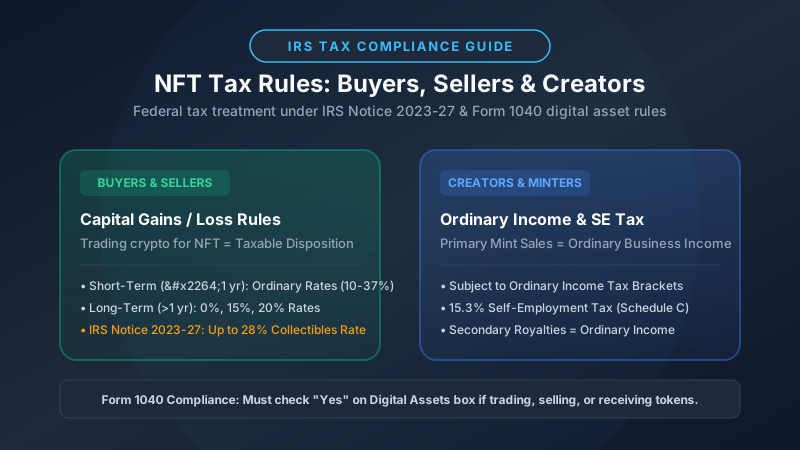
On page 1 of IRS Form 1040 (U.S. Individual Income Tax Return), the IRS includes a mandatory question asking taxpayers: "At any time during the tax year, did you: (a) receive (as a reward, award, or payment for property or services); or (b) sell, exchange, or otherwise dispose of a digital asset (or a financial interest in a digital asset)?"
Checking "Yes" is legally required if you conducted any taxable NFT transactions during the tax year.
2. Tax Rules for Buyers & Investors
Buying and holding an NFT is not inherently a taxable event if purchased with U.S. dollars. However, because most NFTs are purchased using cryptocurrency (such as Ethereum or Solana), buying an NFT creates a dual tax event.
Event 1: Disposing of Cryptocurrency (Taxable Event)
When you use cryptocurrency to buy an NFT, you are disposing of that cryptocurrency. The IRS treats spending crypto as a sale of property, triggering a capital gain or loss on the crypto used:
$$\text{Crypto Capital Gain/Loss} = \text{Fair Market Value of NFT at Purchase} - \text{Cost Basis of Crypto Used}$$
- Example: You purchased 1 ETH three years ago for $1,000 (cost basis). Today, 1 ETH is worth $3,000. You use that 1 ETH to buy an NFT. You must report a $2,000 long-term capital gain on the ETH spent, even though you did not cash out to USD.
Event 2: Establishing Cost Basis in the NFT
The purchase price of the NFT in U.S. dollars (plus network gas fees) becomes your adjusted cost basis in the newly acquired NFT.
3. Tax Rules for Sellers: Short-Term vs. Long-Term Capital Gains
When you sell an NFT for cryptocurrency or fiat USD, you trigger a capital gain or capital loss:
$$\text{NFT Capital Gain or Loss} = \text{Net Sale Proceeds} - \text{Adjusted Cost Basis of NFT}$$
Holding Periods & Rates
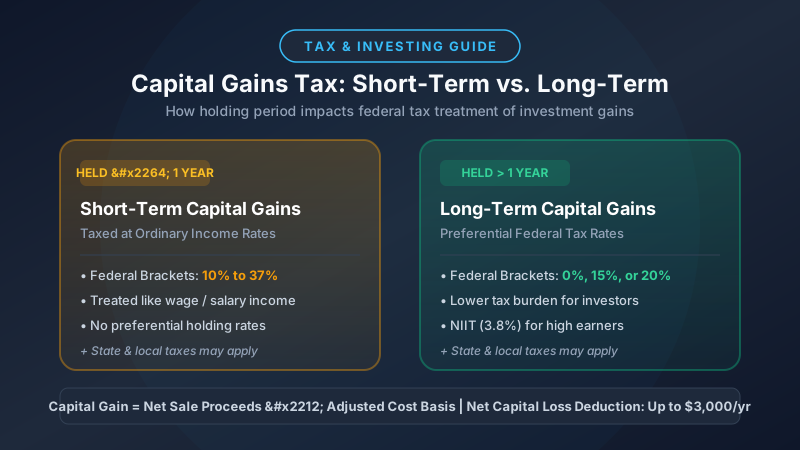
- Short-Term Capital Gains (Held 1 Year or Less): Taxed as ordinary income at standard federal tax rates ranging from 10% to 37%.
- Long-Term Capital Gains (Held More Than 1 Year): Subject to preferential federal long-term rates of 0%, 15%, or 20%, depending on taxable income.
4. The IRS Collectibles Classification (Notice 2023-27)
In March 2023, the IRS issued Notice 2023-27, announcing intention to issue regulations treating certain NFTs as "collectibles" under Internal Revenue Code Section 408(m):
What Is a Collectible under Section 408(m)?
Collectibles include physical artwork, antiques, gems, metals, stamps, and coins. Notice 2023-27 applies a "look-through analysis" to NFTs:
- Look-Through Test: If the underlying asset associated with an NFT meets the definition of a collectible (e.g., a digital artwork, rare digital trading card, or physical gem), the NFT is classified as a collectible for tax purposes.
Tax Impact: 28% Maximum Collectibles Rate
Long-term capital gains on assets classified as collectibles are subject to a maximum federal tax rate of 28%, rather than the standard 20% maximum long-term capital gains rate. High-income investors must account for this potential higher bracket when calculating tax liabilities.
5. Tax Rules for Creators & Minters
Tax rules differ significantly for artists, developers, and creators who mint and sell original NFTs:
Creator Primary Mint Proceeds -> Ordinary Self-Employment Income (Subject to Income Tax + 15.3% SE Tax)
Creator Secondary Royalties -> Ordinary Income (Schedule C or Schedule E)
1. Primary Sales Income
When a creator mints and sells an NFT collection to the public, the revenue received is treated as ordinary business income (not capital gains). Creators reporting income as sole proprietors must file Schedule C:
- Ordinary Income Tax: Subject to standard federal income tax rates (up to 37%).
- Self-Employment Tax: Subject to 15.3% Self-Employment Tax (covering Social Security and Medicare taxes) on net earnings.
2. Secondary Royalty Inflows
Ongoing secondary royalties automatically remitted to a creator's wallet via smart contracts represent recurring business income, taxable as ordinary income in the tax year received based on the fair market value of the crypto at the time of receipt.
3. Deductible Business Expenses
Creators can deduct legitimate business expenses against mint income on Schedule C, including software subscriptions, hardware, website hosting, design contractor fees, and gas fees paid to deploy smart contracts.
6. NFT Tax Scenarios Summary Table
| Transaction Type | Tax Classification | Taxable Event? | Tax Rate / Form |
|---|---|---|---|
| Buying NFT with Fiat USD | None (establishes cost basis) | No | N/A |
| Buying NFT with Crypto | Crypto property disposition | Yes | Capital gains on crypto spent (Form 8949) |
| Selling NFT at a Profit (Short-Term) | Short-term capital gain | Yes | Ordinary income rates (10-37%) |
| Selling NFT at a Profit (Long-Term) | Long-term capital gain | Yes | 0%, 15%, 20% (or 28% Collectibles rate) |
| Selling NFT at a Loss | Capital loss | Yes | Offsets capital gains + up to $3,000 ordinary income |
| Minting & Selling as Creator | Ordinary self-employment income | Yes | Ordinary income + 15.3% SE Tax (Schedule C) |
7. Essential Recordkeeping & Compliance Practices
Because digital asset brokerages do not always issue standardized Form 1099-B reports, taxpayers bear the legal responsibility of maintaining accurate records:
- Maintain On-Chain Transaction Logs: Document dates, wallet addresses, transaction hashes, crypto prices in USD at execution time, and gas fees paid.
- Track Cost Basis Across Wallets: Utilize specialized crypto tax software or spreadsheets to track adjusted cost basis across multi-wallet transfers.
- Report Capital Loss Carryforwards: If realized NFT losses exceed gains, deduct up to $3,000 against ordinary income and carry forward unused losses to future tax years as detailed in our guide to capital gains tax explained.
8. Strategic Conclusions for Investors & Creators
Managing NFT tax compliance requires recognizing that digital asset transactions fall under strict IRS property reporting rules. Understanding the distinction between capital gains treatment for traders and self-employment income for creators ensures accurate tax filing:
- Always report cryptocurrency disposition gains when buying NFTs with ETH or SOL.
- Mind holding periods to distinguish short-term gains from long-term capital gains.
- Review related tax guides on managing a taxable brokerage account and structuring tax-advantaged retirement accounts for broader financial planning context.
MoneyTalkin' provides financial education, educational concepts, and general informational guides. Articles do not constitute personalized financial, investment, legal, or tax advice. Financial products, rates, terms, and regulatory rules change frequently; consult a qualified financial professional regarding your specific situation. Read our full Disclaimer Policy.
Written by MoneyTalkin'
MoneyTalkin' researches and publishes objective financial education content, money management fundamentals, and practical financial guides.
Related Technical Articles
Explore related topics in this cluster to deepen your understanding.