Can Rent and Subscription Payments Build Your Credit? How Reporting Apps Work
An objective evaluation of rent and subscription credit-reporting services, examining how payments are reported to major bureaus, scoring model impacts, and key limitations.
Can Rent and Subscription Payments Build Your Credit? How Reporting Apps Work
For decades, consumer credit scoring models in the United States relied almost exclusively on traditional debt obligations—such as credit card balances, auto loans, student loans, and mortgages. As a result, millions of responsible consumers who paid thousands of dollars in monthly rent and utility payments on time received zero credit score credit for these major cash outflows.
In response, financial technology services introduced rent and subscription credit-reporting apps (such as Experian Boost, RentTrack, Boom, and Esusu). These platforms promise to convert recurring non-debt payments into verified trade lines reported to nationwide credit bureaus.
Evaluating whether rent and subscription reporting can build your credit score requires examining how data verification operates, understanding critical differences across credit scoring models (such as FICO 8 versus VantageScore), analyzing fee structures, and identifying key limitations.
1. How Rent and Subscription Reporting Apps Work
To report non-debt payments to nationwide consumer credit reporting agencies (Equifax, Experian, and TransUnion), reporting services utilize two primary verification channels:
-
Bank Account Data Verification: The app connects to the user's primary checking account via secure open banking APIs, such as those explained in open-banking-apis-explained. The service scans transaction logs to identify recurring, verified debits paid to landlords, utility companies, or streaming subscriptions.
-
Direct Landlord Verification: Specialized rent-reporting services verify lease agreements directly with landlords or property management software platforms, confirming monthly rent payment compliance.
Once verified, the reporting service formats the payment history into standardized Metro 2 credit bureau data files, submitting them as new trade lines on the consumer's credit file.
2. The Critical Nuance: Scoring Model Compatibility
The single most important technical detail consumers must understand is that adding rent or subscription trade lines to a credit bureau report does not guarantee a higher credit score across all scoring models.
Different credit scoring algorithms treat non-traditional payment data in fundamentally different ways:
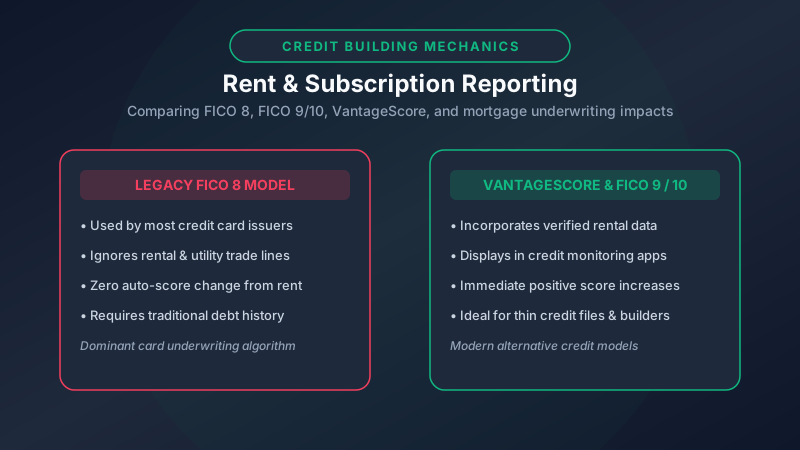
FICO Score 8 (Most Widely Used for Credit Cards and Auto Loans)
FICO Score 8 remains the most widely deployed credit scoring model across U.S. credit card issuers and auto lenders. FICO 8 generally ignores rental and utility trade lines even if they appear on an Experian or TransUnion credit report. Consequently, adding rent reporting may produce zero change in a consumer's FICO 8 score.
FICO Score 9, FICO 10, and FICO 10T
Newer FICO scoring models—such as FICO 9 and FICO 10—were explicitly designed to incorporate verified rental payment history when present on credit bureau files. If a lender utilizes FICO 9 or 10, positive rent reporting can meaningfully improve the score.
VantageScore 3.0 and 4.0
VantageScore models explicitly factor positive rental payment data into credit score calculations immediately upon trade line reporting. Consumers utilizing free credit monitoring tools (which frequently display VantageScore 3.0) often observe immediate score increases after enrolling in rent reporting.
Mortgage Underwriting Standards (FICO 2, 4, 5)
U.S. residential mortgage underwriting backed by Fannie Mae and Freddie Mac relies on legacy FICO models (FICO Score 2 on Experian, FICO Score 4 on TransUnion, and FICO Score 5 on Equifax). These legacy mortgage models do not automatically incorporate third-party rental trade lines from basic credit report feeds. However, automated underwriting systems now allow mortgage lenders to manually import 12 months of verified bank statement rental payments during formal loan applications.
3. Costs, Lookback Capabilities, and Limitations
Consumers evaluating reporting services should consider several operational parameters:
-
Historical Lookback Features: Many rent-reporting services offer past-payment reporting, scanning historical bank statements to report up to 24 months of past on-time rent payments for an additional one-time fee ($50 to $100). Adding 24 months of positive payment history can instantly establish a longer credit file depth.
-
Ongoing Service Fees: While some basic subscription-reporting features are free, comprehensive rent reporting often charges ongoing subscription fees ranging from $2 to $10 per month.
-
Negative Payment Reporting Risk: If a tenant encounters financial distress and misses a rent payment, certain direct landlord-reporting platforms are obligated to report the late payment, potentially damaging credit scores.
-
No Elimination of Negative Marks: Rent reporting cannot erase existing derogatory marks, such as collection accounts or late credit card payments detailed in credit-report-errors-disputes-explained.
Comparative Scoring Model Impact Overview
The table below details how reported rent data is processed across primary U.S. credit scoring algorithms:
| Scoring Model | Primary Usage Area | Rent Data Integration | Potential Impact |
| :--- | :--- | :--- | :--- |
| FICO Score 8 | Credit cards, auto loans | Ignored in standard algorithm | Zero score change |
| FICO Score 9 / 10 | Modern lending platforms | Explicitly incorporated | Moderate positive increase |
| VantageScore 3.0/4.0| Free credit monitoring apps | Fully incorporated | High immediate positive increase |
| FICO 2 / 4 / 5 | Residential mortgage loans | Excluded from auto-score | Requires manual lender verification|
Strategic Advice for Consumers Building Credit
Rent and subscription reporting services provide a helpful supplementary tool for credit builders—consumers with thin credit files (fewer than 5 trade lines) or no established credit history.
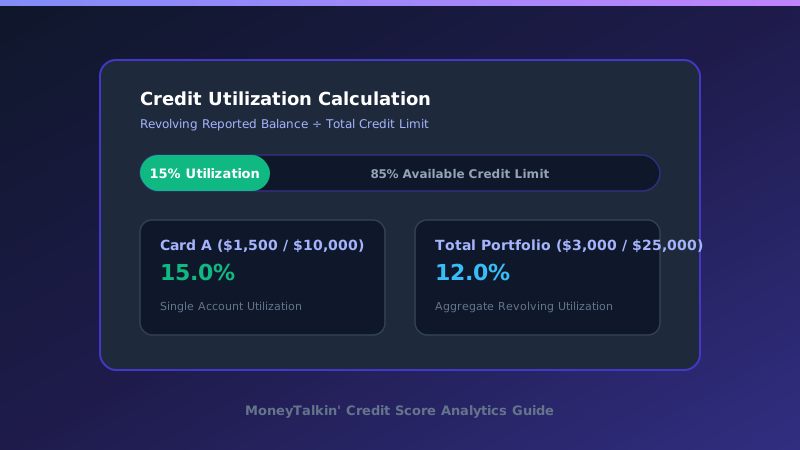
However, relying solely on rent reporting is insufficient for comprehensive credit optimization. To build robust credit scores recognized by all major lenders, consumers should pair rent reporting with traditional credit-building instruments, such as secured credit cards, credit-builder loans, or maintaining low revolving balances as detailed in credit-utilization-ratio-explained.
5. Metro 2 Data Standards and Credit Bureau Verification Protocols
To understand how rental data becomes a credit trade line, consider the technical reporting standards enforced by nationwide credit bureaus.
Credit bureaus ingest consumer data using a standardized file format known as Metro 2. Rent-reporting platforms aggregate verified monthly rental payments, format them into Metro 2 records, and transmit them via secure data pipelines to Equifax, Experian, and TransUnion.
Each reported month contains specific data fields: account opening date, monthly contractual payment amount, current payment status ('paid as agreed' or 'past due'), and date of last activity. Establishing verified Metro 2 compliance ensures that rental trade lines satisfy federal reporting requirements under the Fair Credit Reporting Act (FCRA).
6. Strategic Integration of Non-Traditional Data into Credit Profiles
Incorporating non-traditional data—such as verified rent, utility, and subscription payments—marks a major advancement in expanding credit access for unbanked and credit-invisible consumers.
When paired with responsible credit card usage and consistent on-time debt payments, rent reporting helps consumers transition from thin credit files into robust, multi-trade-line credit profiles. As credit scoring algorithms continue adopting modern FICO 10T and VantageScore 4.0 models, non-traditional payment reporting will play an increasingly central role in democratizing access to prime credit terms for renters nationwide.
7. Summary Guidance: Optimizing Rent Reporting for Maximum Benefit
Consumers utilizing rent and subscription reporting platforms to establish credit history should follow these operational steps:
-
Verify On-Time Payment Records: Ensure you have at least 6 to 12 consecutive months of verified, on-time rent payments before enrolling in paid reporting programs.
-
Check Bureau Coverage: Confirm whether the reporting service submits data to all three major credit bureaus (Equifax, Experian, TransUnion).
-
Combine with Traditional Credit Tools: Pair rent reporting with a low-utilization secured credit card to build a balanced, multi-trade-line credit file recognized by all major lenders.
MoneyTalkin' provides financial education, educational concepts, and general informational guides. Articles do not constitute personalized financial, investment, legal, or tax advice. Financial products, rates, terms, and regulatory rules change frequently; consult a qualified financial professional regarding your specific situation. Read our full Disclaimer Policy.
Written by MoneyTalkin'
MoneyTalkin' researches and publishes objective financial education content, money management fundamentals, and practical financial guides.