Embedded Finance Explained: Why Non-Banks Now Offer Financial Products
An explanation of embedded finance technology, showing how non-financial brands use Banking-as-a-Service (BaaS) platforms to offer branded accounts, payments, and credit.
Embedded Finance Explained: Why Non-Banks Now Offer Financial Products
In traditional commerce, financial services were accessed exclusively through dedicated financial institutions—visiting a bank branch to open a checking account, applying to a lender for a loan, or writing a check to pay a merchant. Today, financial products are integrated directly into non-financial applications.
This phenomenon is known as embedded finance. Examples include ride-share applications issuing branded debit cards to drivers, e-commerce platforms offering point-of-sale installment loans at checkout, and business management software providing integrated business bank accounts.
Understanding embedded finance requires examining its technological infrastructure, analyzing Banking-as-a-Service (BaaS) middleware models, evaluating consumer benefits, and identifying heightened regulatory scrutiny surrounding partner-bank compliance.
1. What Is Embedded Finance? The Core Categories
Embedded finance refers to the integration of financial tools—payments, lending, card issuing, accounts, or insurance—directly into non-financial digital workflows. The main categories include:
-
Embedded Payments: Allows users to complete purchases within an app without navigating to external payment portals or re-entering card credentials (e.g., one-click checkouts inside ride-share apps or social platforms).
-
Embedded Lending: Integrates credit options directly at the point of decision, such as buy-now-pay-later-everyday-purchases integrated into retail checkouts or equipment financing embedded in enterprise software.
-
Embedded Banking: Enables non-bank software companies to issue branded checking or savings accounts to their users, building upon partner structures explored in neobanks-vs-traditional-banks.
-
Embedded Insurance: Offers instant, point-of-purchase insurance coverage, such as flight delay protection added during airline ticket booking or damage protection added during electronics checkout.
2. The Technological Architecture: Banking-as-a-Service (BaaS)
Non-financial software companies—whether e-commerce brands or logistics platforms—do not hold bank charters and lack the regulatory infrastructure required to hold deposits or issue credit directly.
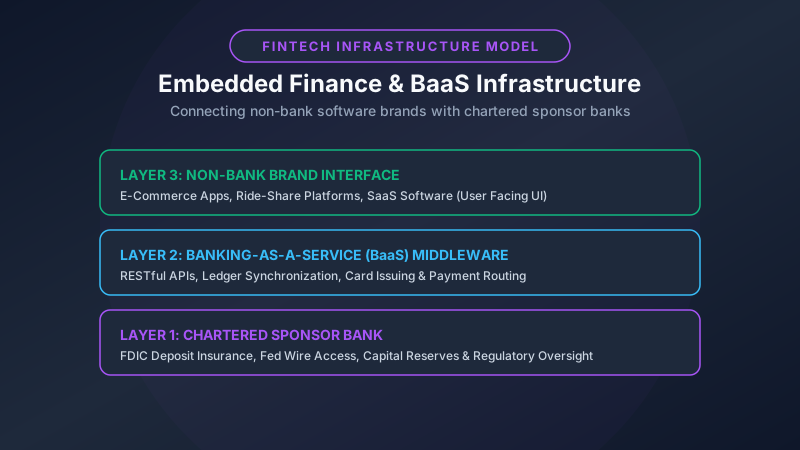
To overcome this barrier, embedded finance relies on a three-tier architecture:
-
Chartered Sponsor Bank: A regulated financial institution holding a state or national bank charter. The sponsor bank holds physical deposits, accesses Federal Reserve payment rails, and maintains primary regulatory responsibility.
-
Banking-as-a-Service (BaaS) Middleware Provider: Specialized fintech infrastructure platforms (such as Treasury Prime, Unit, Synctera, or Galileo) that connect the sponsor bank's legacy core banking systems to modern RESTful APIs.
-
Non-Bank Customer Application: The consumer-facing software brand (e.g., an e-commerce platform or gig-economy app) that embeds banking features into its mobile interface using the BaaS APIs.
3. Business Drivers: Why Non-Bank Brands Offer Financial Products
Non-financial brands adopt embedded finance for compelling commercial reasons:
-
Enhanced Customer Retention: Integrating financial accounts or payment tools increases application engagement, keeping users within the brand's software ecosystem.
-
New Monetization Streams: Non-banks capture revenue sharing from debit card interchange fees, loan origination fees, or interest spreads generated by customer deposits.
-
Data Context for Better Credit Underwriting: A software platform serving small business merchants has real-time visibility into merchant daily sales volume. By embedding lending tools directly into the software, the platform can underwrite business loans with high accuracy based on internal transaction data rather than traditional credit scores.
4. Regulatory Scrutiny and Risk Management
While embedded finance delivers substantial convenience, rapid expansion led to heightened regulatory scrutiny from U.S. banking regulators, including the FDIC, the OCC, and the Federal Reserve.
Regulatory agencies issued explicit enforcement actions targeting chartered sponsor banks that failed to maintain adequate oversight over their third-party BaaS fintech partners. Key compliance risks include:
-
Partner Bank Oversight: Regulators mandate that sponsor banks cannot delegate compliance responsibility to non-bank partners. Banks must independently audit Anti-Money Laundering (AML) controls, Know Your Customer (KYC) verifications, and Consumer Financial Protection Bureau rules across all embedded programs.
-
Ledger Reconciliation Hazards: If a BaaS middleware provider experiences insolvency or technical failures, reconciling customer balances across multiple non-bank applications can freeze consumer funds, as demonstrated during recent middleware disruptions.
-
Misleading Marketing Protections: Federal regulators strictly prohibit non-bank apps from advertising themselves as 'banks.' Non-bank interfaces must clearly disclose the legal identity of the underlying FDIC-insured partner bank holding customer funds.
Architectural Layer Breakdown
The table below details the roles across the embedded finance value chain:
| Layer | Entity Type | Primary Responsibilities |
| :--- | :--- | :--- |
| Layer 1: Charter & Compliance| Chartered Sponsor Bank | FDIC insurance, capital reserves, Fed wire access, AML/KYC oversight |
| Layer 2: API Middleware | BaaS Platform Provider | Core banking API translation, ledger tracking, card issuing software |
| Layer 3: Customer Interface| Non-Bank Brand | UI/UX design, customer acquisition, workflow integration |
Summary: Invisible Financial Infrastructure
Embedded finance represents the structural unbundling of financial services from traditional bank branches into software workflows. As regulatory standards enforce rigorous bank partner oversight and transparent ledger reconciliation, embedded finance will continue expanding, making banking tools an invisible, frictionless layer of daily digital commerce.
5. Sub-Ledger Synchronization and Technical Reconciliation
A critical technical requirement in embedded finance is maintaining precise synchronization between non-bank application ledgers and sponsor bank master accounts.
When millions of consumers execute micro-transactions inside a non-bank application—such as buying coffee with a ride-share driver debit card or receiving a micro-loan—the BaaS middleware platform maintains a real-time sub-ledger. This sub-ledger must continuously reconcile against the sponsor bank's master omnibus account.
If a technical glitch or API timeout causes a discrepancy between the sub-ledger and the bank's master ledger, accounts must be temporarily paused while audit teams reconcile database records. Regulators now require sponsor banks to maintain direct, real-time access to sub-ledger data to ensure consumer funds remain fully accounted for at all times.
6. Risk Management Frameworks for Embedded Financial Services
The expansion of embedded finance into non-bank consumer software elevates the importance of robust risk management frameworks.
Regulatory enforcement from the FDIC, OCC, and Federal Reserve requires chartered sponsor banks to maintain active oversight over all embedded fintech programs. Sponsor banks must establish continuous API audit logs, conduct periodic third-party risk assessments, and verify that non-bank partner applications comply fully with consumer protection disclosures, truth-in-lending rules, and fair lending laws.
By enforcing strict bank partner oversight and transparent ledger reconciliation, the financial industry ensures that embedded finance delivers maximum consumer convenience without compromising safety or systemic banking stability.
7. Consumer Protection Checklist for Embedded Accounts
When opening a financial account or point-of-sale loan inside a non-bank software application, consumers should verify three critical details:
-
Identify the Chartered Sponsor Bank: Confirm the exact legal name of the FDIC-insured partner bank providing deposit insurance and holding account funds.
-
Review Fee Schedules and Terms: Inspect whether third-party deposit or maintenance fees apply when performing transactions outside the core application.
-
Confirm Dispute Resolution Rights: Verify that error resolution procedures comply with Regulation E (electronic transfers) or Regulation Z (credit lending).
8. Looking Ahead: The Future of Embedded Financial Technology
As application programming interfaces and Banking-as-a-Service infrastructure continue to mature, embedded finance will further seamlessly blend into everyday consumer interactions. From automated fleet management payments to instant point-of-sale micro-insurance, embedding financial capabilities directly into software platforms eliminates administrative friction, optimizes working capital management, and expands access to modern financial services across all sectors of the digital economy.
MoneyTalkin' provides financial education, educational concepts, and general informational guides. Articles do not constitute personalized financial, investment, legal, or tax advice. Financial products, rates, terms, and regulatory rules change frequently; consult a qualified financial professional regarding your specific situation. Read our full Disclaimer Policy.
Written by MoneyTalkin'
MoneyTalkin' researches and publishes objective financial education content, money management fundamentals, and practical financial guides.