How to Budget on an Irregular Income: A Guide for Freelancers
Detailed financial analysis and educational guide on How to Budget on an Irregular Income: A Guide for Freelancers.
How to Budget on an Irregular Income: A Complete Guide for Freelancers and Gig Workers
Budgeting with a variable or unpredictable income is one of the most challenging personal finance tasks. Freelancers, independent contractors, commission-based sales professionals, seasonal workers, and gig economy drivers frequently experience "feast-or-famine" cash flow cycles—earning $7,000 one month and $2,200 the next.
Traditional budgeting advice assumes a static, bi-weekly paycheck. Applying fixed monthly expenditure rules to unpredictable earnings creates severe stress during low-earning months. This comprehensive guide outlines the Baseline Floor & Hill-and-Valley Strategy, a proven framework designed specifically to stabilize irregular earnings and build long-term financial security.
Executive Summary: Variable Income Rules
- Core Strategy: Base your lifestyle spending on your lowest monthly earning floor, buffering excess income during peak months to fund lean months.
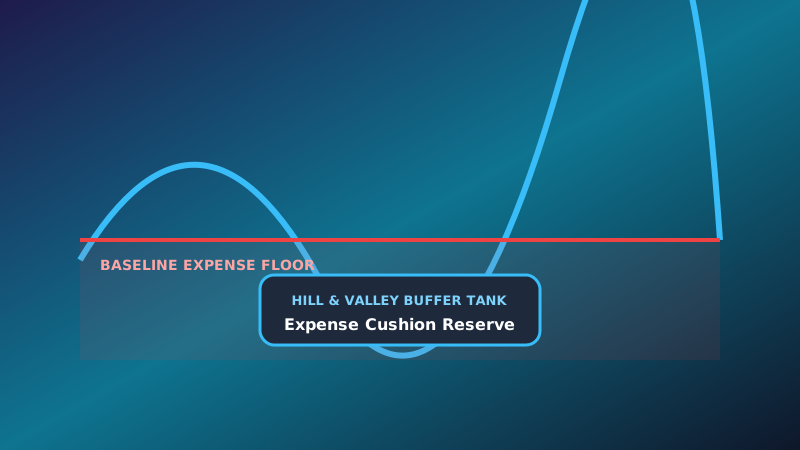
- The Hill-and-Valley Buffer Account: A dedicated holding checking account used to smooth cash flow distributions.
- Tax Withholding Rule: Immediately reserve 25%–30% of every incoming client payment into a separate tax sub-account before allocating personal funds.
- Priority Order: Essential survival needs $\rightarrow$ Baseline tax reserve $\rightarrow$ Emergency cash buffer $\rightarrow$ Discretionary goals.
Step 1: Establish Your Baseline Expenditure Floor
The first step in variable income budgeting is identifying your Minimum Essential Baseline. This represents the absolute minimum amount of cash required to pay your mandatory monthly living expenses.
Calculating Your Baseline Floor
Audit your bank and credit statements from the past 12 months to isolate non-discretionary costs:
- Rent / Mortgage & Housing Taxes: $1,500
- Essential Utilities & Internet: $220
- Basic Groceries & Household Goods: $480
- Minimum Health Insurance & Meds: $320
- Work Transportation & Car Insurance: $380
- Minimum Loan / Credit Card Payments: $200
- Minimum Monthly Baseline Floor: $3,100
Regardless of whether you earn $3,100 or $9,000 in a given month, your mandatory baseline living cost remains $3,100.
Step 2: The Hill-and-Valley Cash Buffer System
To eliminate cash flow anxiety, structure your bank accounts to create a smooth, predictable monthly income stream.
                    HILL-AND-VALLEY CASH FLOW SYSTEM
┌──────────────────────────────┐
│  Client / Business Income    │
│  (Fluctuates: $2,000-$8,000) │
└──────────────┬───────────────┘
               │
               ▼
┌──────────────────────────────┐       25%-30% Taxes
│  Hill-and-Valley Buffer Account ├────────────────────────► [ Tax Sub-Account ]
└──────────────┬───────────────┘
               │
               │ Fixed Monthly Draw ($3,100)
               ▼
┌──────────────────────────────┐
│  Personal Checking Account   │ ──► Pays Monthly Living Baseline
└──────────────────────────────┘
How the Buffer Account Functions
- Deposit All Gross Earnings: All client invoices, sales commissions, or gig payments flow into your Hill-and-Valley Buffer Account.
- Transfer Tax Withholdings: Immediately move 25%–30% of gross earnings into a dedicated Tax Reserve Account.
- Pay Yourself a Fixed Monthly Salary: On the 1st of every month, transfer your fixed baseline ($3,100) from the Buffer Account into your Personal Spending Account.
High Month vs. Low Month Mechanics
-
High-Earning Month ($7,500 Gross Earnings):
- Gross Income: $7,500
- Tax Transfer (30%): -$2,250
- Net Available: $5,250
- Monthly Salary Draw: -$3,100
- Retained in Buffer Account: +$2,150 (Stored for future lean months)
-
Low-Earning Month ($2,100 Gross Earnings):
- Gross Income: $2,100
- Tax Transfer (30%): -$630
- Net Available: $1,470
- Monthly Salary Draw: -$3,100
- Drawn from Buffer Account: -$1,630 (Covered by prior buffer accumulation)
Because you accumulated $2,150 during peak months, the $1,630 deficit during lean months is absorbed seamlessly without stress or debt.
Priority Allocation Ladder for Variable Earnings
When client payments arrive, process your cash flow using a strict priority ranking:
- Tier 1: Quarterly Tax Reserves (Non-Negotiable): Transfer tax withholdings immediately.
- Tier 2: Baseline Living Salary: Fund your current month's $3,100 baseline.
- Tier 3: 3-Month Buffer Reserve: Accumulate cash in your Hill-and-Valley Account until it contains 3 full months of baseline expenses ($9,300).
- Tier 4: Long-Term Financial Goals: Once the 3-month buffer is full, direct excess peak-month earnings toward retirement accounts (Solo 401k or SEP IRA) or extra debt principal payoffs.
Common Variable Income Pitfalls
- Lifestyle Creep During Peak Months: Spending heavily during high-earning months leaves you vulnerable during inevitable seasonal lulls.
- Neglecting Tax Obligations: Failing to set aside quarterly estimated taxes leads to underpayment penalties from tax authorities (e.g., IRS in the US or HMRC in the UK).
- Mixing Business and Personal Funds: Maintaining a single bank account for personal spending and business expenses makes cash flow auditing nearly impossible.
Practical Takeaway Checklist
- Audit last year's bank statements to determine your lowest monthly income month.
- Calculate your minimum baseline living expense floor.
- Open a separate Hill-and-Valley Buffer checking account and Tax sub-account.
- Automate a 25%–30% tax transfer on all incoming client payments.
- Pay yourself a fixed monthly salary on the 1st of every month.
Sources
- Internal Revenue Service (IRS): Self-Employed Individuals Tax Center & Estimated Taxes
https://www.irs.gov/individuals/self-employed - Consumer Financial Protection Bureau (CFPB): Managing Irregular Income
https://www.consumerfinance.gov/consumer-tools/save/
Disclaimer
This educational guide is provided for informational purposes only. Consult a certified public accountant (CPA) or tax professional for individual tax guidance.
Baseline Buffer Accounts & Variable Tax Allocations
For freelancers, commission-based sales professionals, and small business owners, managing cash flow requires two specialized holding accounts:
- The Income Baseline Buffer Account: Move all incoming client payments into a dedicated business holding account. Pay yourself a fixed monthly "salary" into your personal checking account based on your baseline budget needs. During high-income months, excess revenue accumulates in the buffer account to subsidize low-income months.
- Quarterly Estimated Tax Reserve: Set aside 25% to 30% of every gross client payment into a separate high-yield savings tax reserve account to fund quarterly estimated tax payments to the IRS and state tax authorities.
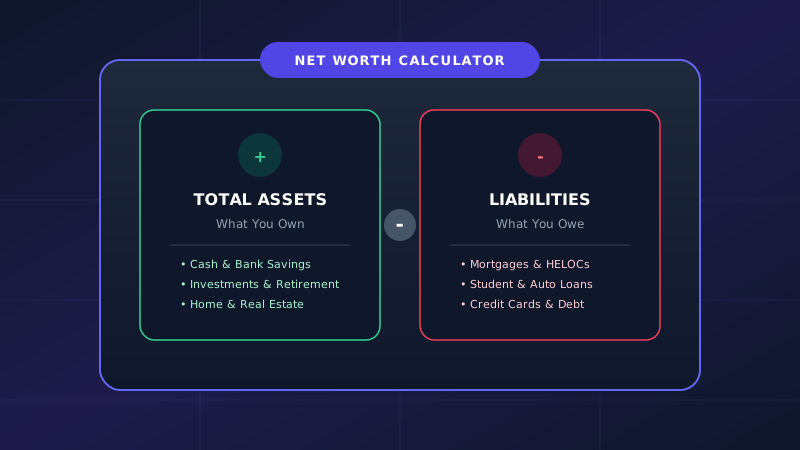
Read more cash management strategies in our guide to net worth how to calculate.
Emergency Fund Allocation for Variable Earners
Variable earners face higher income volatility risk than salaried employees:
- Maintain 6 to 12 Months Liquidity: While salaried employees often maintain 3 to 6 months of expenses, freelancers and business owners should hold 6 to 12 months of baseline living expenses in High-Yield Savings Accounts.
- Audit Baseline Expenses Quarterly: Adjust baseline salary draws seasonally based on trailing 12-month average client revenues.
Educational Summary & Key Definitions
Understanding financial fundamentals requires mastering core vocabulary and operational definitions:
- Principal: The original amount of money deposited or borrowed, excluding interest earnings or finance charges.
- Annual Percentage Yield (APY): The real rate of return earned on a deposit account, taking into account the effect of compounding interest over a 12-month period.
- Liquidity: The ease and speed with which an asset can be converted into liquid cash without incurring significant capital loss.
- Diversification: An investment risk management strategy that mixes a wide variety of investments within a portfolio to limit exposure to any single asset class.
Consulting official regulatory guidelines—such as disclosures from the CFPB, FDIC, NCUA, and Federal Reserve—ensures you make informed financial decisions backed by verified consumer protections.
MoneyTalkin' provides financial education, educational concepts, and general informational guides. Articles do not constitute personalized financial, investment, legal, or tax advice. Financial products, rates, terms, and regulatory rules change frequently; consult a qualified financial professional regarding your specific situation. Read our full Disclaimer Policy.
Written by MoneyTalkin'
MoneyTalkin' researches and publishes objective financial education content, money management fundamentals, and practical financial guides.
Related Technical Articles
Explore related topics in this cluster to deepen your understanding.